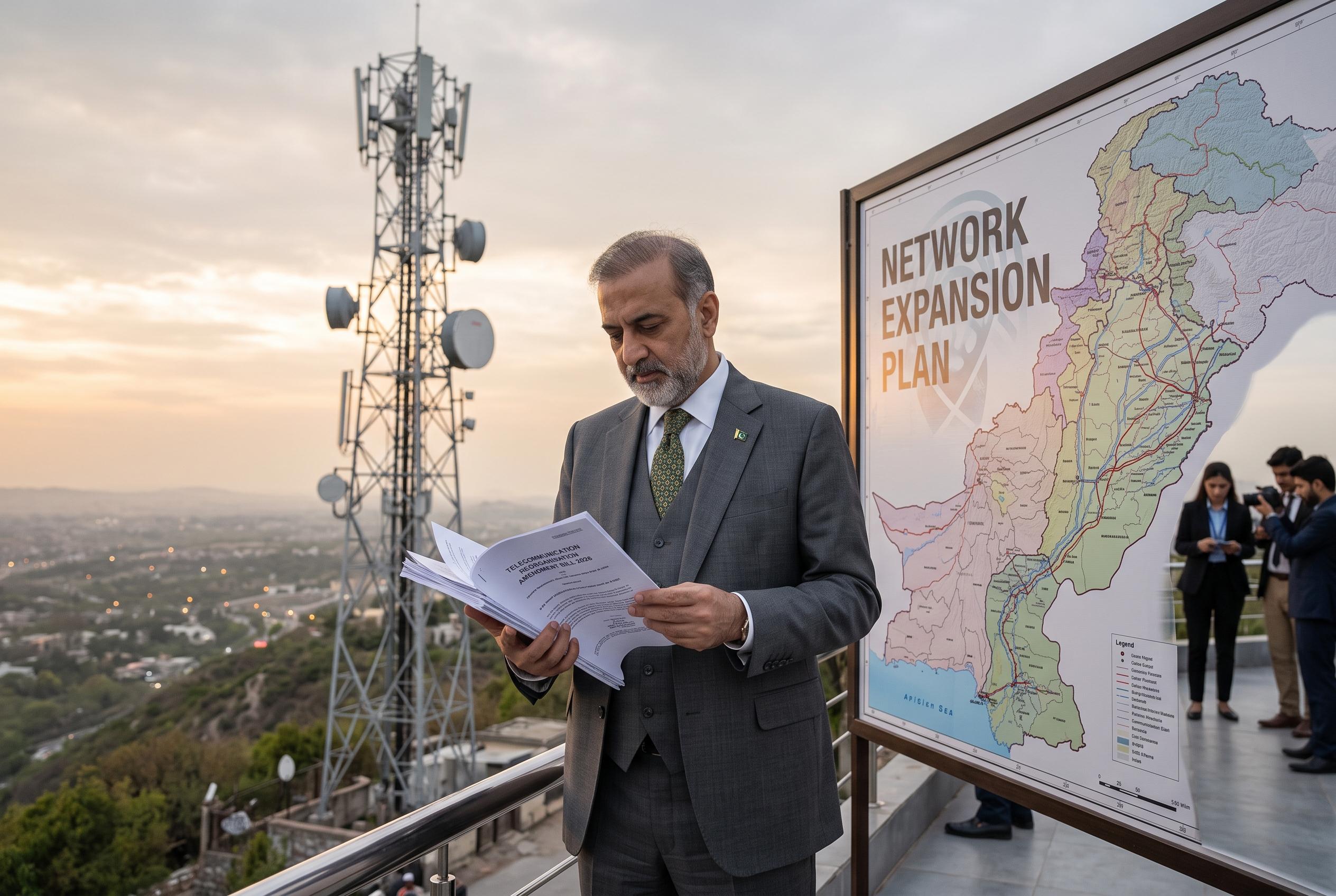

Pakistan’s government is revising the Telecommunication Reorganisation Amendment Bill 2026 to clarify land access rules for telecom companies, balancing network growth with property protections amid political and legal deliberations.
Pakistan is moving to settle long-running uncertainty over telecom companies’ access to right of way as ministers review changes to the Pakistan Telecommunication Reorganisation Amendment Bill 2026. Law Minister Senator Azam Nazeer Tarar has told the Ministry of Information Technology and Telecommunication to resolve the legal and practical problems in the draft before it is sent back for further scrutiny.
A committee chaired by Tarar examined the proposed amendments alongside the existing rules on installing telecom infrastructure and using public access routes. Federal IT Minister Shaza Fatima and senior officials from both ministries attended the meeting, which also looked at the division of powers between federal, provincial and local authorities over public, common development and private property.
The review has centred on one of the most contentious points in the bill: whether telecom operators can place equipment on private land and, if so, under what conditions. According to Pakistan Today, the revised draft already requires property owners’ consent before any installation on private land, reflecting pressure from opposition parties and coalition allies. The Ministry of Information Technology has said the right of way provisions are meant to speed up network expansion while protecting property rights and do not allow operators to enter private land without permission or due process.
The government is also trying to clarify who is responsible for compensation, maintenance and restoration once infrastructure has been installed. According to the Ministry of Law and Justice, the committee formed by Prime Minister Shehbaz Sharif submitted an interim report saying the bill’s main aim is to improve digital connectivity while safeguarding citizens’ rights, but several clauses still need tighter drafting to remove ambiguity. The committee also recommended reviewing the penalty under Section 27B(1) so that it better matches the bill’s purpose.
Tarar said the state must support wider digital connectivity without weakening private property protections. He directed the IT ministry to finalise the draft after addressing the outstanding issues and return it to the committee for another round of consideration.
Disclaimer: This content is intended for informational purposes only. Readers are advised to exercise their own judgement, conduct due diligence, or consult a qualified expert before acting on any information provided.