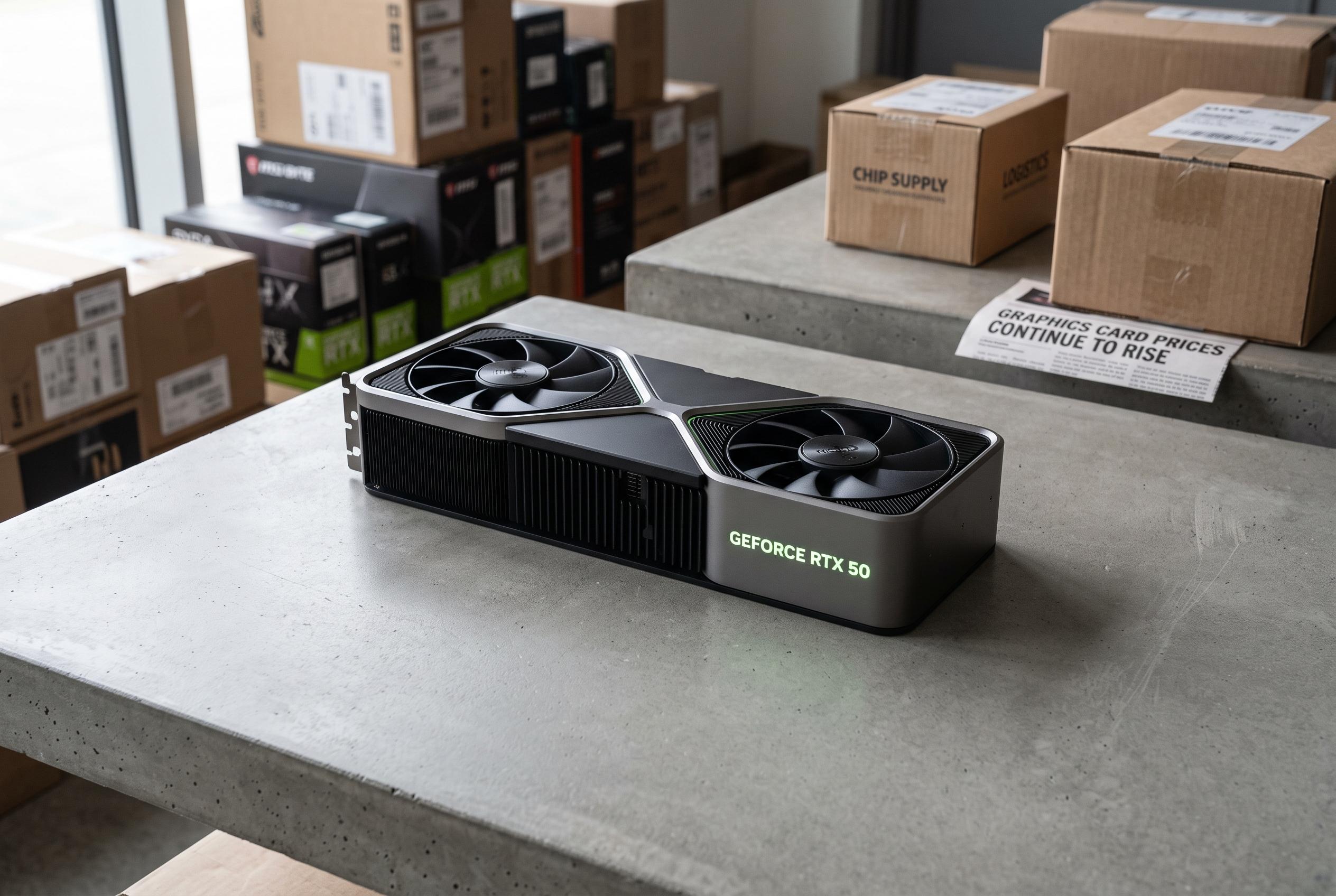

Retail prices for Nvidia’s GeForce RTX 50 series have surged by up to 39% in two months, driven by component shortages and rising manufacturing costs, with consumers facing higher prices despite stable official recommendations.
Prices across Nvidia’s GeForce RTX 50 graphics-card range are climbing sharply, with recent retail tracking showing rises of as much as 39% in just two months. Tom’s Hardware, citing median prices at Newegg, found that the steepest increases in June to August 2026 hit the mid-range cards hardest, adding fresh evidence that shortages and component inflation are still reshaping the consumer GPU market.
The RTX 5060 Ti with 16GB of memory recorded the biggest jump, moving from about €524.39 ($569.99) to €740.59 ($804.99), a rise of 39%. The RTX 5070 was close behind, up 36% to €827.99 ($899.99). Even Nvidia’s entry-level Blackwell card, the RTX 5060, has become harder to justify for buyers: its median price has climbed to €432.39 ($469.99), well above its original suggested price of €275.99 ($299.99).
At the higher end of the range, the RTX 5080 now sits about 50% above its launch level, with a recent 3% increase taking it to €1,379.99 ($1,499.99). The flagship RTX 5090 has also risen 9% and is now listed at about €4,323.99 ($4,699.99). The only notable exception is the RTX 5070 Ti, which has held steady at €1,011.99 ($1,099.99), though it remains far above the launch price Nvidia announced.
Tom’s Hardware reported that the price pressure reflects higher costs for key inputs such as GDDR7 memory and silicon wafers, which are feeding through the supply chain. Nvidia has not formally changed its recommended prices, but the retail market is clearly moving anyway. The same publication reported that, at QuakeCon 2026, Nvidia was still able to sell some RTX 50-series cards at their original launch prices, a reminder that official pricing and real-world availability have diverged sharply.
There are signs the problem is broader than one market. Tom’s Hardware said RTX 50 prices have also jumped by up to 30% in South Korea, where wafer increases from TSMC and higher GDDR7 costs are being passed on by board partners and distributors. The site also reported that Nvidia’s planned RTX 50 Super refresh is being delayed because 3GB GDDR7 modules are proving too expensive, while separate reporting said Nvidia has raised some of its own product prices as manufacturing costs, tariffs and memory shortages continue to tighten margins. For European buyers, that combination suggests further increases may still be ahead.
Disclaimer: This content is intended for informational purposes only. Readers are advised to exercise their own judgement, conduct due diligence, or consult a qualified expert before acting on any information provided.