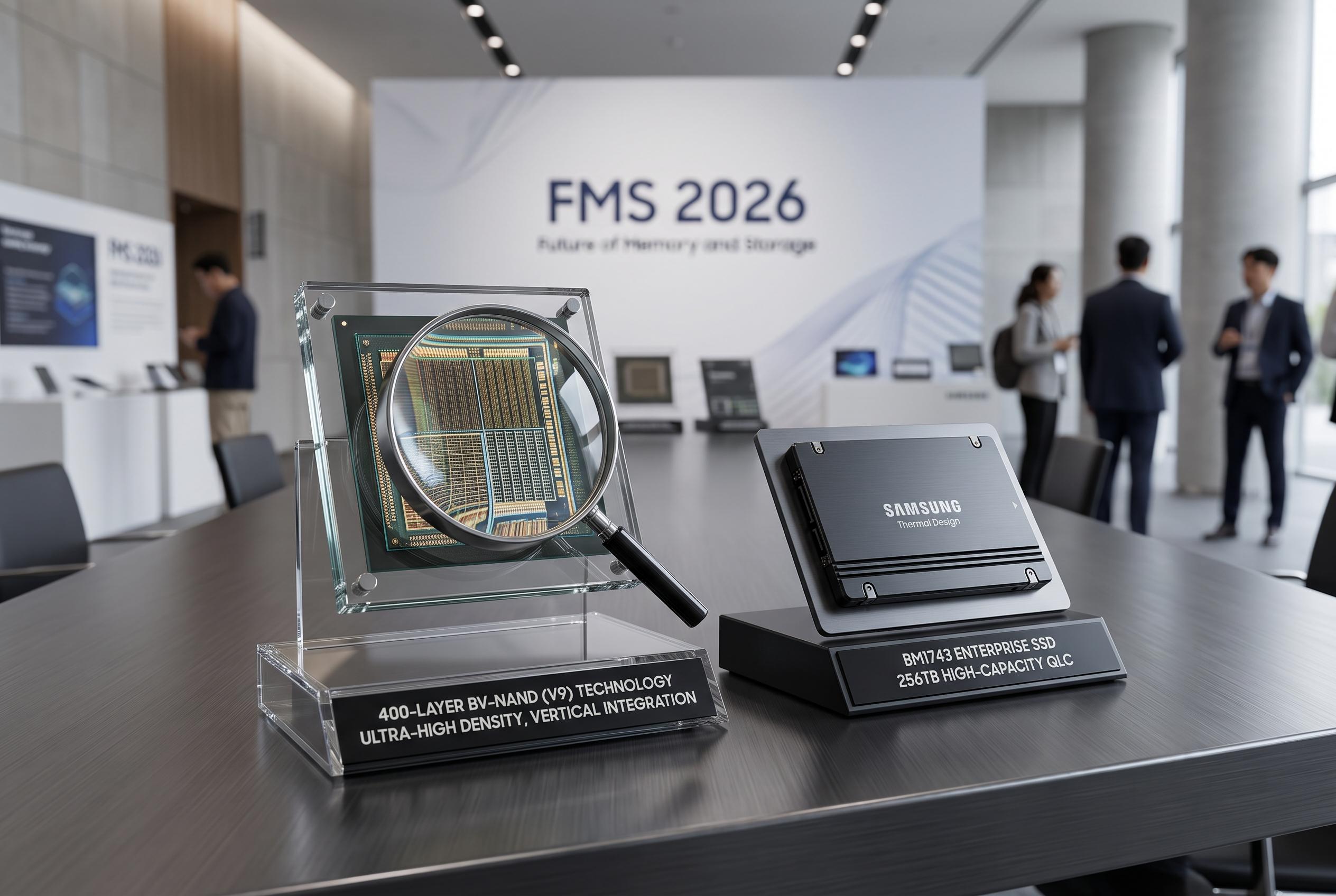

At the 2026 Future of Memory and Storage conference, Samsung unveils groundbreaking memory products, including the first 400-layer BV-NAND, targeting data centres and edge AI devices amid fierce industry competition.
Samsung used the Future of Memory and Storage conference in 2026 to showcase a wave of memory and storage technologies aimed at both data centres and edge AI devices, underscoring how fiercely chipmakers are competing to supply the infrastructure behind artificial intelligence. According to Ferra, the company’s presentation centred on a new generation of flash and high-bandwidth memory products designed to raise capacity, cut latency and improve energy efficiency.
The headline announcement was BV-NAND V10, which Samsung described as the first flash memory with more than 400 layers of cells arranged using a specialised process. Ferra said the new design lifts storage density by 58% from the previous version, while Tom’s Hardware reported that Samsung’s next-generation V-NAND uses a cell-on-peripheral architecture with hybrid bonding, a 5.6 GT/s interface and 1 Tb per die, all intended to support denser, faster solid-state drives.
Samsung also highlighted zHBM, a memory system for AI that sits directly on top of AI accelerators to shorten the path data must travel. Ferra reported that the design is meant to deliver eight times the speed and 10 times the density of standard HBM5 while using one-third less power. The company also introduced LPDDR5X-PIM, a form of memory that can process some data internally rather than relying entirely on the processor, along with zNAND-O for edge AI devices such as smartphones and smart cameras.
The broader backdrop is an industry race to push NAND flash to ever greater densities. Tom’s Hardware reported that Kioxia and Sandisk also used the same conference to unveil a 332-layer 3D QLC NAND device, highlighting how storage makers are competing on capacity, bandwidth and power use at once. Samsung’s latest lineup suggests the company is positioning itself not just for conventional storage, but for the growing market for AI systems that need memory placed closer to the compute engine.
Disclaimer: This content is intended for informational purposes only. Readers are advised to exercise their own judgement, conduct due diligence, or consult a qualified expert before acting on any information provided.