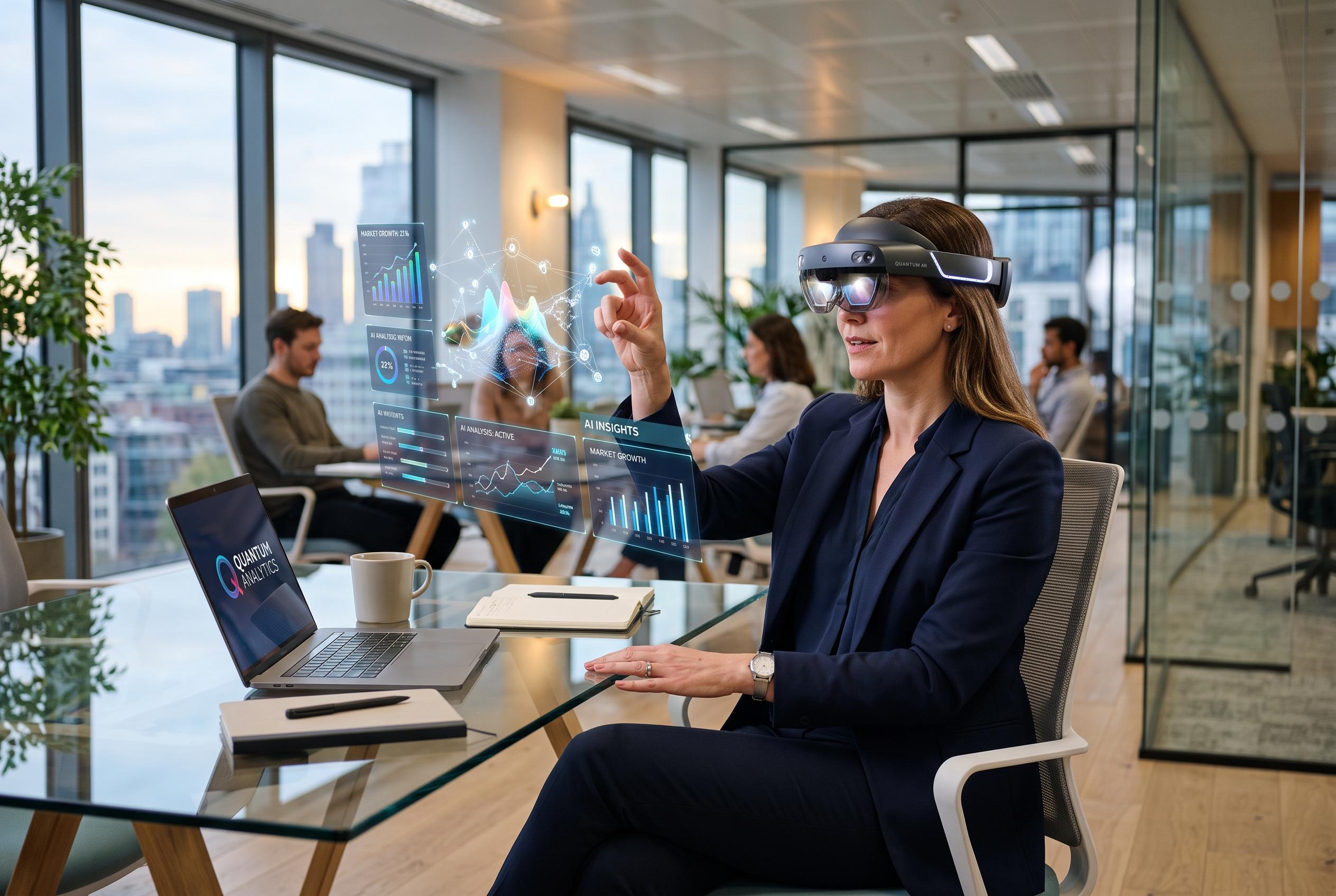

The evolution of virtual and augmented reality beyond gaming pushes tech giants like Google, Samsung, Apple, and Meta into a competitive race to redefine human-computer interaction through integrated AI and immersive digital environments.
Virtual reality is no longer confined to games. It is increasingly being folded into mixed reality, augmented reality and artificial intelligence, creating what some industry watchers describe as a new layer of human-computer interaction. In that model, users do not simply tap a screen. They work, learn and create through voice, gesture and visual input inside three-dimensional digital spaces.
The broader shift reflects a familiar pattern in computing. Personal computers made keyboards and mice central to everyday work in the 1980s. The iPhone then redefined mobile use by putting touch at the centre of the experience. Today, the next contest is over spatial computing, where software is designed to respond to the physical world as well as to the user. According to commentary from the technology press, that direction is already visible in products such as Apple’s Vision Pro and in platform bets from Google and Samsung.
The promise of VR now extends far beyond entertainment. Headsets can simulate large screens, create multi-display workstations and support training in medicine, engineering, architecture, education and military environments. The addition of AI makes those devices more useful still. Smart glasses and headsets can identify objects, provide live information, translate speech and assist with analysis, turning them from displays into tools that act as personal aides.
Google and Samsung are trying to build that future around Android XR, a platform designed to unify VR, AR and mixed reality with Gemini AI at its core, according to Android Central and Tom’s Guide. The first commercial device in that ecosystem, Samsung’s Galaxy XR, arrived in 2025 with support for Google services and common development standards such as OpenXR. At the same time, Google’s approach has drawn criticism from developers, with reports that it has not done enough to court smaller studios, raising questions about whether the platform can attract the broad software base needed for long-term success.
Meta is taking a different route, but with a similar ambition. Android Central reported that the company has reorganised its immersive-tech operations, giving Horizon OS greater strategic weight while also sharpening its focus on AI. The broader market has become more crowded, with Apple, Google, Samsung and Meta all pushing different versions of the same idea: a computing platform that combines the digital and physical worlds.
For Taiwan, the shift could be particularly important. The island already has major strengths in semiconductors, chip design, advanced manufacturing, optics and precision engineering. As spatial computing matures, demand is likely to rise for high-performance chips, sensors, micro OLED panels, lenses and advanced packaging. The challenge will be to pair that hardware advantage with stronger software, ecosystems and talent development.
There are still obstacles. Headsets remain expensive, heavy and limited by battery life, while some users still experience discomfort or motion sickness. But those problems have eased before in computing, and the article’s central argument is that they will probably improve again as the technology matures. The larger point is that the next platform shift may not be driven by AI alone, but by the way AI is delivered through new interfaces that change how people communicate, learn and build.
Disclaimer: This content is intended for informational purposes only. Readers are advised to exercise their own judgement, conduct due diligence, or consult a qualified expert before acting on any information provided.