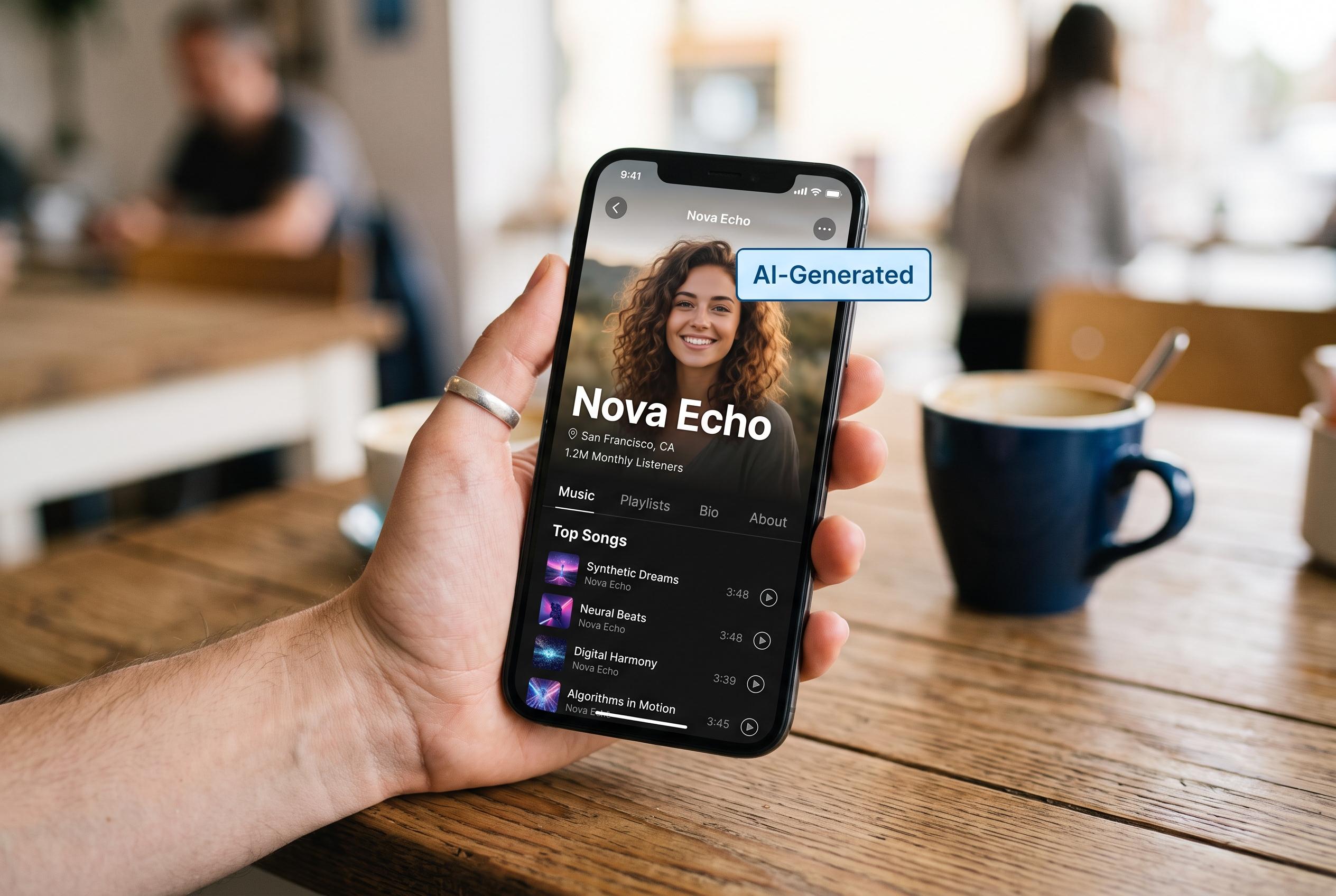

Spotify will now label artist profiles believed to be AI-generated with a new badge, aiming to improve transparency amid evolving global regulations around synthetic content, especially as India enforces stricter disclosure rules for AI-created media.
Spotify is preparing to label artist profiles that do not belong to real people with an “AI Persona” badge, in a move aimed at making synthetic acts easier to spot across the service. The label will appear on profile banners, in About sections, in search results and on track rows inside playlists, while accounts flagged by Spotify’s review team as photorealistic AI identities will instead receive a “Likely AI Persona” marker. The rollout is due to begin on mobile in mid-September 2026, according to reporting from TechRadar and MusicRadar.
The change addresses the artist identity layer rather than the recordings themselves. That distinction matters because Spotify’s badge will warn listeners about the act, but it will not directly label the music file in the way some rivals already do. TechRadar said the company is relying partly on self-disclosure and partly on its own review process, with affected artists able to appeal or correct their status. What remains unchanged is that Spotify’s system is built around transparency, not removal.
That approach sits awkwardly beside India’s synthetic-content rules, which already require a more specific form of disclosure. MediaNama reported that Rule 3(3) of the Information Technology (Intermediary Guidelines and Digital Media Ethics Code) Rules, 2021, as amended by G.S.R. 120(E) on February 10, 2026, requires intermediaries that can generate or alter synthetic content to label the content itself, not merely the account behind it. For audio, the rule calls for a prominently prefixed disclosure and, where technically feasible, embedded metadata or other provenance mechanisms, including a unique identifier. The amendments also bar intermediaries from allowing the label or identifier to be removed.
That means a profile badge is not the same as a track-level disclosure. A listener who opens a shared link, plays a song in an embedded player, or encounters it inside a third-party playlist may never see the artist page at all. In India, the legal obligation is therefore broader and closer to the recording itself. The consequence is also different: Spotify’s badge is a product policy, while India’s requirement is a legal duty linked to the safe-harbour protections in Section 79 of the Information Technology Act, 2000.
The timing is notable because Spotify is also building generative tools that would let listeners create covers and remixes within its own environment, using catalogues from rights holders that opt in. Universal Music Group has described that framework as an “industry-first”, while Spotify signed a separate licensing deal with Kobalt on August 13, 2026, according to Digital Music News. Charlie Hellman, Spotify’s Global Head of Music, said: “This agreement with Kobalt is grounded in consent, credit, and compensation for the songwriters who take part,”. If those tools reach India, the country’s labelling rules would apply directly. YouTube already operates a closer analogue in the market, requiring disclosures for AI-altered or AI-generated photorealistic content and applying penalties when creators fail to comply.
Disclaimer: This content is intended for informational purposes only. Readers are advised to exercise their own judgement, conduct due diligence, or consult a qualified expert before acting on any information provided.