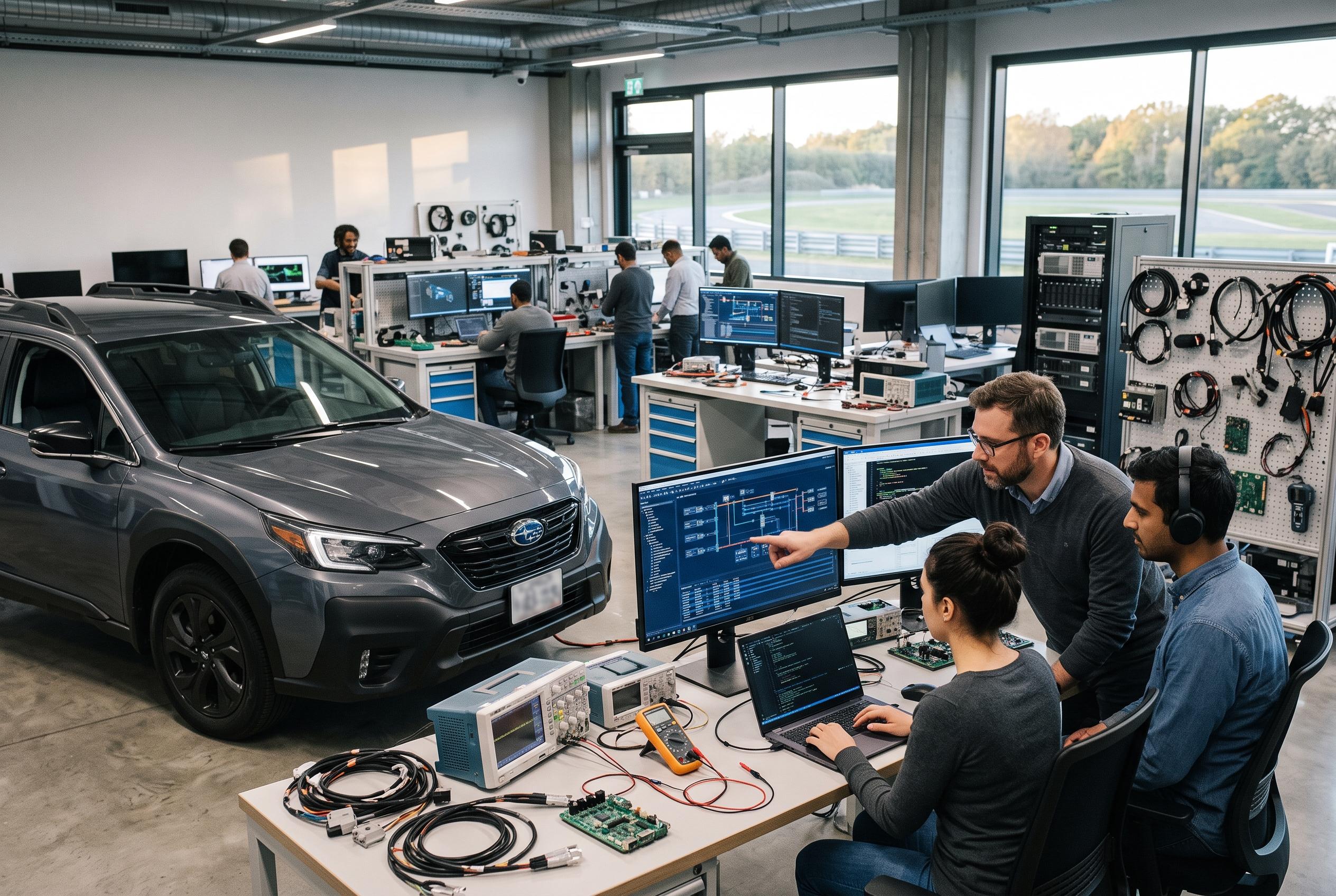

The Japanese carmaker plans in-house vehicle electronics, over-the-air updates and digital testing as it prepares a new generation of cars later this decade.
Subaru is preparing a wider shift towards software-defined vehicles later this decade, with over-the-air updates, more in-house electronics and a faster development cycle at the centre of its next-generation plan. The Japanese carmaker said on Sunday that it intends to cut the time needed to bring new models to market by 40% by using more digital design and simulation before physical prototypes are built.
The company said its future SDVs will rely on electronic control units developed internally, with its EyeSight driver-assistance system integrated into the ECU that governs vehicle movement. Subaru also plans to develop control semiconductors with Advanced Micro Devices in the United States, while building in support for wireless software updates so vehicles can be improved after delivery. Executive officer Takatomo Watamori said the aim is to keep cars affordable while still updating them over time.
This push is part of a broader overhaul of Subaru’s engineering process. Instead of moving through design, testing, prototyping and production in sequence, the company wants to run several stages at once, allowing problems to be identified earlier and fixes to be made without waiting for the next hand-off between departments. Subaru says the time saved will be redirected towards real-world refinement of performance and quality.
The change is not starting from zero. National Instruments said in 2018 that Subaru was already using hardware-in-the-loop testing to reproduce road conditions in a controlled environment, cutting dependence on weather and surface conditions and reducing test time. More recently, Stratasys said in January 2026 that Subaru of America had more than halved tooling development time using high-speed 3D printing, while also reducing prototyping and tooling costs. ETAS said in 2025 that Subaru had adopted automation software to reduce steady-state vehicle testing time by 49%.
Subaru has also been building a software base in its current models for several years. The company announced Automotive Grade Linux for the infotainment systems in the 2020 Outback and Legacy, and those vehicles also featured a larger tablet-style display and a more integrated digital cockpit. That earlier work now looks like part of a longer transition towards cars whose electronics, user interfaces and update pathways are managed more like software platforms than fixed hardware packages.
Beyond software, Subaru is also reshaping its hardware strategy. It plans to raise parts commonality across models to 50%, reduce the number of supply-chain processes by half and cut around 100kg from future versions of its Subaru Global Platform for petrol and hybrid vehicles. The company also wants to halve the number of engine variants, while using its boxer-engine combustion know-how to improve thermal efficiency by 50%. Subaru has already said it will launch four electric models developed with Toyota, but it now expects to unveil an independently developed EV in 2028 or later.
Disclaimer: This content is intended for informational purposes only. Readers are advised to exercise their own judgement, conduct due diligence, or consult a qualified expert before acting on any information provided.