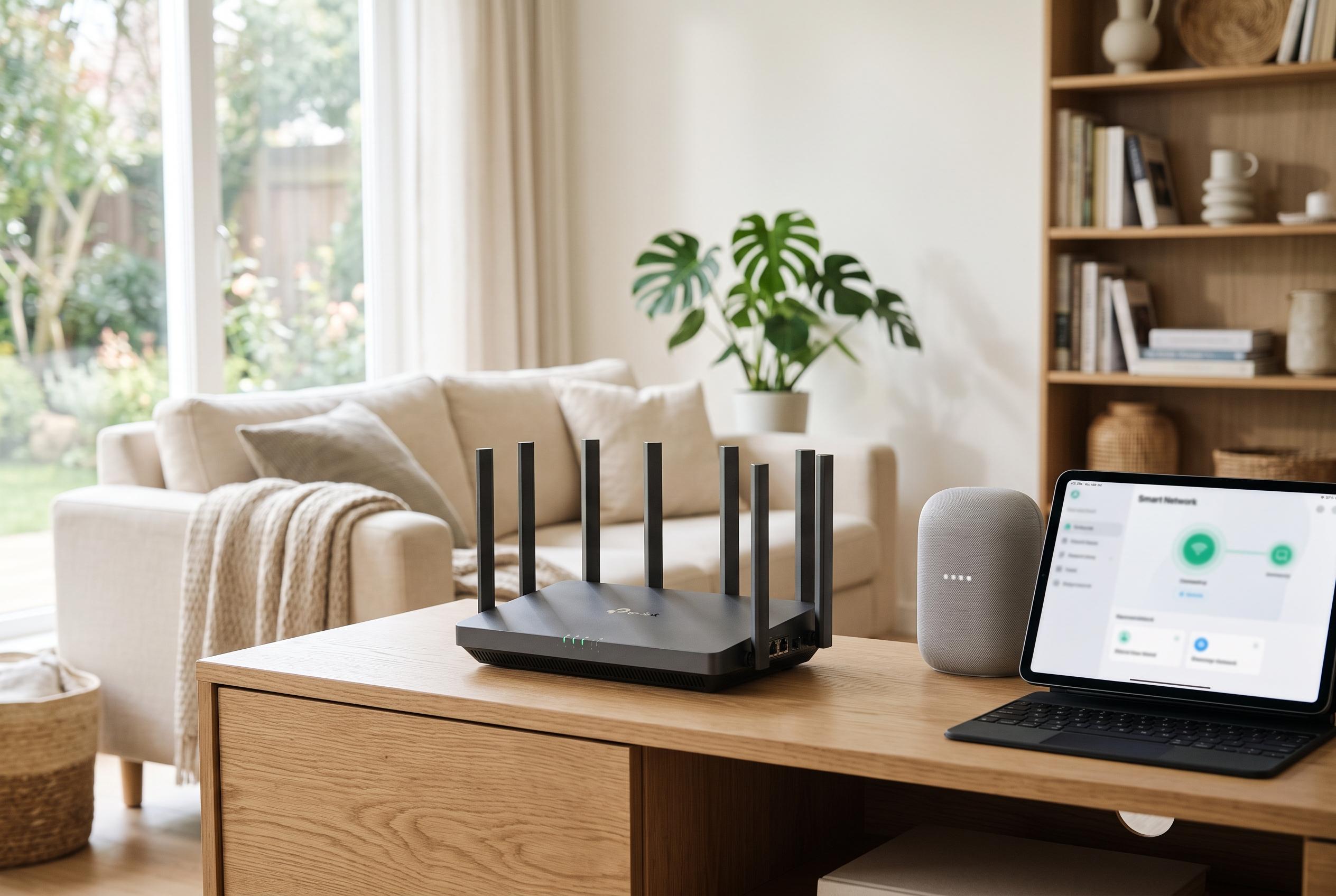

TP-Link unveils its first consumer Wi-Fi 8 products at IFA Berlin, emphasising ultra high reliability over raw bandwidth with new designs and advanced software features aimed at stabilising connections across smart homes.
TP-Link has used IFA Berlin to argue that the next round of home networking will be sold on reliability rather than raw speed, unveiling the Archer 8 Ultra router and Deco 8 Ultra mesh system as its first consumer products built around Wi-Fi 8. The company says regional pre-orders for the Archer 8 Ultra will begin on 30 September 2026, while the mesh product is due later, in the first quarter of 2027.
That matters because Wi-Fi 8, the consumer name for the draft IEEE 802.11bn standard, is being positioned less as a bandwidth jump than as an “Ultra High Reliability” upgrade. PCWorld said the standard is intended to deliver steadier connections under everyday conditions, especially when many devices are fighting for airtime or when a laptop, camera or smart speaker sits at the far edge of coverage. TechRadar also noted that backward compatibility remains in place, so existing Wi-Fi 7 and older devices should still connect, even if they cannot use every new feature.
On the hardware itself, TP-Link is starting at the premium end. The Archer 8 Ultra BN19000, also identified in some materials as the Archer BN800, is a tri-band router rated at up to 19Gbps with 10Gbps wired networking and 18 internal antennas. The Deco 8 Ultra BN22000, or Deco BN85 in some markets, is a tri-band mesh system rated at up to 22Gbps globally, although TechRadar reported a 19Gbps European version for regulatory reasons. A three-pack is claimed to cover as much as 9,800 square feet, or about 910 square metres, and to handle more than 200 connected devices. Tom’s Guide added that the devices it saw were configured with two 10Gbps inputs and USB ports for network storage.
TP-Link’s main pitch is a software and radio package it calls StabilityEngine. According to the company and the supporting coverage, that bundle combines Enhanced Long Range and Distributed Resource Units to help devices keep talking when they are distant from the router or working with limited transmit power, a common problem for battery-powered smart home kit. Non-Primary Channel Access is meant to keep the network responsive when the preferred channel is busy, while Unequal Modulation and revised modulation and coding schemes are intended to preserve throughput when neighbouring networks or household electronics add interference. TechRadar said TP-Link is also highlighting Dynamic Sub-band Operation, which allocates only the bandwidth each device needs rather than tying up wider channels unnecessarily.
The industrial design is almost as central to the launch as the radio technology. TP-Link’s argument is that home routers often perform badly because owners hide them behind furniture or in cupboards. Gary Chang, the company’s industrial design lead in Irvine, told several publications: “We stopped building a piece of networking equipment and started designing for the home.” He added: “When a router’s design becomes something people want to display, it ends up exactly where it performs best.” The Archer 8 Ultra replaces a row of conventional status lights with a softer glow and a dual-tone front grille, while the Deco 8 Ultra keeps the rounded Deco form but uses a matte body with a glossy top.
There are still important uncertainties around where these products will be sold first. TP-Link’s own statements refer only to “regional” or “select region” pre-orders from 30 September, with fuller specifications and local availability to be discussed during a global online event the same day. Tom’s Guide reported that the Archer 8 Ultra is expected to go on sale in Germany and the UK in October, with US sales following in early 2027. Tom’s Hardware, however, said US timing remained unclear and linked that uncertainty to TP-Link’s lack of approval to release all-new products in the American market, contrasting the situation with conditional FCC clearance previously granted to Amazon’s Eero and Netgear.
The timing also underlines how early this market still is. Tom’s Guide said the underlying 802.11bn specification is not expected to be finalised until 2028, which means first-generation devices may rely on firmware updates as the standard evolves. The same report said buyers should not expect a quick wave of compatible phones, PCs and tablets: those are more likely to arrive in early to mid-2027. It also warned that existing Wi-Fi 7 routers cannot be upgraded into Wi-Fi 8 hardware, making these launches more of a future-proofing purchase than an immediately transformative one for most households.
TP-Link is nevertheless signalling that this is a platform strategy, not a one-off flagship release. Tom’s Hardware and The Electronics Data both said the company plans to broaden the range with a standard Deco 8 mesh system in the first quarter of 2027, followed in the second quarter by a Roam 8 travel router, range extenders and client adapters in PCIe and USB formats. The company says the whole line draws on chipsets from Broadcom, Qualcomm and MediaTek, combined with TP-Link’s own engineering. Pricing had still not been announced by 8 September 2026, but the message from Berlin is already clear: after years of selling ever higher theoretical speeds, router makers now think fewer dropouts and more predictable coverage may be the easier upgrade to market.
Disclaimer: This content is intended for informational purposes only. Readers are advised to exercise their own judgement, conduct due diligence, or consult a qualified expert before acting on any information provided.