
Waymo has revealed its latest hardware architecture, centred around a custom 5 nm chip designed to process sensor data in real time for fully autonomous driving, signalling a significant step forward in robotaxi technology.
Waymo has laid out more of the hardware stack behind its robotaxis, describing a compute system built around a custom 5 nm application-specific integrated circuit and supported by Nvidia, AMD and other suppliers. According to the company, the design is intended to turn sensor data into driving decisions in milliseconds, with the overall architecture tuned for the demands of fully driverless operation.
The disclosure comes as Waymo expands commercial robotaxi services and seeks to explain how its vehicles handle the full driving task without a human fallback. In a jointly written post on the company’s website, engineering vice-president Satish Jeyachandran and compute lead Daniel Rosenband said: “Compute is the brain of the Waymo Driver, translating raw sensor data into real-time driving commands.” Waymo says the system has been developed from experience gained over more than 200 million miles of autonomous driving.
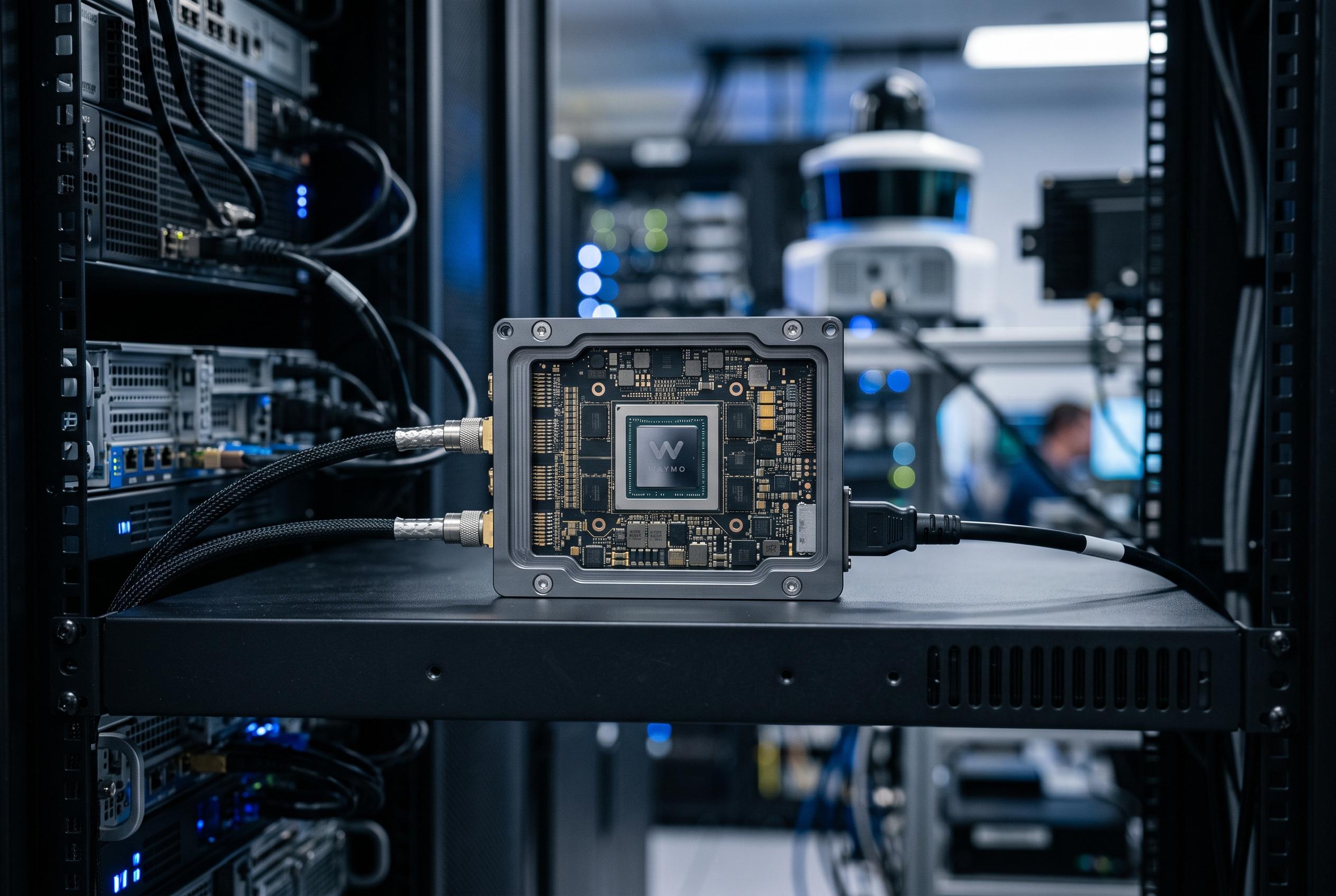
At the centre of the platform is the custom chip, which Waymo says delivers more than 1,000 TOPS of machine learning performance and is used to process information from cameras, lidar and radar before it reaches the main machine learning architecture. The company says the silicon is co-designed with its sensors and software to improve fidelity, bandwidth efficiency and model performance, and that the latest setup can process data from 13 high-resolution cameras in real time, including inputs used to improve low-light perception.
Waymo also says the platform uses a heterogeneous mix of processors and accelerators from partners including Nvidia, AMD, Micron, Samsung, Sandisk, Socionext and TSMC. It has built in redundancy through two independent compute paths that can take over from one another if a fault occurs, and has ruggedised the hardware for vibration, shock and extreme temperatures. The system is integrated with liquid cooling and is designed to preserve cargo space, stay quiet and limit battery load as the company prepares for broader deployment and further AI-driven applications.
Disclaimer: This content is intended for informational purposes only. Readers are advised to exercise their own judgement, conduct due diligence, or consult a qualified expert before acting on any information provided.