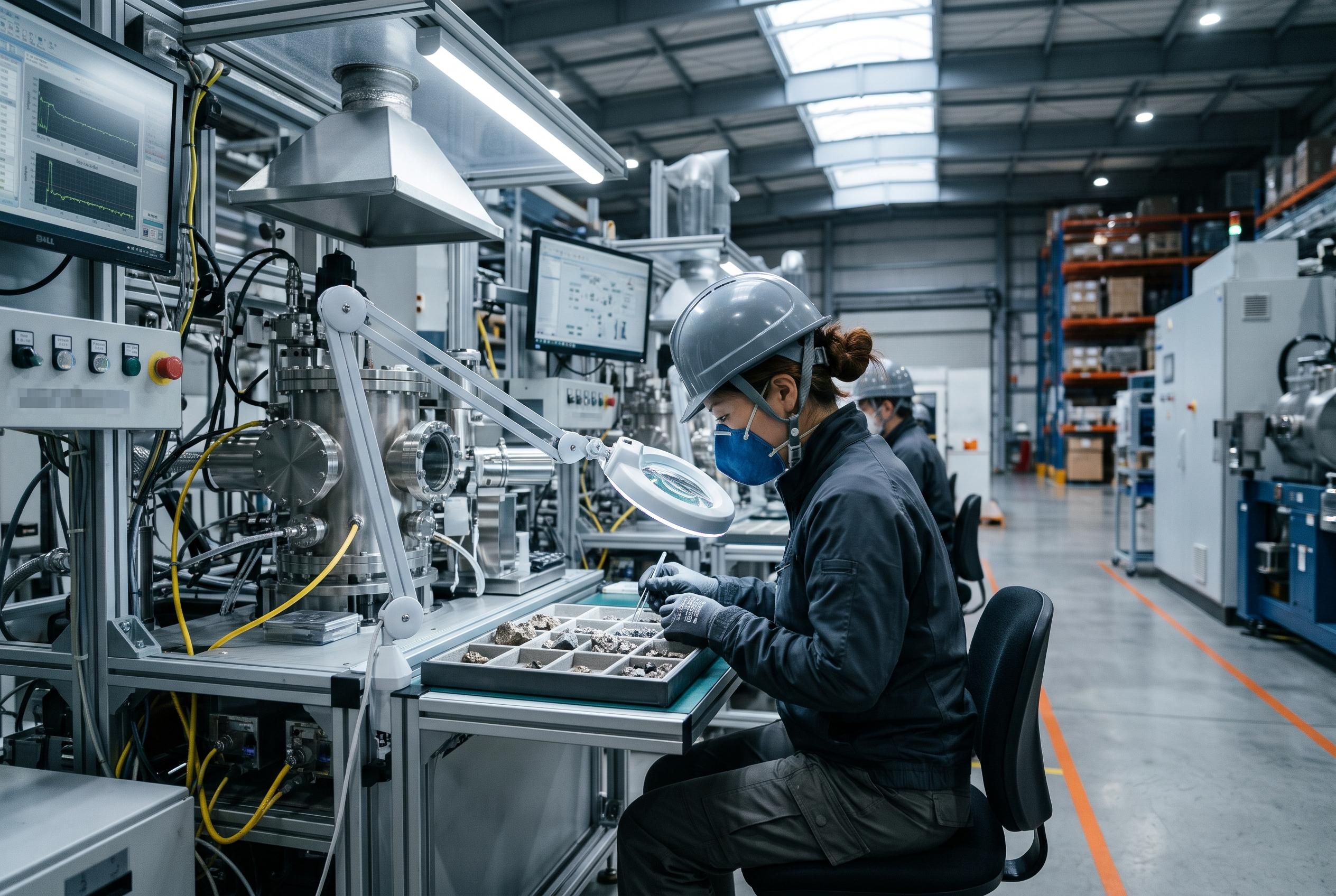

Japan warns that stocks of the critical rare earth could run out within months, threatening semiconductor, aerospace and defence manufacturing worldwide.
Japan’s industrial supply chains, long regarded as among the most advanced in the world, are now being tested by a shortage of yttrium, a little-known rare earth with outsized importance in high-end manufacturing. According to The Japan Times, officials in Tokyo say global exports have stalled, creating a supply-demand squeeze and sharp price increases that could leave Japanese users short of material within months. The metal is used in semiconductor equipment, aviation engines, LEDs and specialist industrial products, making the disruption far wider than its low profile might suggest.
The immediate concern is not the size of the market but the difficulty of replacing the material in tightly controlled production processes. Yttrium is used in coatings and ceramics that must withstand extreme heat, corrosive environments and contamination-sensitive conditions. In aerospace, it helps stabilise thermal barrier coatings on turbine parts; in semiconductor manufacturing, it is used in equipment exposed to aggressive chemicals and high temperatures. These are not materials that can be swapped out quickly, and any substitute normally requires fresh engineering work, testing and certification.
The squeeze reflects China’s tightening grip on the supply chain. The Japan Times reported that Japan received about 4,000 kilograms of yttrium oxide in September, down from 51,000 kilograms in the same month a year earlier. The paper also said China now accounts for about 92% of refined yttrium output, underscoring the scale of Tokyo’s dependence. China introduced export controls on yttrium and other rare earths in April 2025, and Japan has since faced a broader reduction in shipments amid worsening political tensions with Beijing.
That political backdrop matters because the shortage is already affecting manufacturers beyond Japan’s borders. The Financial Times reported this week that Japanese officials believe available stocks could be exhausted before the end of the year if flows do not recover. It also said American defence supply chains depend on Japanese components containing yttrium, which means the problem can move through several tiers of production before it appears in a final product. A chipmaker in Taiwan or an aerospace contractor in the United States may have no direct relationship with Chinese suppliers, yet still be exposed to the same constraint through Japanese equipment or materials.
Japan has spent years trying to reduce its exposure to Chinese rare earths by investing in overseas mining, processing and recycling, but alternatives for yttrium cannot be assembled quickly. The International Energy Agency has identified yttrium as one of the strategic minerals facing especially high supply-security risks, largely because production is concentrated and substitution is limited. Reuters has previously reported that Tokyo is working with Washington and European partners to secure more stable access to rare earths, while urging the US to press China to ease restrictions. For manufacturers, the episode is a reminder that resilience depends not only on where a supplier is based, but also on the hidden materials embedded in its own production line.
Disclaimer: This content is intended for informational purposes only. Readers are advised to exercise their own judgement, conduct due diligence, or consult a qualified expert before acting on any information provided.