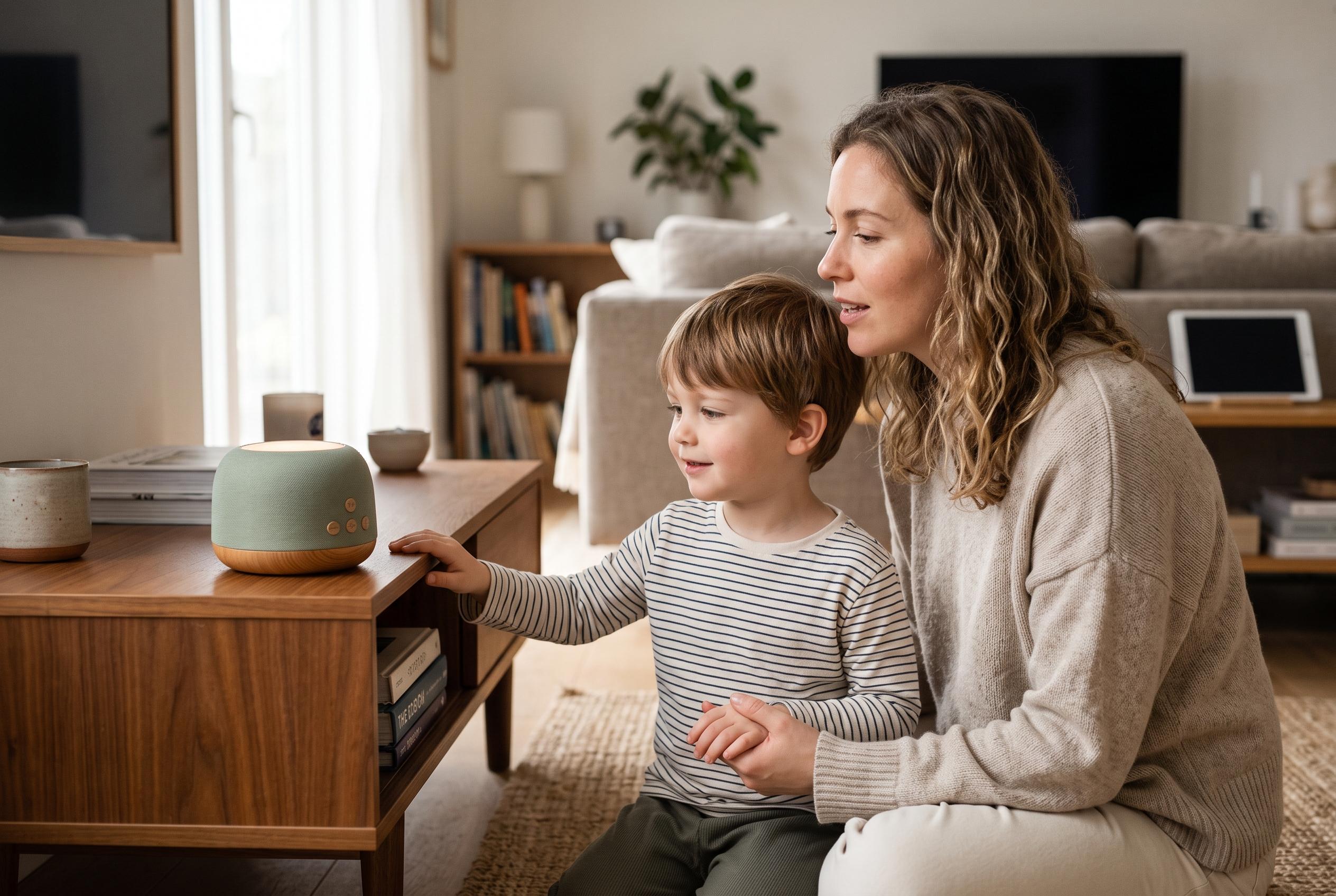

French start-up Mallow launches an innovative screen-free children’s device using generative AI to create interactive, customisable stories, emphasising developmental safety and privacy with carefully authored content and safeguards.
Mallow is the latest entry in a fast-growing class of screen-free children’s devices that use generative AI to make stories feel interactive rather than linear. The French start-up has built an audio speaker for children aged four to ten that aims to move beyond the familiar model of fixed story boxes, such as Toniebox or Lunii, by letting young users speak, choose and solve problems while the narrative adapts in real time. According to the company’s launch material, the device went on sale on 30 September at €119.99, with a reduced introductory price of €99.99 until 14 October.
The product works around NFC figurines that children place on the speaker to unlock content. Mallow says this can trigger one of four formats: adventures, creature-raising games, mini-games and quizzes. At launch, the device ships with Zorp, a figurine that doubles as both the first story and a guided introduction to the system. The company has also lined up branded content, including an emotions-based adventure featuring Ladybug from Miraculous and a quiz built around Kididoc, the educational collection published by Nathan.
Mallow’s pitch is not simply that AI makes stories more dynamic. It is that the underlying content remains carefully authored rather than generated on the fly. The company says the games, characters and worlds were designed by children’s writers, narrative designers and cognitive science specialists. That claim matters, because much of the current debate around AI toys concerns whether conversational systems can create age-appropriate experiences without producing unpredictable or unsafe responses. Mallow says it developed the device with a scientific advisory group that includes Grégoire Borst of Université Paris Cité, Adele Diamond of the University of British Columbia and Justine Cassell, who works at Inria and Carnegie Mellon University on human-machine interaction.
The start-up also tries to distinguish itself from the current wave of AI companions by stressing what its speaker will not do. Mallow says its characters are not designed as friends, confidants or substitute adults. If a child expresses romantic interest, the system is meant to respond that the character is imaginary. If it detects something worrying, the experience is supposed to stop and direct the child to a trusted adult. The company also says the speaker will not ask for a child’s address, school or contact details.
Privacy remains the most sensitive question for any connected children’s product, and Mallow is making strong claims on that front. It says a child’s voice is processed only to progress the game and is neither recorded nor stored. It also says the speaker uses multiple AI models with safeguards intended to block inappropriate suggestions, and that the voice recognition has been adapted for children’s speech patterns. The company adds that the device needs Wi-Fi for gameplay, although an offline listening mode is available through an SD card. For now, the system supports French only, but Mallow says English support and a launch in the US are planned later. Additional figurines cost €19.99 each, with no subscription required, which places the appeal of the product and the scale of the bill firmly in the hands of families collecting the full set.
Disclaimer: This content is intended for informational purposes only. Readers are advised to exercise their own judgement, conduct due diligence, or consult a qualified expert before acting on any information provided.