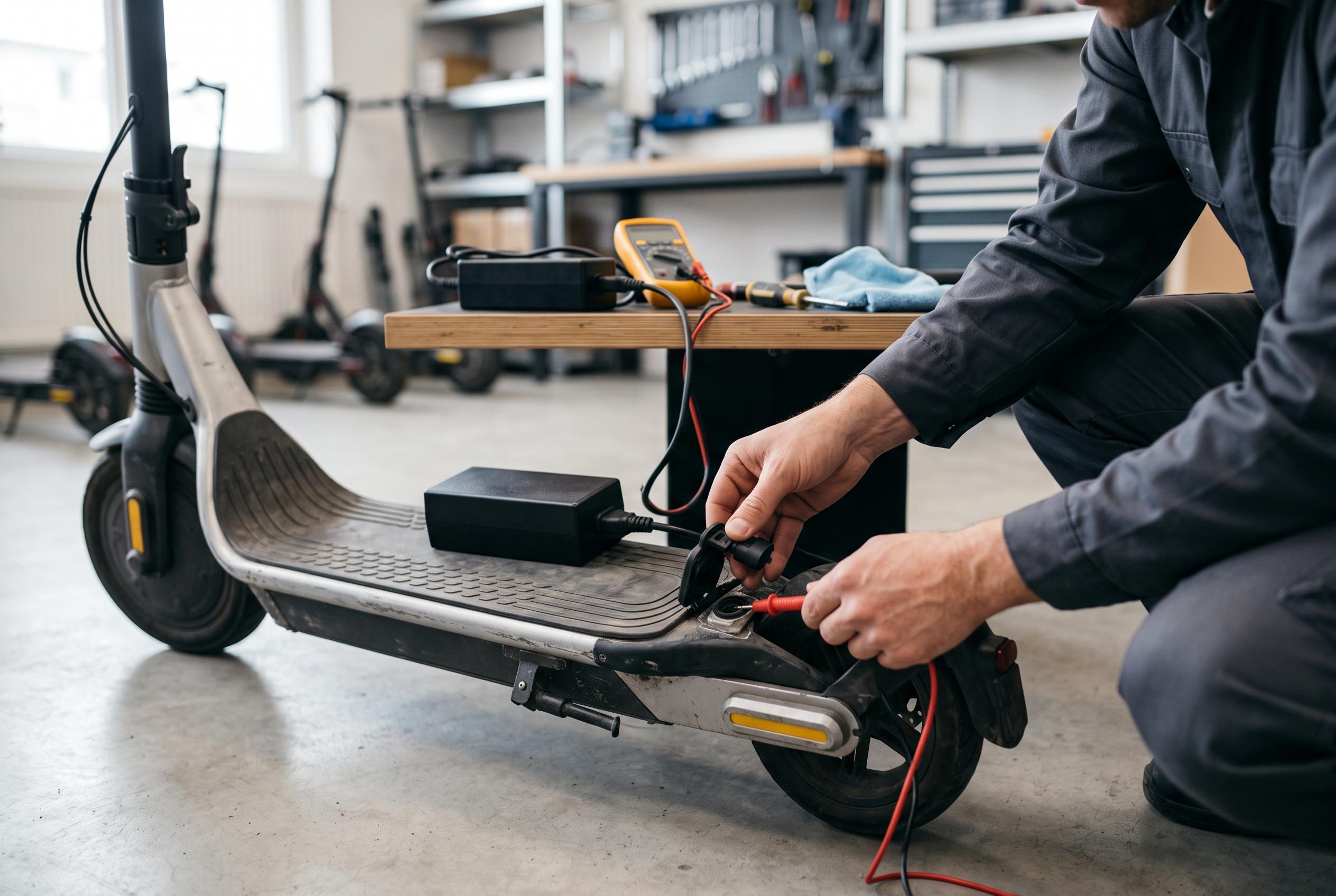

A comprehensive guide to identifying whether charging failures stem from the power brick, port, or battery, helping riders make informed repair decisions and avoid unnecessary replacements.
A silent electric scooter charger does not automatically mean the battery has failed. In practice, the same symptom can come from several points in the charging chain, from a dead power brick to a damaged port, a protection lock in the battery management system, or simple debris in the connector. That is why a methodical check matters before spending money on a replacement pack.
The first clue is usually how the scooter behaves in daily use. According to guides from Scooter Gear Lab and other repair specialists, a battery that is genuinely wearing out tends to show a sharp drop in range, faster-than-usual voltage loss under load, weaker performance on hills, or a scooter that shuts down even though the display still shows charge. A pack that becomes unusually warm, swells, or refuses to hold a charge overnight is also a warning sign that the cells themselves may be reaching the end of their life.
By contrast, a charging problem that starts with no response at all often points elsewhere. Repair guides from Scooter Gear Lab and ProMechBC note that the charger is one of the most common failure points, especially when the indicator light never changes state, the unit runs abnormally hot, or the cable shows visible damage. A charger may also appear to work at the wall while failing to deliver the correct output to the scooter.
A simple way to narrow the fault is to test the power source first. Plug another device into the same socket to rule out a house-side issue, then inspect the charger cable, plug and pins for bending, cuts or loose connections. If the charger has an LED, its behaviour can be useful: a light that stays green when connected to the scooter may mean it is not detecting a proper demand, while a light that is off, flickering or accompanied by an unusual noise suggests the charger itself may be defective.
The charging port deserves close attention as well. Scooter Gear Lab and eRiders both point out that corrosion, dirt and physical damage at the port can stop current from flowing even when the charger is healthy. Water ingress, oxidation and loose internal contacts can create the impression of a dead battery when the real fault is a poor connection between the charger and the pack.
A multimetre can add useful evidence, although it is not a complete diagnosis. According to eRiders, measuring the charger’s output voltage against the label on the unit can confirm whether it is delivering the expected power. The same approach can be used at the scooter’s charging port where access allows. A reading that is far below specification can indicate a charger fault, a protection state in the battery circuit or a deeply discharged pack.
That protection state is important. Several repair guides, including those from Scooter Gear Lab, describe a battery management system lockout that can occur after a deep discharge. In this condition, the pack may refuse to accept charge even though it is not necessarily physically destroyed. A charger connected to such a scooter can stay green, misleading users into assuming the power brick has failed. In some cases, specialist equipment is needed to recover the pack safely.
Battery health also changes with age. Scooter Gear Lab and Levy Electric note that many electric scooter packs last around two to three years, or roughly 300 to 500 charge cycles, depending on use, storage and temperature. A gradual decline is normal; a sudden collapse in range is not. Rapid degradation is often associated with cell imbalance, thermal stress, repeated deep discharge or simple chemical ageing.
Physical signs should never be ignored. Swelling, deformation, abnormal heat or a chemical smell are strong indicators that the battery should be removed from service immediately. TakeTravelInfo and Levy Electric both stress that these symptoms can signal internal damage that is no longer just a performance issue but a safety risk. In such cases, the pack should not be left connected to the charger and should be handled only through proper recycling or qualified repair channels.
For riders deciding whether to repair or replace, the key is to identify the actual fault, not just the symptom. A failed charger, corroded port or loose connector is usually cheaper and simpler to fix than a worn-out battery pack. But where the cells are degraded, swollen or repeatedly shutting down under load, replacement is usually the safer and more economical option than trying to revive a pack that is already at the end of its useful life.
Disclaimer: This content is intended for informational purposes only. Readers are advised to exercise their own judgement, conduct due diligence, or consult a qualified expert before acting on any information provided.