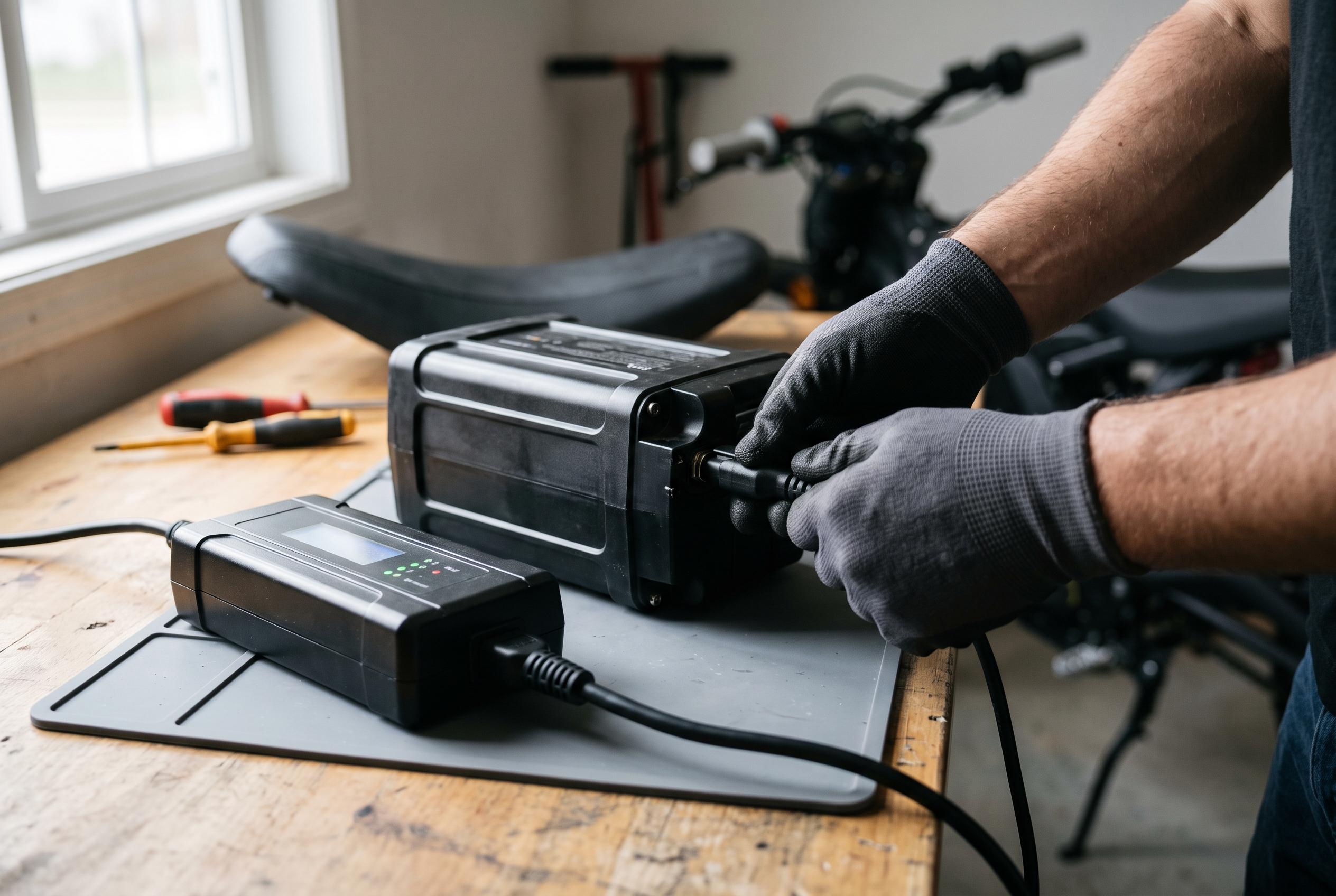

As lithium-powered batteries gain popularity in powersports machines, experts emphasise that using the correct charger and following careful procedures is crucial for enhancing durability and safety.
Lithium powersports batteries have become popular because they are lighter than lead-acid units, hold charge longer and are better suited to modern machines. But they are less forgiving of poor charging practice. According to CarParts.com, the difference matters for ATVs, UTVs, dirt bikes, motorcycles, scooters, personal watercraft and snowmobiles alike: the charger, the temperature and the battery’s internal protection circuitry all affect how long the pack will last.
Most of these batteries use lithium iron phosphate, or LiFePO4, chemistry, which does not need the same treatment as lead-acid. As Engineer Fix explains, lithium packs rely on a battery management system, or BMS, to guard against overcharging, over-discharging, overheating and excessive current. That protection is useful, but it is not a licence to use any charger available in the garage. High-voltage repair functions, desulphation modes and uncontrolled output can still damage a lithium battery or trigger its protection circuit.
The safest way to charge begins with inspection. CarParts.com advises checking for cracks, swelling or heat damage before connecting a charger, and replacing any battery that looks compromised. It also recommends charging in a dry, ventilated place and paying close attention to temperature. Many manufacturers set a charging window of roughly 32°F to 104°F, with some allowing slightly higher limits. Charging below freezing can cause permanent harm inside the cells, so a cold battery should be warmed indoors before use.
CarParts.com sets out a straightforward charging sequence: switch off the machine, disconnect the negative lead or use a quick-connect harness, select lithium or LiFePO4 mode on a compatible charger and connect positive before negative. The charger should be unplugged from the wall only after the battery is connected, then removed in reverse order once charging is complete. Harley-Davidson’s own guidance similarly warns against automotive-style chargers and recommends a charger designed for powersports batteries, with a low maximum output better suited to small motorcycle packs. Yamaha Motor Canada also cautions that high-amperage automotive chargers can overheat and shorten battery life.
The charger itself is the critical piece of equipment. A lithium-friendly smart charger should use a constant current, constant voltage profile and shut off automatically when full. Both CarParts.com and CarCody warn against desulphation, equalisation and repair modes, because those settings are intended for lead-acid batteries, not lithium packs. Harley-Davidson says a powersports charger should be limited to the output the battery can safely accept, while Yamaha recommends a quality maintainer for machines left idle for long periods. In practice, that means choosing a charger with a dedicated lithium setting, the correct voltage, and an amp rating that matches the battery size.
Voltage readings can help riders tell whether a battery is healthy or simply deeply discharged. CarParts.com notes that a resting 12-volt LiFePO4 battery in the 13.2 to 13.4 volt range is generally fully charged, while anything below about 12 volts needs prompt attention. During charging, the pack typically sits around 14.2 to 14.6 volts, with 14.4 volts a common target. The article also recommends using the battery’s amp-hour rating to estimate charge time, while keeping within the manufacturer’s maximum charge current. That matters because a battery that is regularly run flat will age faster than one kept within a sensible range.
Different machines create different charging problems. On ATVs and UTVs, accessories such as winches, light bars and audio systems can draw power even when the ignition is off, which may drain the battery and trip the BMS. Dirt bikes, motorcycles and scooters usually need smaller chargers, often in the 1 to 2 amp range, because their batteries are compact and their charging systems are not built for heavy external loads. For personal watercraft, moisture control is important; for snowmobiles, cold weather is the main challenge, and some lithium packs need a warmer environment before they will accept a charge. CarParts.com also notes that some batteries can appear dead when the BMS has simply gone into sleep mode, and that a manufacturer-approved reset method may be needed before normal charging resumes.
Storage is another area where lithium behaves differently from lead-acid. CarParts.com says lithium batteries self-discharge much more slowly than conventional batteries, which means many riders do not need a charger connected all winter. A true lithium maintainer can still be useful, but a fixed-float lead-acid charger is not ideal. For starter batteries, a full charge before storage is usually appropriate, while some larger packs are better stored at around half charge if the maker recommends it. Yamaha and Harley-Davidson both reinforce the same broader point: the best protection is a proper charger, a sound charging system on the machine and regular checks rather than reliance on improvised equipment.
Disclaimer: This content is intended for informational purposes only. Readers are advised to exercise their own judgement, conduct due diligence, or consult a qualified expert before acting on any information provided.