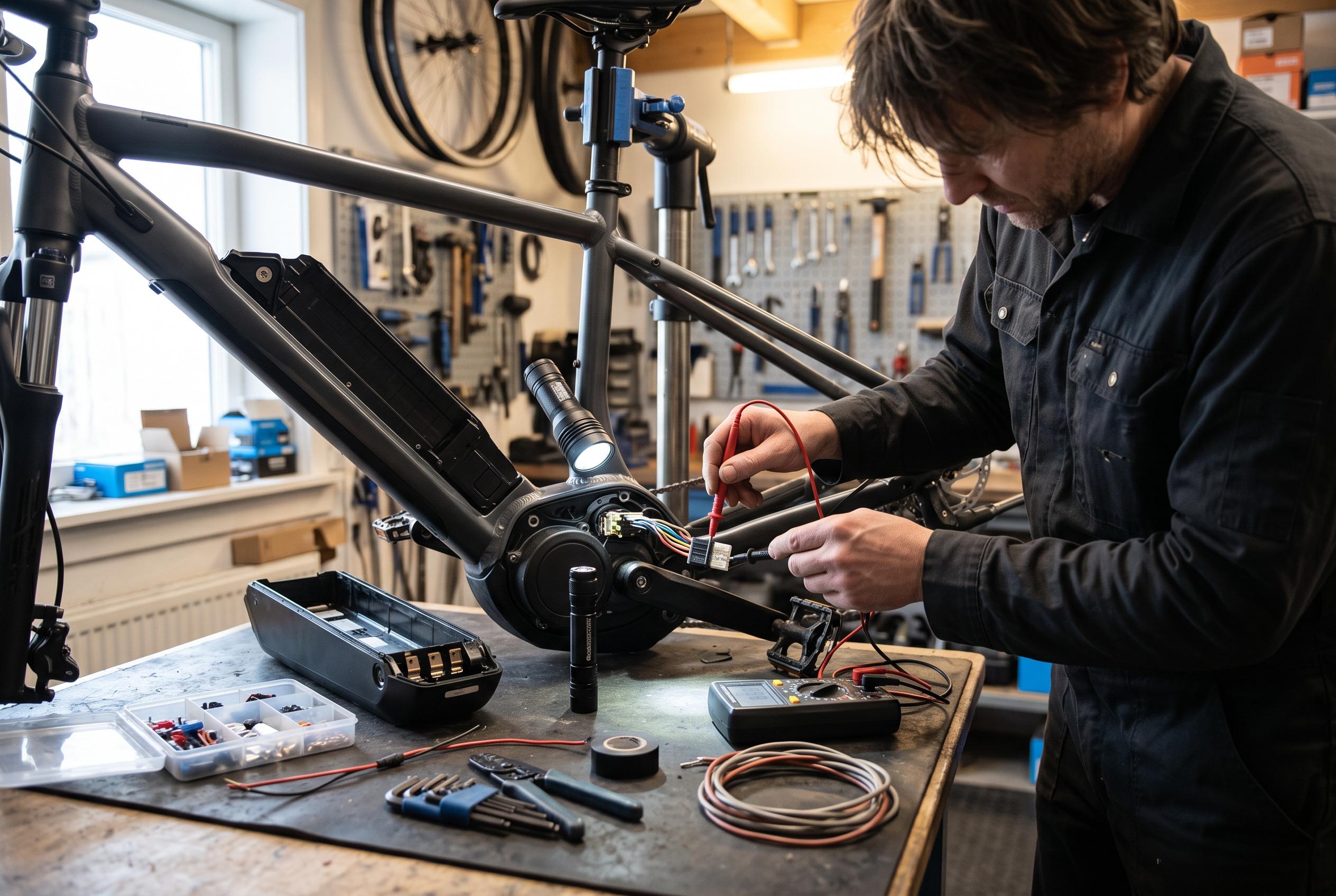

A comprehensive repair guide highlights that most electric bike faults stem from easy-to-spot issues such as loose connections and battery problems, urging riders to adopt systematic diagnostics before considering costly repairs.
Electric bikes sit between two systems: a conventional bicycle and a powered machine. That means faults are often split between mechanical wear, electrical faults, and occasional software or sensor errors. In practice, the safest approach is to diagnose the simplest causes first, rather than assuming a failed motor or battery. Himiway’s repair guide and similar maintenance notes from HD-Ebike and Heybike all point to the same lesson: many apparent breakdowns are caused by loose connections, poor charging, or worn bicycle parts rather than major component failure.
When an ebike will not switch on, the battery is the first place to look. Check that it is charged, properly locked into its mount and fully seated, then confirm that the display is connected and powered. Himiway notes that some systems will not start if the battery is only partially engaged. HD-Ebike likewise advises riders to inspect the charger, charging port and connectors before concluding that the battery has failed. Temperature also matters, because lithium-ion packs may refuse to charge when they are too hot or too cold. Using the correct charger remains essential, as a matching plug alone does not guarantee compatibility.
If the display powers up but the motor will not assist, the problem often lies in the control chain rather than the motor itself. The assist level may simply be set too low, or a brake-cutoff sensor may be telling the bike that the brakes are applied. Himiway and electricscootercar both highlight the importance of checking brake levers, motor cables, sensor positions and any error code shown on the display. Those codes are not universal, so riders should use the manual for the exact bike, controller and display combination rather than relying on a generic list found online.
Intermittent power loss can be more revealing than a total shutdown. If the motor cuts out over bumps, a loose battery, display plug or main harness is a likely suspect. If it fails on hills, battery voltage sag, heat or an ageing pack may be to blame. If the problem appears only when braking, the cutoff sensors may be working normally, but they should still be checked if assistance does not return once the lever is released. Himiway’s guidance is consistent with HD-Ebike’s fleet-based advice: repeated resets are not a substitute for tracing the fault properly.
Pedal assist and throttle faults often point to sensor or configuration problems. Cadence, torque and speed sensors all play a role, and a displaced magnet or misaligned speed sensor can stop assistance from triggering correctly. Himiway also notes that some bikes restrict throttle use by speed, mode or local setting, so the feature may be disabled rather than broken. That said, safety devices should never be bypassed simply to restore throttle response.
A sudden loss of range is not always a battery failure. Underinflated tyres increase rolling resistance, cold weather can reduce usable capacity, and riding style matters as much as hardware. Frequent throttle use, high assist levels, hard acceleration, steep climbs and heavy loads will all shorten real-world distance. Himiway and A1 Ebikes both stress that battery ageing is also a normal factor: a pack that once delivered long range may simply be reaching the end of its useful life.
Mechanical issues should not be treated as secondary merely because the bike is electric. Brake squeal usually means contamination, misalignment or worn pads, while clicking and grinding often point to chain, derailleur or drivetrain wear. Heybike’s maintenance guide and Himiway’s repair advice both emphasise that disc rotors should stay free of oil and that drivetrain cleaning and lubrication are routine tasks, not optional extras. On hub-motor bikes, wheel removal and flat repairs can be more involved because the axle, wiring and torque hardware must go back together correctly.
Battery safety deserves particular caution. Himiway’s guide is clear that swelling, heat, leaks, strange smells, deformation and unusual noises are warning signs that the pack should be taken out of service at once. UL safety guidance, echoed by Himiway, treats the battery, charger and drive system as one integrated safety system. That is why DIY work is sensible for tyres, chains, brakes and simple connector checks, but not for opening a lithium-ion pack, repairing a controller board or dealing with burned wiring. When repeated resets fail, error codes persist, or the fault involves the battery, motor or controller, professional diagnosis is the better option.
Disclaimer: This content is intended for informational purposes only. Readers are advised to exercise their own judgement, conduct due diligence, or consult a qualified expert before acting on any information provided.