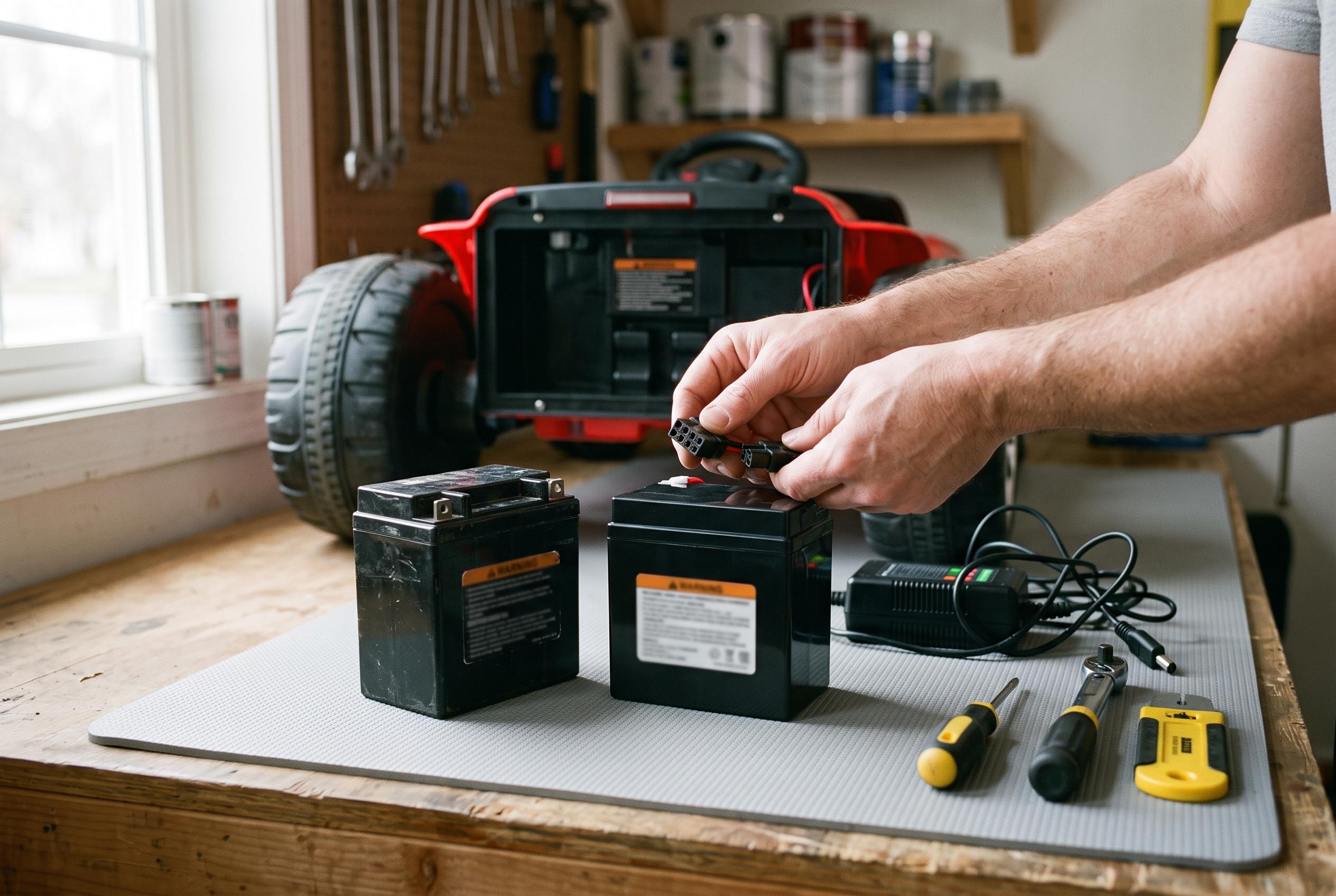

Replacing a child’s ride-on vehicle battery or charger requires careful matching of specifications to ensure safety and functionality, warns Toronto Toys. Experts recommend detailed inspection and accurate identification of original components before replacement.
When a child’s ride-on car starts losing charge quickly, or the charger has gone missing, the answer is not always to buy the first part that appears to fit. According to Toronto Toys, the safest approach is to identify the original battery and charging system first, then replace them with an exact or manufacturer-approved match.
A vehicle that refuses to move may still have a battery that is serviceable. Trouble can also come from a faulty charger, a loose connector, dirty contacts or another electrical fault. Guides from Cars for Kids, Power Wheels HQ and other ride-on maintenance specialists all point to the same starting point: check the manual, confirm that the correct charger has been used, and inspect the visible connections before assuming the battery has failed.
Before ordering a replacement, Toronto Toys advises collecting a full set of details. That includes the vehicle model or product code, the battery label, the connector type, the battery dimensions and the charger ratings. Photographs are often more useful than a general description, because similar-looking ride-on cars may use different parts. If the battery cannot be removed safely using the manual’s instructions, the retailer or manufacturer should be consulted before any panels are taken off.
The key specification is voltage, but it is not the only one that matters. Capacity, usually shown in amp-hours, battery chemistry, casing size, terminal layout and polarity all affect compatibility. A label such as 24V 7Ah identifies the electrical rating, but it does not guarantee that two batteries will be interchangeable. Toronto Toys notes that even a listed 24V 7AH battery should not be treated as a universal replacement for every 24V ride-on vehicle.
The same principle applies to chargers. A plug that fits is not enough on its own. The charger must match the battery’s voltage, chemistry, connector and polarity, and it should be the model intended for that specific vehicle or battery pack. Industry guides from Power Wheels HQ and similar sites also warn against using a generic adapter simply because it appears to have the right connector. If the original charger is missing, the best starting point is to provide the vehicle model, battery label and charging-port photos rather than guessing from product images.
Charging and storage guidance is also model-specific. Toronto Toys says there is no single charging time that suits every ride-on car, and indicator lights can mean different things depending on the charger. Advice from ride-on maintenance guides is consistent on storage too: keep batteries in a cool, dry place, follow the manufacturer’s charge schedule, and check the permitted storage conditions before putting the vehicle away for winter. For families replacing a battery, the final check should always be the same: confirm the exact model, verify the original specifications, match the connector and polarity, and make sure the charger is approved for the battery system.
Disclaimer: This content is intended for informational purposes only. Readers are advised to exercise their own judgement, conduct due diligence, or consult a qualified expert before acting on any information provided.