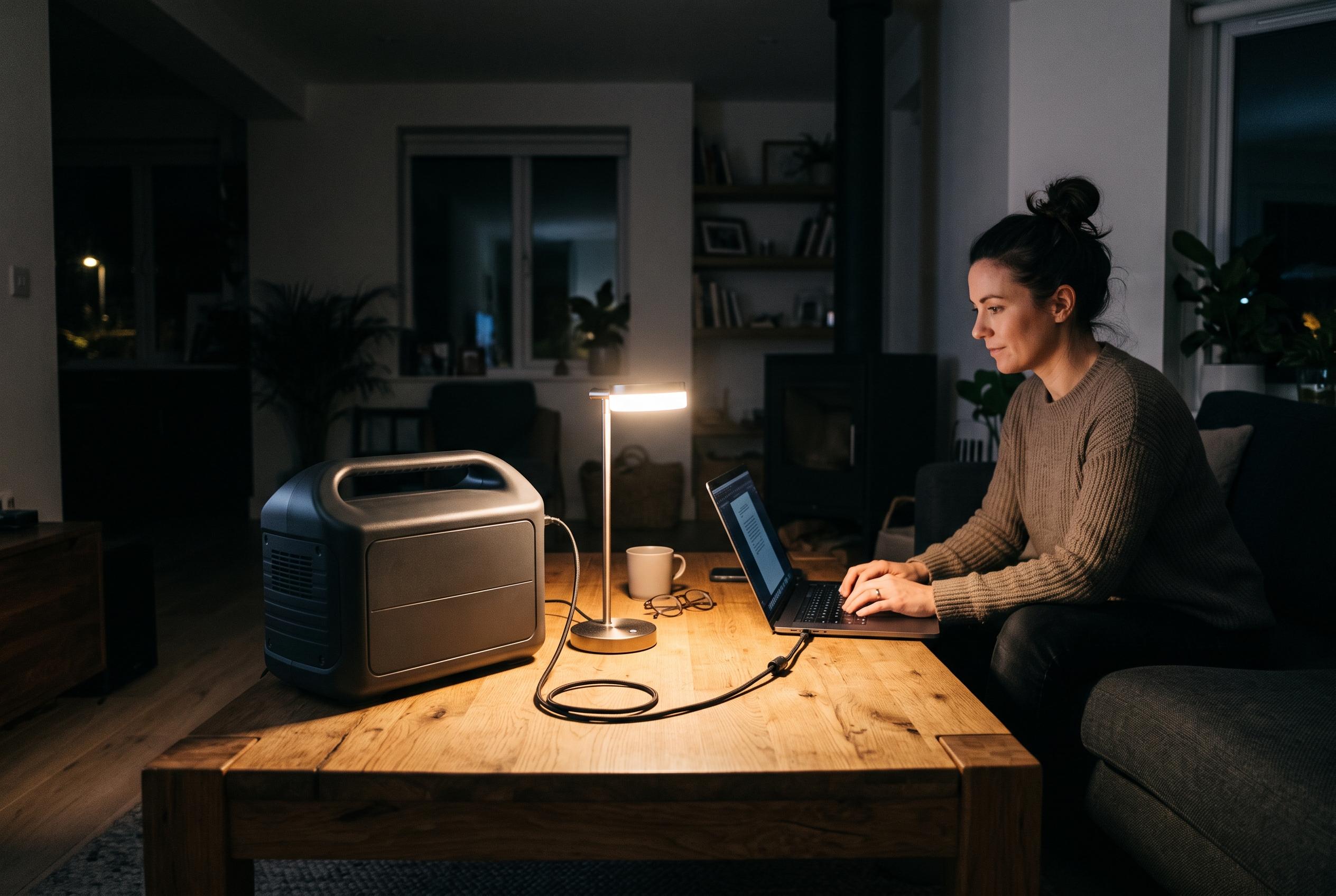

In outage scenarios, choosing a power station requires careful assessment of load needs and recharge options rather than simply aiming for the highest capacity. With a variety of models available, understanding their output and functionality ensures reliable household backup for essential devices during blackouts.
When the mains fails, the most useful portable power station is rarely the biggest one on the shelf. It is the unit that can keep a household’s most important devices running for long enough to matter. That means starting with the load, not the battery. A home may need only phones, lighting and broadband equipment for a short interruption, but the priorities change quickly if a black-out stretches into the night or threatens refrigerated food and medical equipment.
The first step is to list what must stay on, and for how long. A router, a few LED lamps, a laptop and phone chargers may be enough for brief outages. A fan can become valuable in hot weather, while a CPAP machine may be non-negotiable for overnight use. Refrigerators and freezers are a different test altogether, because they combine ongoing demand with a brief but much higher start-up surge. That is why watts and watt-hours need to be treated as separate figures: watts define what can run at once, while watt-hours determine how long it can run.
That distinction explains why many buyers over- or under-specify their systems. A unit with 1,000Wh of storage may sound substantial, but if its continuous output is too low it will still fail to run heavier appliances. Similarly, a compact model can be ideal for communications and lighting yet unsuitable for a fridge or microwave. TechRadar’s 2026 portable power station guide reflects that spread of use-cases, naming the EcoFlow Delta 3 Plus as a strong all-rounder, while pointing to the Anker Solix F3800 for larger home-backup needs and the Bluetti Elite 30 V2 for budget-conscious buyers.
For households that want a more practical benchmark, recent product data also shows how quickly this market has segmented. TechRadar reported that Anker’s Solix S2000 offers just over 2kWh of capacity, 1,500W of continuous output and a 3,000W peak, with a 10ms UPS switchover and a low idle draw aimed at home use. Mango Power, meanwhile, positions its E series in a far higher bracket, with systems ranging from 3.5kWh to 7kWh and AC output up to 6kW. Those figures show the difference between a portable emergency reserve and a setup that begins to resemble a more serious household backup system.
Recharge options matter as much as stored energy if an outage lasts beyond a few hours. Wall charging is useful before and after a storm, but solar input, vehicle charging and generator support become important in longer disruptions. The real-world usefulness of a power station also depends on the details: AC outlets, USB-C ports, runtime displays, app alerts, carrying weight and whether the unit can act as a UPS for a computer or router. Safety still comes first. Portable power stations are not a substitute for correct home wiring, and they should not be backfed into a household socket. For medical devices, the equipment should be tested in advance with the exact settings that will be used in an emergency.
The most reliable approach is to test the full setup before the weather turns bad. Fully charge the unit, connect the devices you expect to rely on and check what actually happens when a refrigerator compressor starts or a CPAP runs with humidification enabled. Power-station planning is less about chasing the largest number and more about matching capacity, output and recharge strategy to a realistic outage scenario. The better the planning, the less guesswork there is when the lights go out.
Disclaimer: This content is intended for informational purposes only. Readers are advised to exercise their own judgement, conduct due diligence, or consult a qualified expert before acting on any information provided.