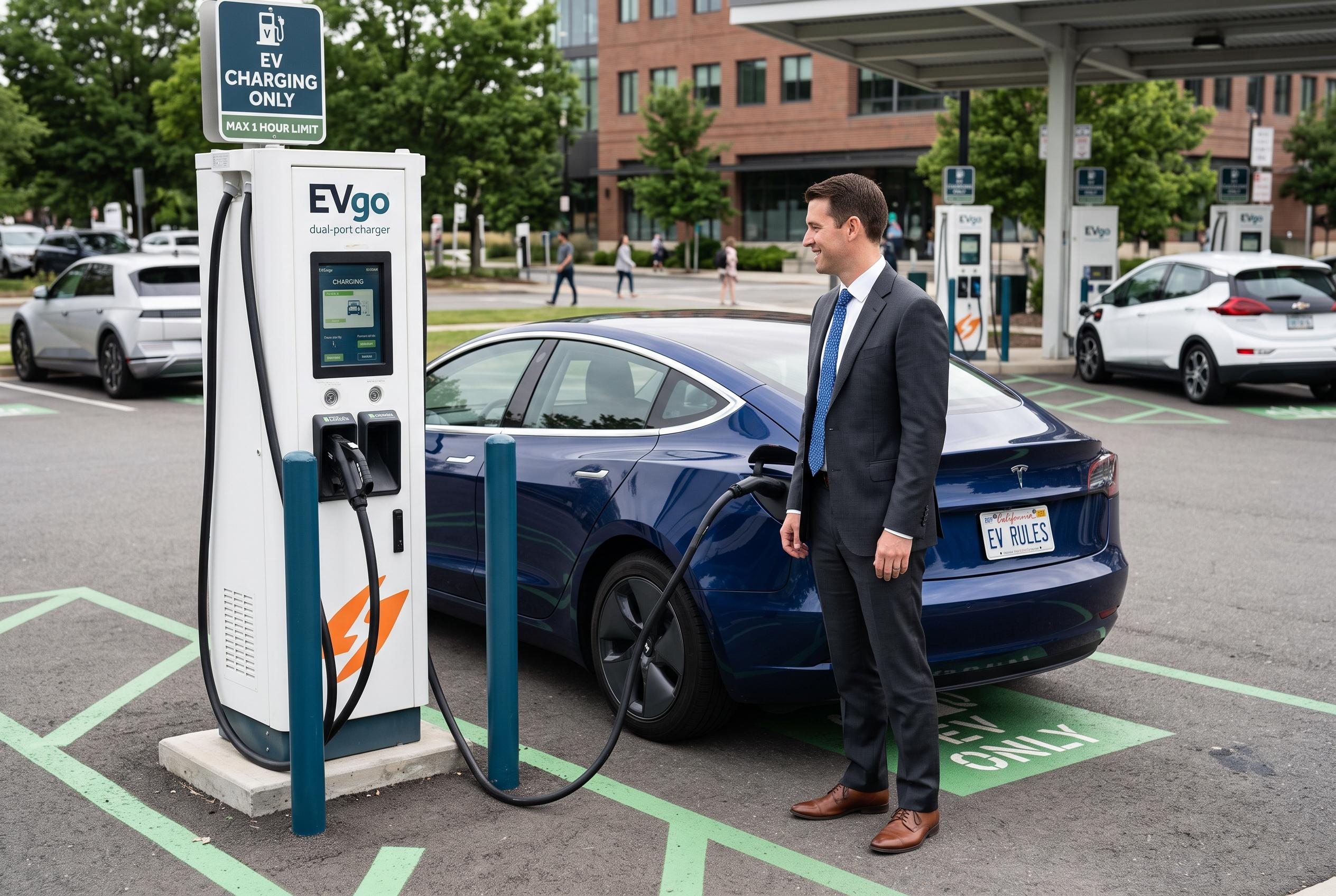

As electric vehicle charging stations expand rapidly, new behavioural norms are shaping to tackle issues such as ICEing, idle occupying, and considerate use, highlighting the evolving etiquette among EV drivers to ensure fair access and efficient charging.
Public EV charging is still governed less by formal rules than by shared habit. As Stuff notes, drivers have had to build their own etiquette around a system that is expanding fast but remains uneven, with broken units, occupied bays and patchy layouts still common frustrations. Industry guides from EV Daily, Capital One and Chase make the same point: the network works best when drivers treat a charger as a temporary service point, not a parking space.
First, combustion-engine cars do not belong in EV bays. The practice known as ICEing remains one of the most irritating forms of misuse, especially in supermarket and retail car parks where chargers are often placed close to entrances. If a vehicle is not charging, it should not be there. That basic norm is now repeated across public guidance from several motoring and finance sites.
Second, move away once the session is finished. A charger left occupied after the battery has filled is effectively unusable to everyone else, and many networks now impose idle fees to discourage that behaviour. Public charging advice from Capital One and Chase both stresses the same principle: stay with the car when you can, watch the session, and clear the bay promptly when charging ends.
Third, do not chase 100% unless you genuinely need it. On rapid and ultra-rapid chargers, the charging curve slows markedly once the battery is around 80% full, so the final stretch can take disproportionately long. That is why experienced drivers often stop earlier, especially when others are waiting. Stuff is right to frame this as both a time-saving and a courtesy issue: leaving at 80% can free the charger for the next driver far more quickly.
Fourth, park carefully and leave enough room for the cable. Public charging bays are not standardised, and cable length varies by network and charger type. Misalignment can make a unit unusable even when it is technically working. Mazda’s guidance and other etiquette explainers both stress that drivers should think about the position of the charge port before pulling in, so the cable does not have to cross walkways or neighbouring spaces.
Fifth, report faults rather than assuming someone else will. A dead charger is not just an inconvenience for the driver who discovers it; it can waste the time of everyone who arrives after them. Several public charging guides now treat fault reporting as part of routine etiquette, because a quick app submission can help operators identify problems faster and reduce repeat failures.
Sixth, do not occupy the fastest charger if a slower one will do. This is not a hard rule, but it matters more as public networks become busier. If you only need a short top-up, a lower-powered unit may be the better choice, leaving the high-speed bay for drivers with less charge or longer onward journeys. EV Daily and other guides describe this as one of the clearest examples of considerate charging behaviour.
Finally, give newcomers some patience. Public charging still confuses many first-time users, who may be dealing with apps, payment methods, cable types and unfamiliar connector standards at the same time. The friction is often caused less by bad manners than by inexperience. As Stuff suggests, the etiquette is still evolving, and a little leniency helps the system work for everyone.
Disclaimer: This content is intended for informational purposes only. Readers are advised to exercise their own judgement, conduct due diligence, or consult a qualified expert before acting on any information provided.