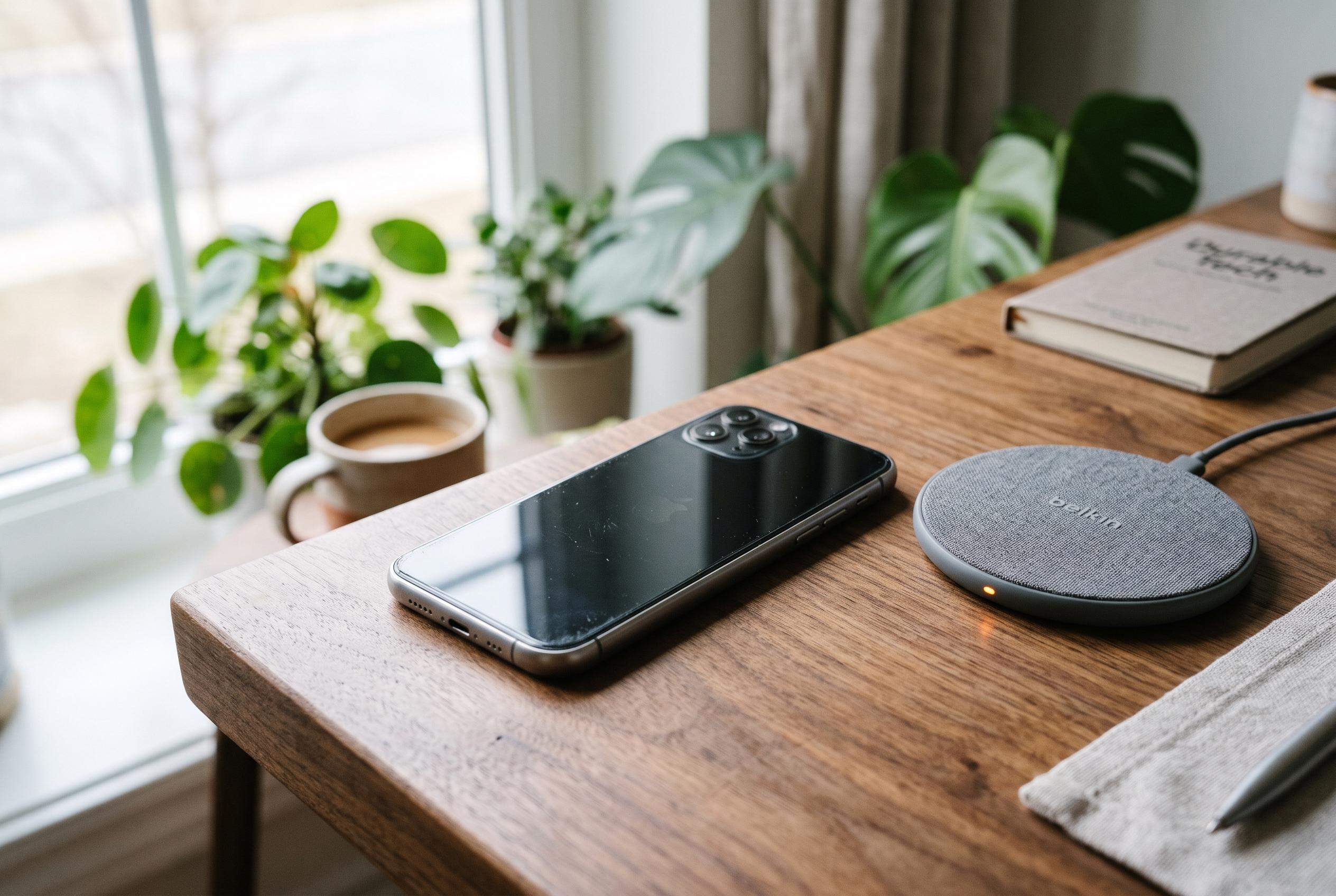

Keeping an iPhone below full charge and avoiding deep discharges may slow battery wear, with one iPhone 17 Pro Max retaining 97% capacity after a year.
Apple users looking to slow battery wear may get more benefit from charging habits than from any accessory or app. In a recent account published by MelaBlog, technology journalist Juli Clover argued that the simplest approach is to avoid keeping an iPhone at a full charge for long periods and to limit deep discharges where possible. The point, she suggested, is not to stop battery ageing altogether, but to reduce the chemical stress that lithium-ion cells experience over time.
Clover’s most striking example came from an iPhone 17 Pro Max, which, after 12 months of use with an 80% charging limit, was still showing 97% maximum capacity and had logged 277 charge cycles. She said that compares favourably with earlier Pro Max models used in the same way. According to her figures, an iPhone 16 Pro Max had fallen to 94% after a year, while the iPhone 15 Pro Max had also reached 94% after 12 months. Over longer periods, she reported that the 15 Pro Max retained 88% health after 36 months and 369 cycles, while the 16 Pro Max stood at 93% after 24 months and 343 cycles.
The charging method may also matter. Clover said she relied mainly on USB-C charging with the newer device rather than MagSafe or Qi2 wireless charging. That distinction matters because wireless charging generally produces more heat, and heat is one of the main enemies of battery longevity. She also pointed to the newer model’s aluminium construction and vapour chamber cooling system as possible contributors to lower operating temperatures during everyday use.
The logic behind the 80% rule is straightforward. Lithium-ion batteries degrade as they go through charge and discharge cycles, but they also age faster when they spend long periods at the top end of their charge range. Leaving a phone plugged in at 100% for hours, especially in a warm environment, puts the cells under more strain. Capping the charge at 80% does not prevent ageing, but it can slow it down by keeping the battery away from its most stressful state.
Clover also described a second habit that appears to help: avoiding very low charge levels. Keeping the battery above 20% most of the time reduces the number of deep discharges, which can also affect long-term health. The practical trade-off is obvious. An 80% ceiling means less immediate runtime each day, and some users will need to charge earlier, particularly if they rely heavily on navigation, video streaming, gaming or hotspot use. But the benefit, as Clover framed it, is measured over months rather than hours.
Apple now gives users built-in tools to manage that trade-off. On supported iPhones, charge limits can be adjusted in the Battery settings, where users can choose a fixed ceiling or rely on optimised charging features that learn daily routines and delay topping up past 80% until necessary. Official Apple support notes that the phone may still occasionally reach 100% to keep battery readings accurate. Android phones offer similar controls on many models, though the names vary, with options such as battery protection, adaptive charging or charging limits.
The wider lesson is that there is no universal rule that suits every user or every device. Battery health depends on temperature, usage patterns, charging method and the number of cycles already completed. Even so, the reporting around Clover’s test suggests that small changes can make a meaningful difference. For users who want to keep a phone in good condition for longer, reducing time spent at full charge is one of the simplest steps available, and it does not require buying anything new.
Disclaimer: This content is intended for informational purposes only. Readers are advised to exercise their own judgement, conduct due diligence, or consult a qualified expert before acting on any information provided.