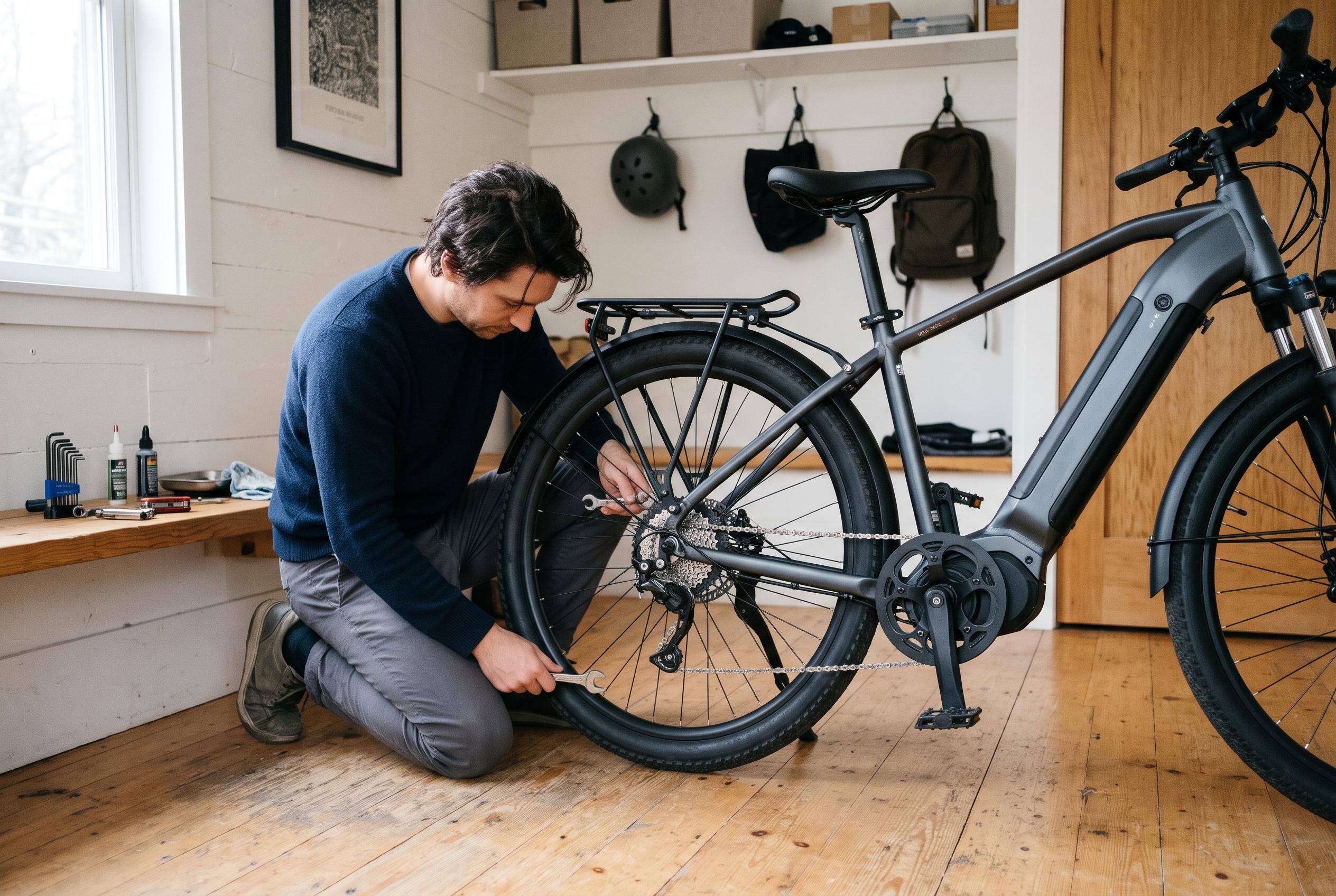

Regular checks of tyres, brakes, drivetrain and wiring can catch problems early, while careful charging and gentle cleaning help protect an e-bike’s battery and electronics.
Keeping an electric bike in good condition is less about occasional deep servicing than about disciplined, routine checks. The basic principles are the same as for a conventional bicycle, but an e-bike adds a battery, motor, controller, sensors and wiring that need their own attention. The maintenance schedule also depends on the maker’s own instructions, which should take precedence over any general guide.
A practical routine begins before every ride. Tyre pressure, brake response, wheel security, handlebar clamping, saddle position, chain condition, battery mounting, lighting and the display all warrant a quick look. A short test ride at low speed can reveal brake drag, poor shifting or unreliable motor assistance before a problem becomes a safety issue. Riders who cover rough ground, carry heavy loads or commute in wet weather are likely to need closer and more frequent checks than the average owner.
Cleaning should be gentle. Dirt, road salt and mud can hide wear, but e-bike electronics make aggressive washing risky. A soft cloth, mild cleaner, a brush and clean water are usually enough. The battery should be switched off, and if it is removable, taken out before washing. Water should never be directed at the motor housing, battery compartment, hubs, bearings or display, and high-pressure washers are best avoided because they can force moisture past seals and into electrical parts.
Battery care is central to both safety and longevity. The United States Consumer Product Safety Commission says riders should use the charger supplied with the bike or an approved replacement, remain present while charging, and never charge a lithium-ion battery while asleep or away from home. Bosch gives similar advice for its own systems, recommending supervised charging in a dry, ventilated space, away from heat and flammable materials, and disconnecting the charger once charging is complete. Bosch also advises storing a battery at roughly 30 to 60 per cent charge, where possible, if the bike will not be used for some time.
Battery inspection matters as much as charging practice. Owners should look for cracks, swelling, unusual heat, damage around the contacts, corrosion and any odd smell. If a battery appears swollen, leaks, smokes or becomes abnormally hot, it should not be used or charged. The safest response is to move away from the unit and seek professional help. Spent lithium-ion batteries should go to an approved recycler or hazardous-waste collection point rather than household rubbish.
Tyres and wheels deserve regular attention because e-bikes are typically heavier than ordinary bicycles and often travel at higher sustained speeds. Underinflated tyres can reduce range, worsen handling and increase puncture risk. The correct pressure depends on the tyre, the rider and the load, so the sidewall range and the bike maker’s guidance should be followed rather than inflated to the maximum by default. Cuts, embedded glass, bulges, worn tread and loose spokes are all signs that a tyre or wheel needs closer inspection, and persistent wobble should be assessed by a mechanic.
Brake maintenance is equally important. Shimano’s service documentation for its hydraulic disc systems says pads at 0.5 mm or below should be replaced in the relevant models, which underlines a key point: pad limits are not universal and depend on the brake design. Rotor condition should also be checked for warping, cracking, heavy scoring and contamination. If a brake lever feels spongy, pulls too close to the handlebar or loses power, the system may need bleeding or professional servicing. Lubricant and general-purpose cleaners must never be allowed onto braking surfaces.
The drivetrain takes extra strain on many e-bikes, especially mid-drive models where motor assistance passes through the chain and gears. A dirty or dry chain can make shifting noisy and inefficient, and it can wear out the cassette and chainring more quickly. Park Tool’s guidance on chain wear supports the common replacement thresholds of about 0.75 per cent for many five- to ten-speed chains and 0.5 per cent for many eleven- to twelve-speed chains, while also noting that exact limits vary by chain design. Cleaning and lubrication should be done with products intended for bicycle drivetrains, then excess lubricant should be wiped away.
The motor itself usually needs little direct servicing from the owner, but its surroundings do not. Cables should be checked for abrasion, loose plugs and corrosion, and the housing should be kept clean without opening the unit or spraying water into it. Unusual grinding, clicking, vibration or sudden changes in assistance are warning signs. If the motor mounts or related hardware are loose, the correct torque values should be used rather than guesswork.
The same logic applies to the display, controller, sensors and frame hardware. A clean screen can be wiped with a lightly damp cloth, while exposed wiring should be watched for pinching, wear or poor routing. Riders should also inspect the frame for cracks or damaged welds, and fasteners for loosening caused by vibration. Suspension components, if fitted, need their own checks for oil leaks, seal damage and reduced movement. REI notes that riders who log high weekly mileage should expect more frequent attention than occasional users, often around every three to four months or roughly every 1,000 miles as a general guide.
Not every fault can be solved at home. Persistent brake problems, wheel damage, motor errors, battery charging failures, broken spokes, structural frame issues and suspension servicing usually call for a trained mechanic. A maintenance log is useful because it shows when parts were cleaned, adjusted or replaced, and it helps identify patterns such as repeated punctures, declining range or recurring electrical faults. For most owners, the best maintenance strategy is simple: inspect often, clean gently, charge safely and deal with warning signs early.
Disclaimer: This content is intended for informational purposes only. Readers are advised to exercise their own judgement, conduct due diligence, or consult a qualified expert before acting on any information provided.