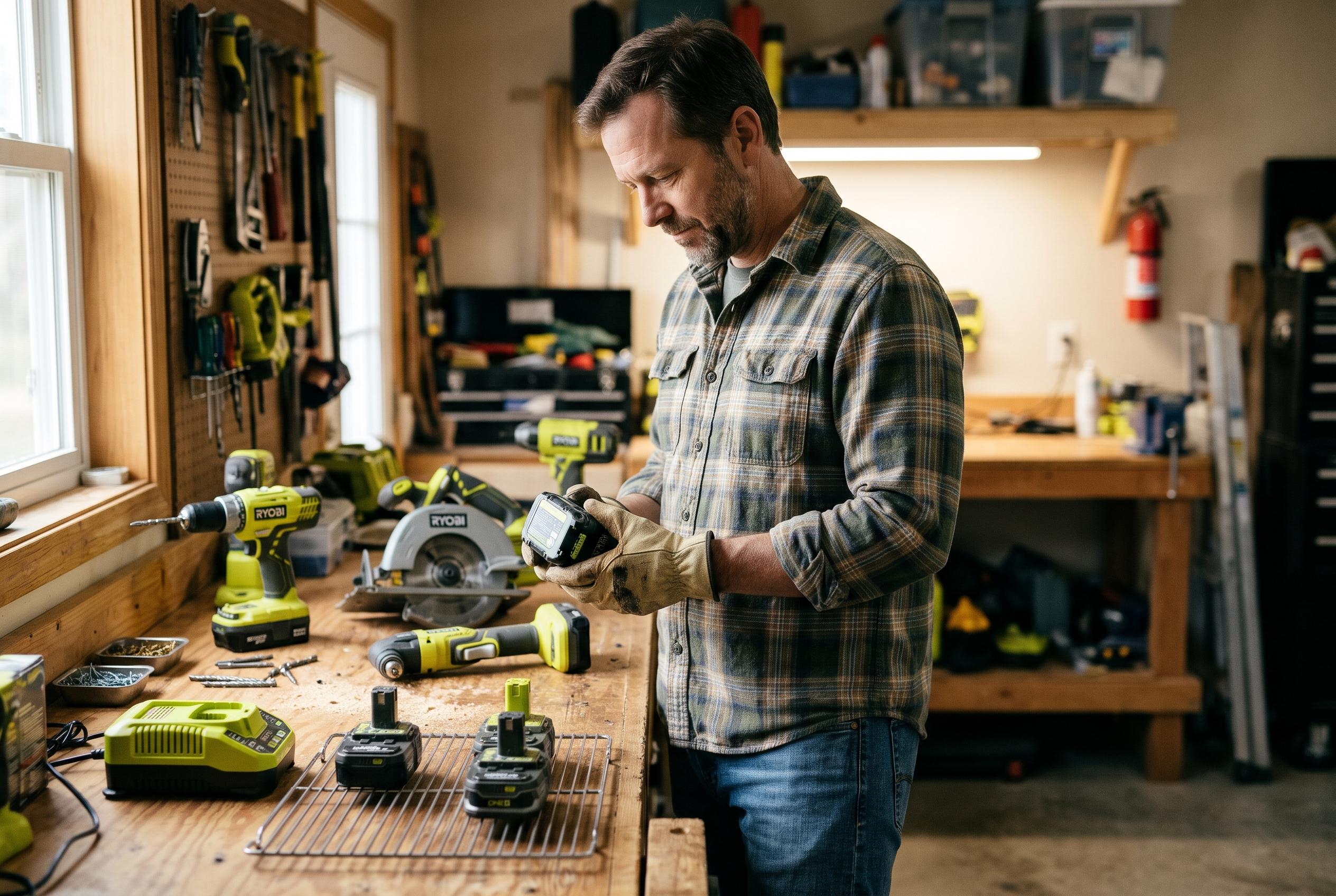

Charging a hot pack, overloading compact batteries and leaving depleted cells unattended can all shorten the life of a Ryobi ONE+ battery.
Ryobi ONE+ batteries do not fail on a fixed timetable. Their lifespan depends heavily on how they are handled between charges, and the most damaging habits are often the ones that happen during a normal job rather than during long-term storage. MakeUseOf notes that while shelving a pack at full charge is a familiar mistake, five other routine behaviours can also shorten service life if they become habit.
One of the most common errors is putting a battery straight back on the charger as soon as it comes off a tool. MakeUseOf says that a pack fresh from heavy cutting or drilling is already warm, and charging it immediately adds more heat to cells that have not had time to cool. Lithium-ion batteries age faster at higher temperatures, and Ryobi’s own support guidance recommends allowing a hot pack to rest for about 30 minutes before charging. The company’s chargers can delay charging when a battery is too warm, but that protection does not remove the heat the cells absorbed during use.
Another mistake is using a small compact battery in equipment that demands sustained power. MakeUseOf points out that 1.5Ah and 2.0Ah packs are well suited to lighter tools such as drill/drivers, but struggle in high-draw machines, including stick vacuums. In that situation, the battery may shut down even when it still shows charge remaining, because the cells are being pushed hard. For that reason, larger packs are better matched to heavier tools, while the smaller ones are best kept for lighter-duty work. The article also stresses that capacity should be chosen for the task, not simply for the biggest number available.
Letting a battery run flat and then leaving it unused is another way to damage it. According to MakeUseOf, Ryobi tools are designed to switch off before the cells reach a harmful voltage, but the problem begins once the pack is left near empty. Self-discharge continues after the tool stops, and a battery that sits low for too long can drift into a state where the charger may not recognise it properly. Ryobi’s manuals, as summarised by iTechGuides, generally advise storing batteries at about 30% to 50% charge in a cool, dry place, which makes topping up a depleted pack the same day a practical safeguard.
Temperature remains a recurring theme in the storage advice. MakeUseOf says Ryobi warns against keeping batteries in vehicles, where summer heat and winter cold can both be harmful. That advice aligns with guidance from Ryobi’s support pages in Australia and New Zealand, which recommend avoiding extreme temperatures and keeping batteries in a storage range of roughly 10°C to 37°C. The final risk is assuming a third-party adapter will stop discharge at the right point. MakeUseOf says owners should only use adapters that clearly list low-voltage or over-discharge protection, because an unprotected accessory can push a pack beyond safe limits more quickly than a Ryobi tool would. Taken together, the lesson is simple: let warm packs cool, match battery size to the job, recharge drained packs promptly, avoid vehicle storage where possible, and check that adapters include proper cutoff protection.
Disclaimer: This content is intended for informational purposes only. Readers are advised to exercise their own judgement, conduct due diligence, or consult a qualified expert before acting on any information provided.