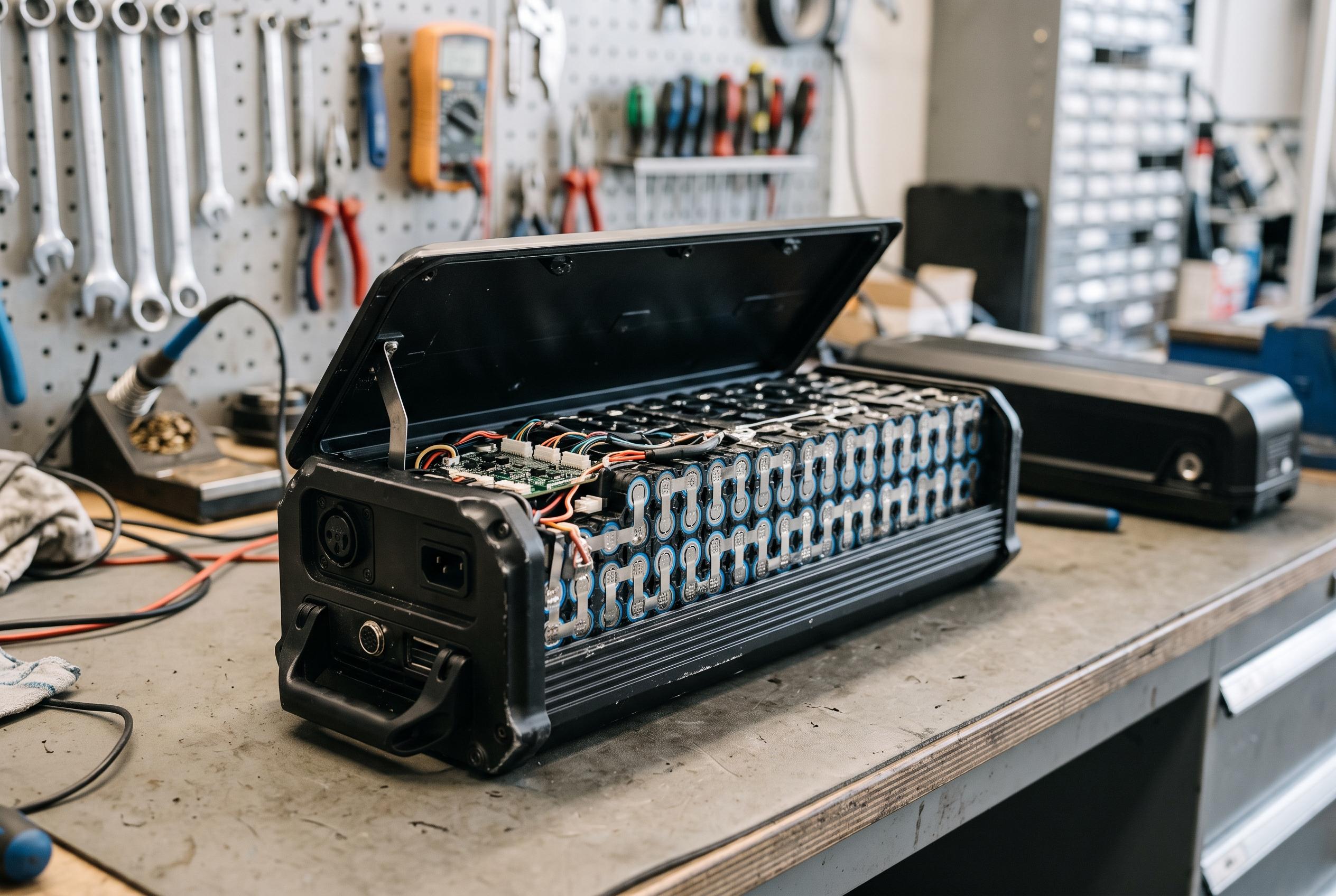

Expert guides reveal that many e-bike battery faults stem from external issues and can often be recovered, but safety risks mean replacement is sometimes the safest option.
E-bike battery faults are often less dramatic than riders fear. In many cases, the problem begins outside the pack itself: a failed charger, a damaged port, a blown fuse, a loose connector, or a key switch left in the wrong position. The practical first step is to rule out those external causes before opening the case. Guides from Himiway, Ebikefaults and other repair specialists all stress the same point: a battery that appears lifeless is not always beyond recovery.
A sensible diagnosis starts with voltage. Using a digital multimeter set to direct current, the charger should produce the expected output for the battery class, such as roughly 42V for a 36V pack, 54.6V for a 48V pack and 58.8V for a 52V pack. If the charger is healthy, the next check is the battery’s discharge port. A reading of zero volts, or a value far below normal after a full charge, can indicate a protection shutdown, a disconnected switch, a fuse fault or a deeper internal problem. The same approach is recommended in charging guides from Ebikefaults, which also advise checking the wall outlet, the charger indicator light and the charge socket for bent pins or scorching.
If the external parts check out, attention turns to the battery management system, or BMS. This control board protects the pack from overcharge, over-discharge and excessive current, but it can also place the battery into sleep or fault mode if cells are deeply discharged or a component fails. According to repair guides from Himiway, Ebike Review Lab and Dyu Bikes, a pack may show healthy voltage before the BMS while reading zero or only ghost voltage at the output terminals after it. That distinction matters: it helps separate a recoverable protection lockout from a damaged control board or a failed MOSFET stage.
The next layer of diagnosis is the cell groups inside the pack. E-bike batteries are built from multiple lithium-ion cells arranged in series and parallel groups, so one weak group can bring down the whole system. Professionals measure each group through the balance leads and compare the readings. Most groups should sit within a narrow range of one another, typically around 0.05V to 0.1V apart. If one group falls well below the rest, or reads near zero, the pack likely has degraded cells, a broken weld strip or a failed parallel section. As Ebike Review Lab and Dyu Bikes note, repair is possible in some cases, but only with exact cell matching and the proper welding equipment.
For most riders, replacing a single cell is not a reliable long-term fix. Even if the pack can be opened safely, a new cell usually behaves differently from older neighbours in the same string, which can create imbalance and shorten the life of the repair. A better approach is often to replace the whole parallel group, rebuild the entire pack or buy a new battery, especially when the original pack uses proprietary electronics or a locked BMS. Compatibility is critical here: voltage, connector type, physical dimensions and charging electronics all have to match, and safety certification matters as much as capacity.
There are also warning signs that the battery should not be repaired at all. Swelling, heat, hissing, a chemical smell, melted casing or repeated shutdowns under light load can indicate a pack that is already unsafe. At that point, the priority is isolation and proper disposal, not testing or recharging. In practical terms, the best repair is often the one that stops short of a dangerous rebuild. For many failed e-bike batteries, the choice is not between repair and reuse, but between a controlled replacement and a riskier attempt to rescue cells that have already reached the end of their safe life.
Disclaimer: This content is intended for informational purposes only. Readers are advised to exercise their own judgement, conduct due diligence, or consult a qualified expert before acting on any information provided.