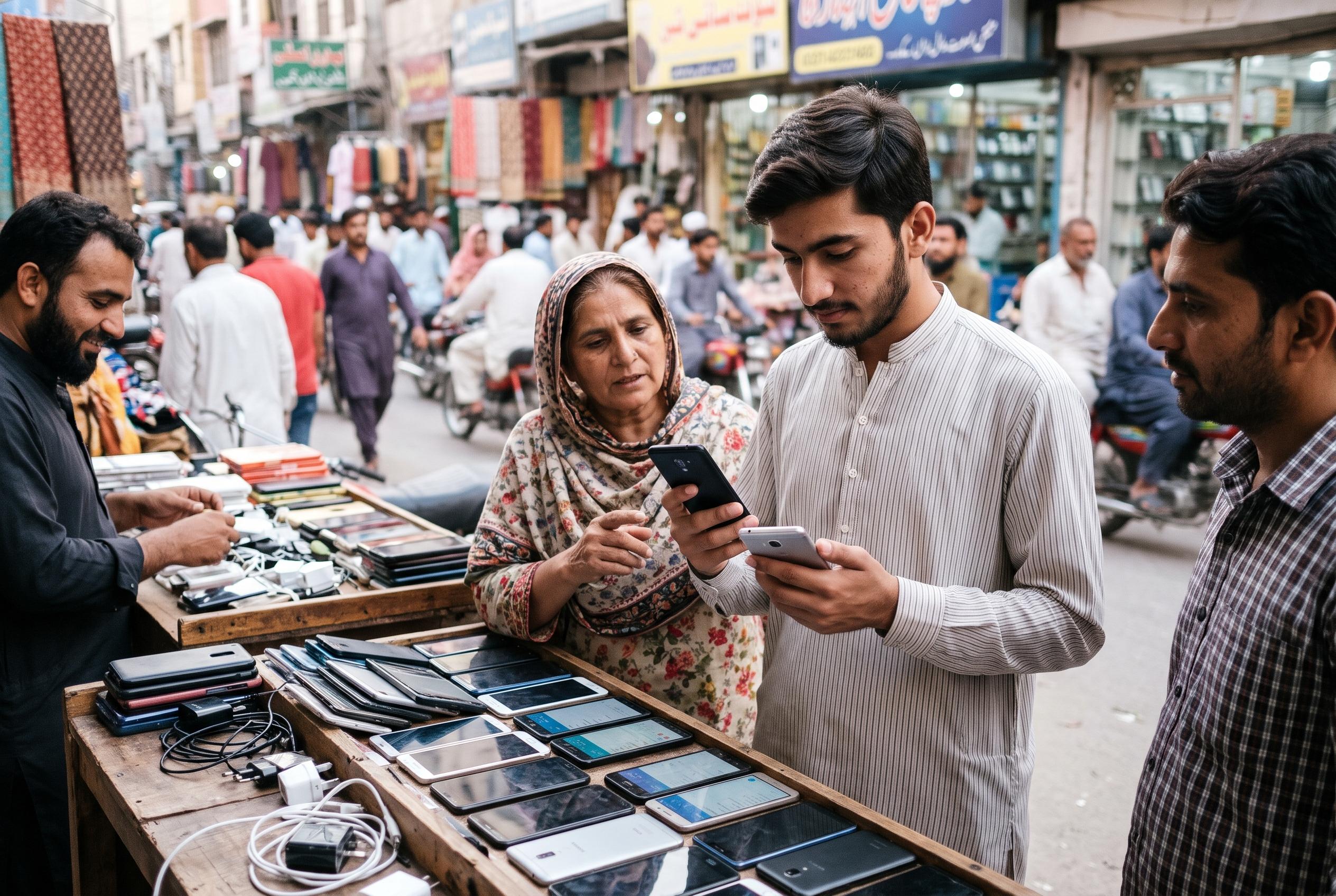

From storage variants and battery health to PTA status and warranty terms, Pakistan’s smartphone buyers need to look beyond the advertised price to find genuine value.
Buying a smartphone in Pakistan is rarely as simple as comparing the first price that appears on a search page. The same model can carry very different tags depending on its storage, condition, warranty, seller and registration status. In practice, a phone that looks inexpensive at first glance can become poor value once those details are taken into account, while a slightly dearer handset may better suit the buyer’s actual needs.
A more disciplined search usually begins with one organised platform rather than several scattered listings. WhatMobiles.com.pk, MobilePricePakistan.pk and similar catalogue sites present model names, specifications and price ranges in a way that makes early comparison easier, while also allowing users to sort by brand or budget. Pak Genz goes a step further by grouping devices by price band and brand, which can help narrow the field quickly before a buyer visits a shop or contacts a seller.
That early shortlist is only useful if the buyer understands what each quoted figure actually represents. A lower price may refer to a smaller storage version, a used handset, or an imported device with different warranty terms. BestMobile.pk and WhatMobile.com.pk both stress the value of updated specifications and reviews, but the critical step is to record the exact variant, the date of the listing and the conditions attached to the offer. A number alone tells very little.
Budgeting should also include more than the handset itself. In Pakistan, the final outlay can extend to accessories, a charger, protection items and, in some cases, registration-related costs. That is why the cheapest advertised price is not always the lowest real cost. The buyer should decide in advance what is essential, what is optional and how much flexibility exists without drifting into needless upgrades.
The right phone is also the one that matches the way it will be used. A buyer who mainly calls, messages and streams video will usually value battery life, comfort and screen readability. Someone creating content may focus more on camera consistency, storage and recording options. The point is not to chase the longest specification sheet, but to match the device to the routine it will actually support.
Side-by-side comparison is useful once the shortlist is small. MobilePricePakistan.pk and WhatMobiles.com.pk both offer comparison tools, and that kind of layout makes it easier to examine display size, processor, battery, memory and camera details without losing track of the differences. The method works best when the buyer asks what each variation means in daily use, not simply which phone has the longer list of features.
Storage and RAM deserve particular attention. Similar model names can hide meaningful differences between variants, and a quoted price should always be tied to the exact configuration. That matters for buyers who store photos, videos, documents and apps on the device itself. If expandable storage is important, it should be confirmed for the precise model and regional version rather than assumed from the series name.
Camera claims also need careful reading. A higher megapixel count does not automatically mean better results. BestMobile.pk and other catalogue sites may list camera specifications, but the buyer should still look for sample images or hands-on reviews of the exact model. For most users, focus behaviour, colour accuracy, low-light performance and video stability matter more than the headline resolution figure.
Battery performance should be assessed in the same practical way. Capacity is only part of the story; the real outcome depends on usage, software behaviour and the state of the battery itself in a used handset. Buyers should also ask whether a charger is included and whether it supports the charging standard intended for the phone. For second-hand devices, the battery’s condition is often as important as the listed specification.
In Pakistan, PTA status is another issue that cannot be ignored. A model name or seller description does not confirm the legal or registration position of the handset being offered. Buyers should ask for clear information, verify the device identifiers through the proper channels and make sure any status-related obligations are understood before money changes hands. For imported phones in particular, the registration position can materially affect the final cost.
Tax calculators can help with budgeting, but only if the assumptions are read carefully. A calculator that uses a historical reference sheet or an illustrative exchange rate is useful for rough planning, not for establishing the exact official amount payable today. That distinction matters because the figure produced by a simplified tool should not be treated as a final registration quote.
Used and refurbished phones require the most scrutiny. The screen, body, charging port, cameras, speakers and microphones should all be checked before payment. Buyers should also ask whether parts have been replaced, whether the seller offers any checking period and whether the phone can be set up normally without another person’s account credentials. A low asking price is not a substitute for a proper inspection.
Warranty and after-sales support can change the value of the deal just as much as the sticker price. A seller warranty and a manufacturer-backed warranty may involve different claims processes, so the terms should be requested in writing. The invoice should identify the exact model and configuration, and the return or replacement policy should be understood before the purchase is completed. A slightly pricier offer with clear support can be safer than a cheaper one with uncertain conditions.
The most effective buying routine is straightforward: set a total budget, identify the three most important requirements, shortlist suitable models, compare exact variants, read realistic reviews, confirm condition and status, and then obtain the seller’s final written offer. That process keeps the decision focused on ownership, not just on the number attached to the phone. A good purchase is one that fits the buyer’s routine, budget and risk tolerance with as little ambiguity as possible.
Disclaimer: This content is intended for informational purposes only. Readers are advised to exercise their own judgement, conduct due diligence, or consult a qualified expert before acting on any information provided.