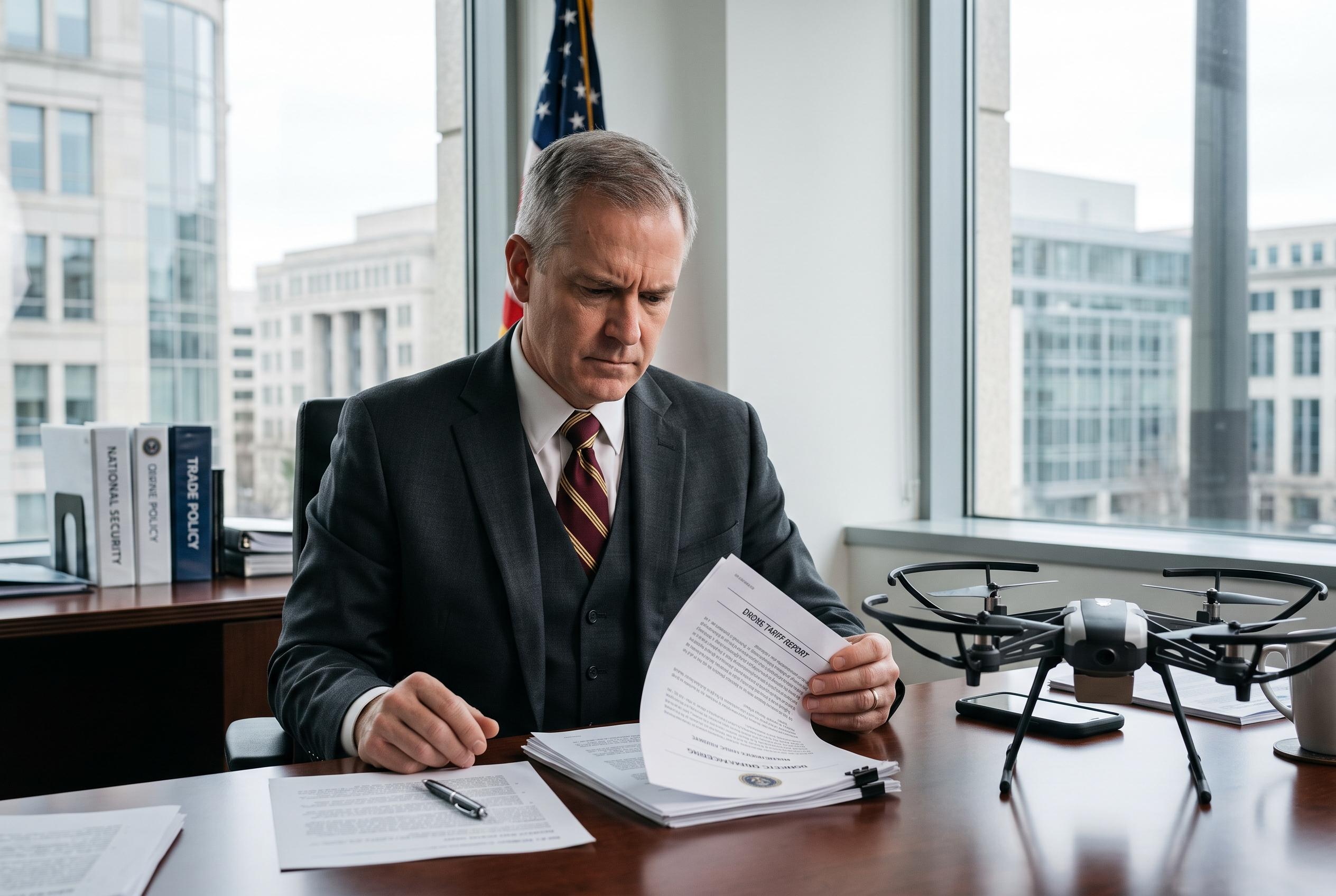

Donald Trump has signed a proclamation imposing new tariffs on imported drones and parts, citing national security concerns and aiming to promote domestic manufacturing while addressing transshipment issues involving China and other countries.
Donald Trump on 13 August signed a proclamation under Section 232 of the Trade Expansion Act of 1962 imposing new tariffs on imported drones and parts, framing the move as a national security measure aimed at reducing U.S. dependence on foreign suppliers, especially China. The White House said the policy is intended to support domestic production, while the legal basis rests on a statute that gives the president broad authority to restrict imports judged to threaten security. (whitehouse.gov)
Under the measure, sensitive unmanned aircraft systems, including larger drones and models with security-relevant functions such as thermal imaging, face duties of up to 100%, while smaller, non-sensitive drones and other components are subject to a 25% rate. Taiwan, the European Union, Japan, South Korea, Switzerland and Liechtenstein are set to receive a lower 15% ad valorem rate, and Britain 10%, but only if “substantially all” hardware, software and technology originate in those countries or the United States, according to the announcement. Reuters-style coverage of earlier U.S. drone scrutiny has shown that Washington has already treated imported unmanned aircraft as a national security issue, giving context to the latest escalation. (whitehouse.gov)
Most of the new duties take effect 21 days after signing, with the less sensitive components delayed for 180 days. The Commerce Department is also authorised to create domestic production programmes to encourage firms to invest in U.S. manufacturing. Separate White House material released the same day outlined what it described as a transshipment problem involving Chinese goods routed through more than 40 countries, a sign that the administration is tightening origin checks as well as tariff policy. (whitehouse.gov)
For Taiwan, the immediate picture is mixed. Taipei is not being singled out as a transshipment offender in the drone action, but it now sits in a privileged yet conditional category that could benefit manufacturers able to prove clean supply chains. Reuters has previously reported that the United States and Taiwan had already agreed preferential tariff terms in broader trade talks, including a 15% rate on some Taiwanese imports, which makes the drone tariff decision part of a wider pattern of differentiated treatment for trusted partners. Analysts say the practical test will be documentation: firms that cannot prove non-Chinese content may lose the benefit and face higher costs, while those that can may gain from U.S. demand shifting away from China. (investing.com)
Disclaimer: This content is intended for informational purposes only. Readers are advised to exercise their own judgement, conduct due diligence, or consult a qualified expert before acting on any information provided.