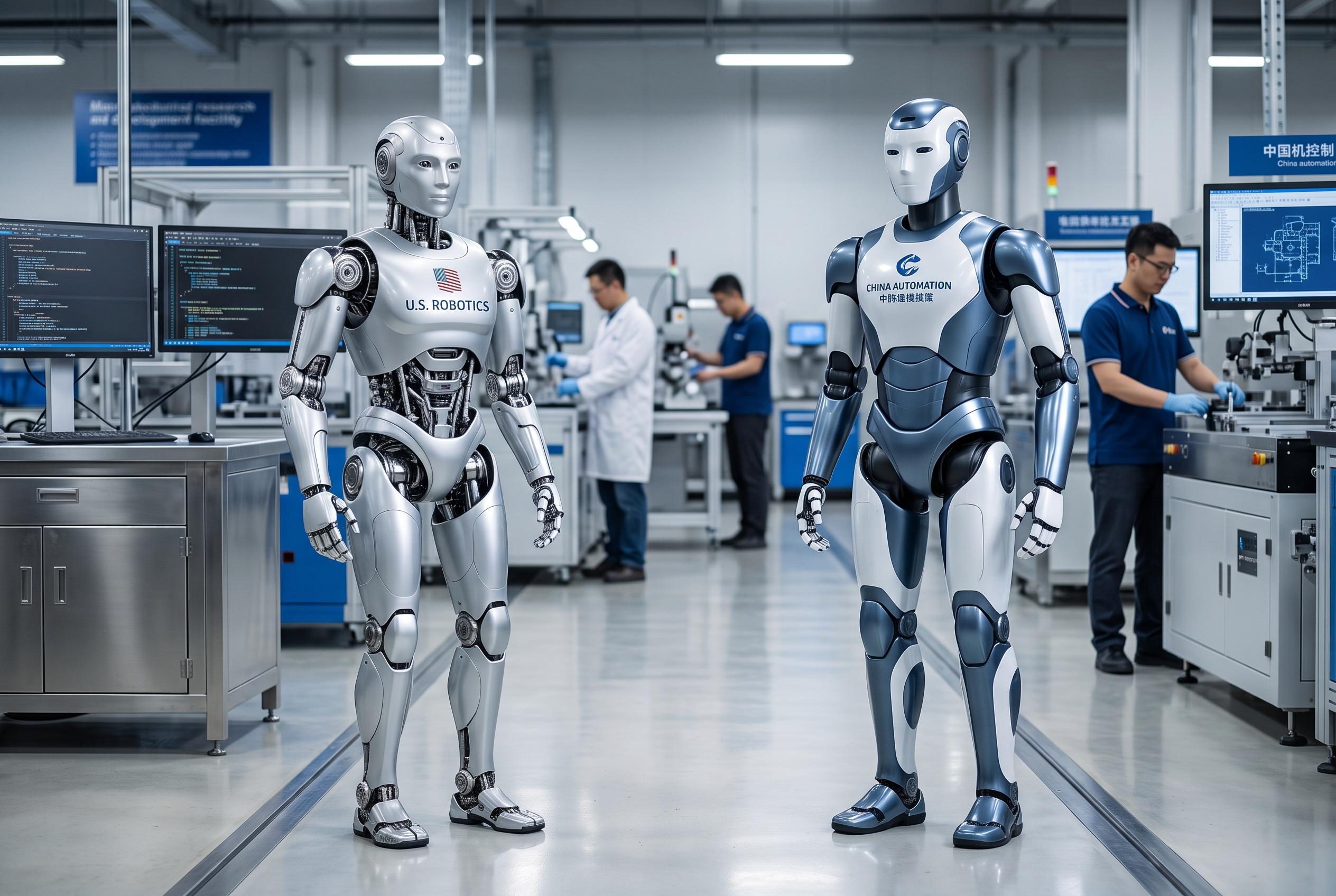

While the United States aims to expand its humanoid robot production, it faces significant hurdles in scale, supply chain independence, and technological maturity compared to China, which leads the world in industrial robot deployment.
The United States wants to build more humanoid robots at home, but the industry is still far from a scale that can challenge China. Analysts cited by VietnamPlus say leading US companies are only making a few hundred machines this year, with most units confined to factory and warehouse trials rather than open sales. By contrast, Chinese firms Unitree and Agibot are said to have produced about 10,000 robots between them, underlining how wide the gap has become.
The problem is not only volume but supply. McKinsey has argued that China’s edge comes from a manufacturing base tightly linked to electric vehicles, which gives robot makers faster access to motors, power electronics, batteries and other parts. In the US, companies still depend heavily on Chinese components, including for high-profile projects such as Tesla’s Optimus. Start-ups and investors quoted in the report say building a cost-competitive plant in the United States is difficult because labour is dearer and key materials such as lithium and aluminium are still largely sourced abroad.
That dependence is now shaping the debate over industrial policy. Teddy Haggerty, founder of Robo Inc., told the report that trying to remove China entirely from the supply chain may simply make robots more expensive, rather than more resilient. Sunny Cheung of the Jamestown Foundation said young US manufacturers would need substantial financial and policy backing if they are to compete. A recent Information Technology and Innovation Foundation report reached a similar conclusion, warning that the United States is falling behind a field it once helped invent and lacks the industrial depth needed for large-scale production.
Even if the supply chain problem were solved, the technology itself remains immature. Humanoid robotics still faces difficult engineering constraints, including motion control, sensor integration, battery performance and heat management, according to HumanoidIntel.ai. That helps explain why many systems remain demonstrations rather than dependable products. Industry observers say robots still struggle with rapid decision-making in changing environments and often fall short of the reliability expected by industrial buyers. TrendForce has also reported that Tesla halted production of Optimus because of battery-life and hardware-software integration issues, a sign that even the best-funded programmes are still wrestling with basic limits.
The commercial case is also unproven. Supporters argue humanoid robots could eventually assist in hospitals or work in dangerous settings such as mines and chemical plants, but no major manufacturer has yet shown that such machines can be deployed profitably at scale. The International Federation of Robotics says China already had more than 2 million industrial robots operating in factories in 2024 and added about 300,000 more that year, more than the rest of the world combined. That industrial base gives Chinese firms a practical advantage that the United States has yet to match, even as Washington moves to tighten controls on certain advanced robotic imports.
Disclaimer: This content is intended for informational purposes only. Readers are advised to exercise their own judgement, conduct due diligence, or consult a qualified expert before acting on any information provided.