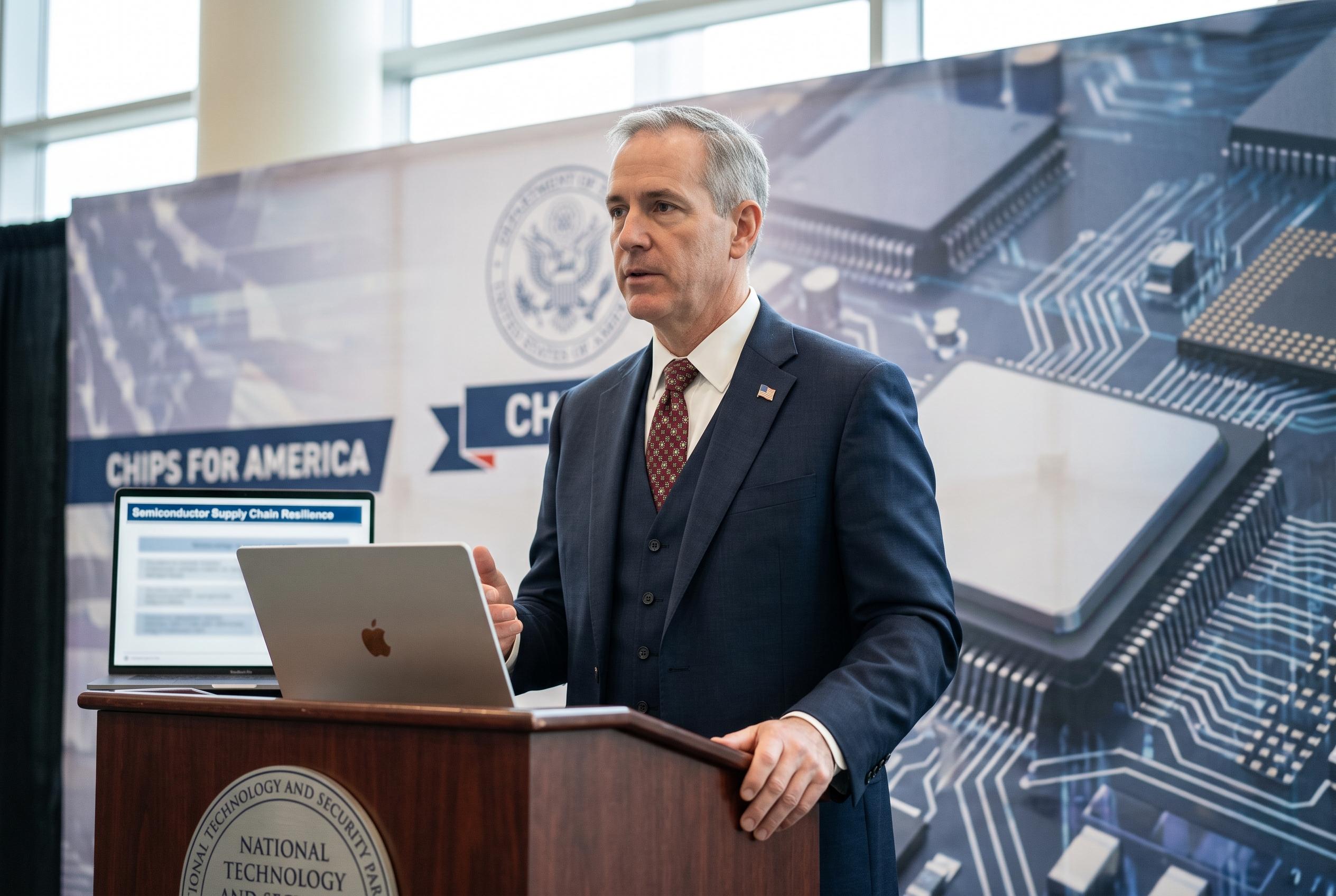

Commerce Secretary Howard Lutnick signals that the US government opposes Apple sourcing memory chips from Chinese firms CXMT and YMTC, intensifying tensions over semiconductor supply and national security.
Commerce Secretary Howard Lutnick has signalled that the Trump administration does not want Apple buying memory chips from Chinese suppliers ChangXin Memory Technologies, or CXMT, and Yangtze Memory Technologies Co., or YMTC, sharpening a dispute that sits at the intersection of supply-chain pressure and national security. On 14 August 2026, Lutnick said the government was “not in favour” of the arrangement, according to reporting cited in Crypto Briefing, effectively leaving Apple to choose between higher component costs and political risk.
The talks did not emerge suddenly. In June 2026, reports said Apple had been exploring purchases from CXMT, YMTC and at least one other Chinese semiconductor maker as memory prices climbed under the weight of global AI demand. The company was said to have been testing CXMT’s DRAM chips and discussing YMTC’s NAND flash, with an eye to using the parts in products sold outside the United States. Apple’s logic was straightforward: memory is a core input across the iPhone, Mac and iPad lines, and shortages have made cheaper sourcing increasingly attractive.
That strategy, however, runs directly into Washington’s restrictions on Chinese chipmakers. YMTC has been on the Commerce Department’s Entity List since 2022, while CXMT was added to the Pentagon’s list of Chinese Military Companies in 2025, according to the supplied reports. A bipartisan group of senators later pressed Apple to drop the plan altogether, citing security concerns. Micron has also lobbied against any deal, arguing that it could weaken the US semiconductor industry at a moment when domestic production remains strategically important.
Apple’s proposed compromise was to restrict any Chinese-sourced parts to devices sold in China, a move that would leave other suppliers’ output available for the US market. But the administration appears unwilling to set a precedent that could normalise deeper reliance on Chinese chipmakers, even for overseas sales. With a reported 21 August deadline approaching for Apple to commit to avoiding CXMT and YMTC, the issue now carries implications beyond one company’s procurement choices, touching on the wider contest over who controls advanced semiconductor supply chains.
Disclaimer: This content is intended for informational purposes only. Readers are advised to exercise their own judgement, conduct due diligence, or consult a qualified expert before acting on any information provided.