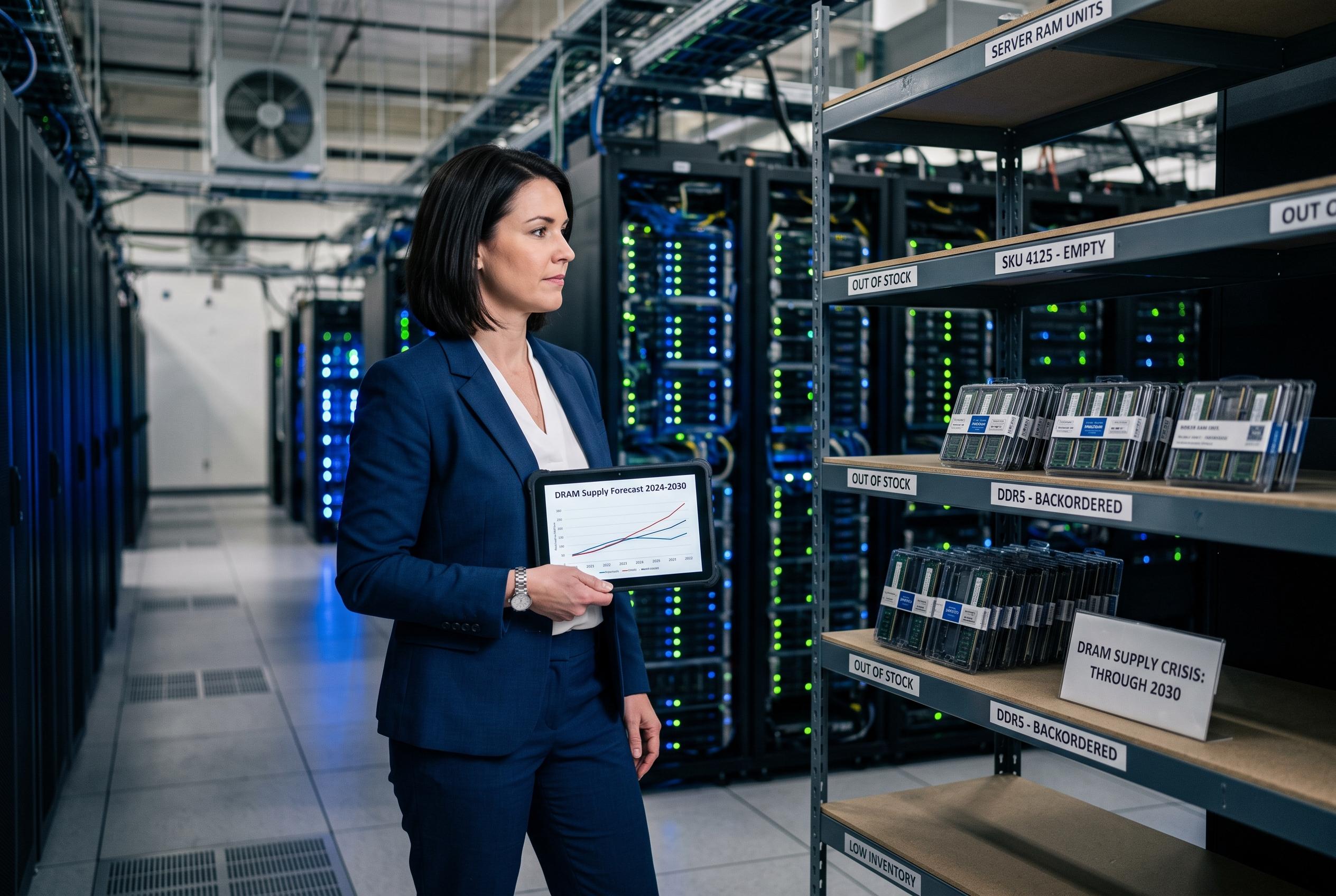

A prolonged surge in memory prices driven by AI infrastructure build-out is disrupting the RAM market, with shortages looming until at least 2030 and consumer costs rising sharply amidst full industry capacity booking.
The surge in memory prices is no longer a short-lived squeeze. According to market reports and industry executives, the rise in demand from artificial intelligence infrastructure has pushed the RAM market into a prolonged shortage that is lifting costs across consumer devices and enterprise systems alike. The effect is now visible in everything from laptops and tablets to smartphones and cloud hardware.
The pressure comes from a market dominated by Samsung, SK Hynix and Micron, whose factories make both conventional DRAM for consumer products and high-bandwidth memory for AI accelerators. Although the two are not directly interchangeable, they compete for the same industrial capacity. Micron chief executive Sanjay Mehrotra said last year that a single HBM package consumes roughly three times as many wafers as a DDR5 consumer module, while reports cited by DigiTimes suggest that global RAM production capacity for 2027 has already been fully booked.
That imbalance is being driven by the scale of AI build-out. Bloomberg reported in March that hundreds of large data-centre sites were under construction, and spending has continued to accelerate. In October 2025, OpenAI and AMD announced plans for 6GW of data-centre capacity, while xAI’s Colossus installation in Memphis has been described as one of the most extreme examples of the sector’s appetite for memory-heavy hardware. More recently, Axios reported that hyperscalers including Meta, Microsoft and Alphabet are securing long-term memory supply, adding further strain to an already tight market.
Prices for consumers have moved sharply higher. PCPartPicker data show that some DDR5 kits which were below €91 at the start of 2025 are now selling for more than €363, while 32GB modules in the DDR5-6000 class have climbed from about €227 to more than €1,090. Tom’s Hardware reported that HBM demand is also expected to push standard DDR5 prices higher, as manufacturers redirect production towards AI-related memory.
Executives do not expect relief soon. Reuters reported that SK Hynix’s Kwak Noh-jung sees conditions worsening in 2027 and remaining tight beyond 2030, while Micron’s Mehrotra has pointed to difficult supply conditions through at least 2028. TechSpot said analysts are still not expecting meaningful normalisation before 2028, and Deloitte has been cited as seeing no clear return to balance before 2030. Micron has also been investing in capacity, and SK Hynix has committed to new factories in South Korea, but those lines are not due to start production until 2029.
The industry has already started to reorganise around the shortage. Micron ended its Crucial consumer brand at the end of 2025, saying it wanted to focus on larger strategic customers and faster-growing segments. The company has since reported strong margins, while SK Hynix and Samsung have also posted record results. The result is a market in which AI demand is crowding out ordinary computer memory, and buyers of PCs and phones are paying the price.
Disclaimer: This content is intended for informational purposes only. Readers are advised to exercise their own judgement, conduct due diligence, or consult a qualified expert before acting on any information provided.