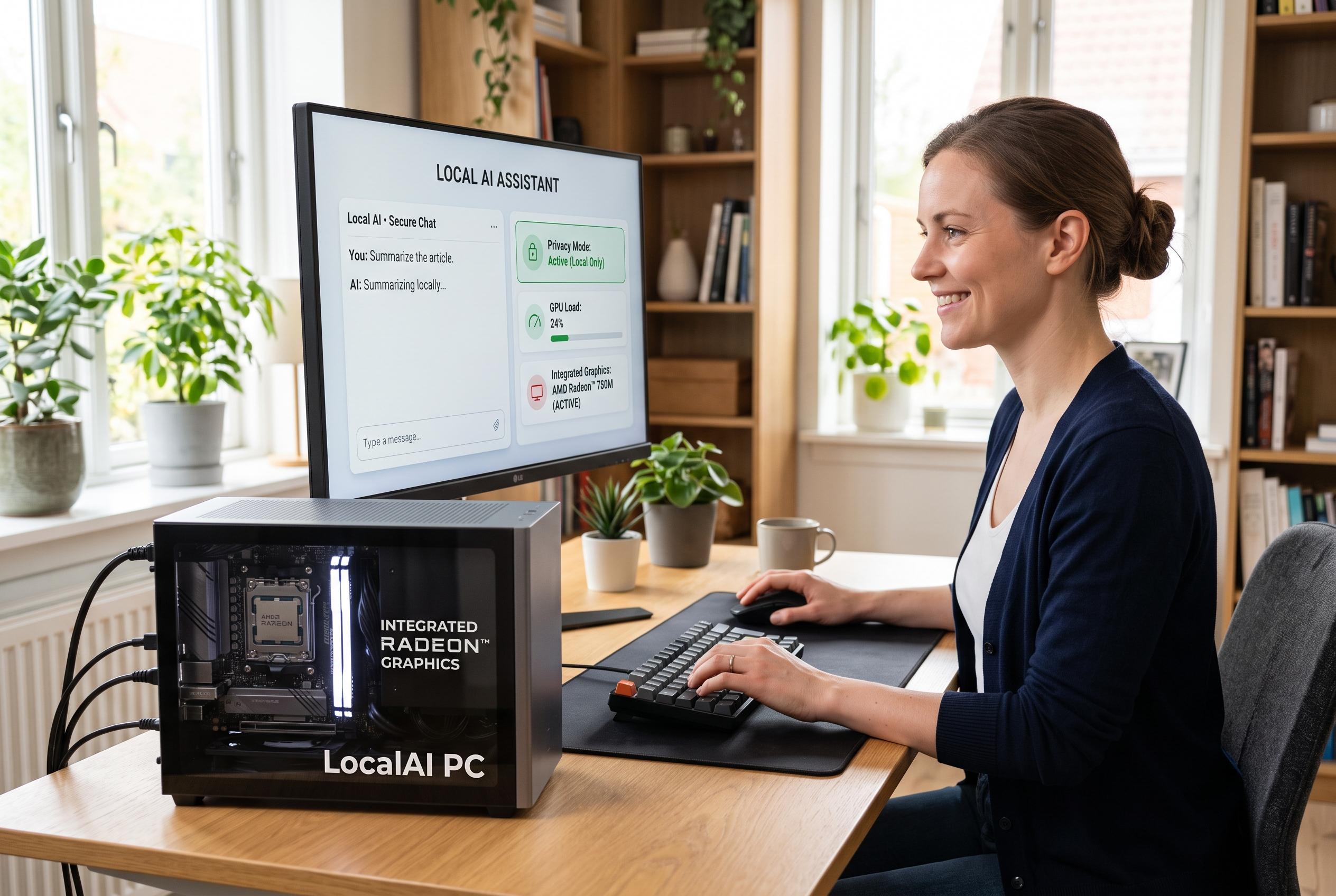

Running self-hosted AI models on integrated graphics is increasingly feasible for everyday tasks, with recent tests on AMD and Intel hardware showing promising performance for models up to 7B in size, emphasising privacy and accessibility.
Running self-hosted AI models on integrated graphics is no longer as far-fetched as it once sounded. In testing on a Lenovo IdeaPad Slim 3 with an AMD Ryzen 7 5000 Series processor, 16GB of RAM, a 512GB SSD and Radeon integrated graphics, several local models proved fast enough for genuine day-to-day work. The practical limit was not whether they would run at all, but how much speed and quality could be preserved before the experience became cumbersome. Industry guides and benchmark tools support that conclusion, with LLMs in the 1B to 7B range often delivering usable token rates on integrated GPUs, especially on newer AMD and Intel designs.
The most useful all-rounder was Mistral 7B, used here in an 8-bit quantised build for brainstorming, outlining and expanding rough ideas. It was not the fastest option, but it offered enough depth for planning work without demanding a dedicated graphics card. That matches wider hardware advice that integrated graphics can handle smaller models reasonably well, while larger ones quickly run into memory and latency limits. For local use, the key advantage is privacy: prompts and files stay on the machine rather than being sent to a cloud service.
For lighter jobs, Phi-4 Mini was the easiest model to keep open for quick edits, summaries and short explanations. Gemma 3 4B was the better choice when the task needed more reasoning, such as comparing options or checking a line of thinking. Qwen 3.5 4B stood out for coding, handling fixes, explanations and smaller snippets well, even if larger code generation took noticeable time. That pattern is consistent with reporting that VRAM and available memory matter more than raw headline GPU strength for local AI, because once a model spills into system memory, performance drops sharply.
The broader lesson is that local AI no longer requires an expensive gaming PC to be useful. With realistic expectations, integrated graphics can support everyday experimentation, especially in the 3B to 7B range, where the balance of speed and output quality is strongest. Larger models can run, but the trade-off in waiting time is often too high for routine work. Recent benchmarking efforts and hardware guides point in the same direction: the best results on integrated graphics come from matching model size to memory capacity, rather than chasing the biggest model available.
Disclaimer: This content is intended for informational purposes only. Readers are advised to exercise their own judgement, conduct due diligence, or consult a qualified expert before acting on any information provided.