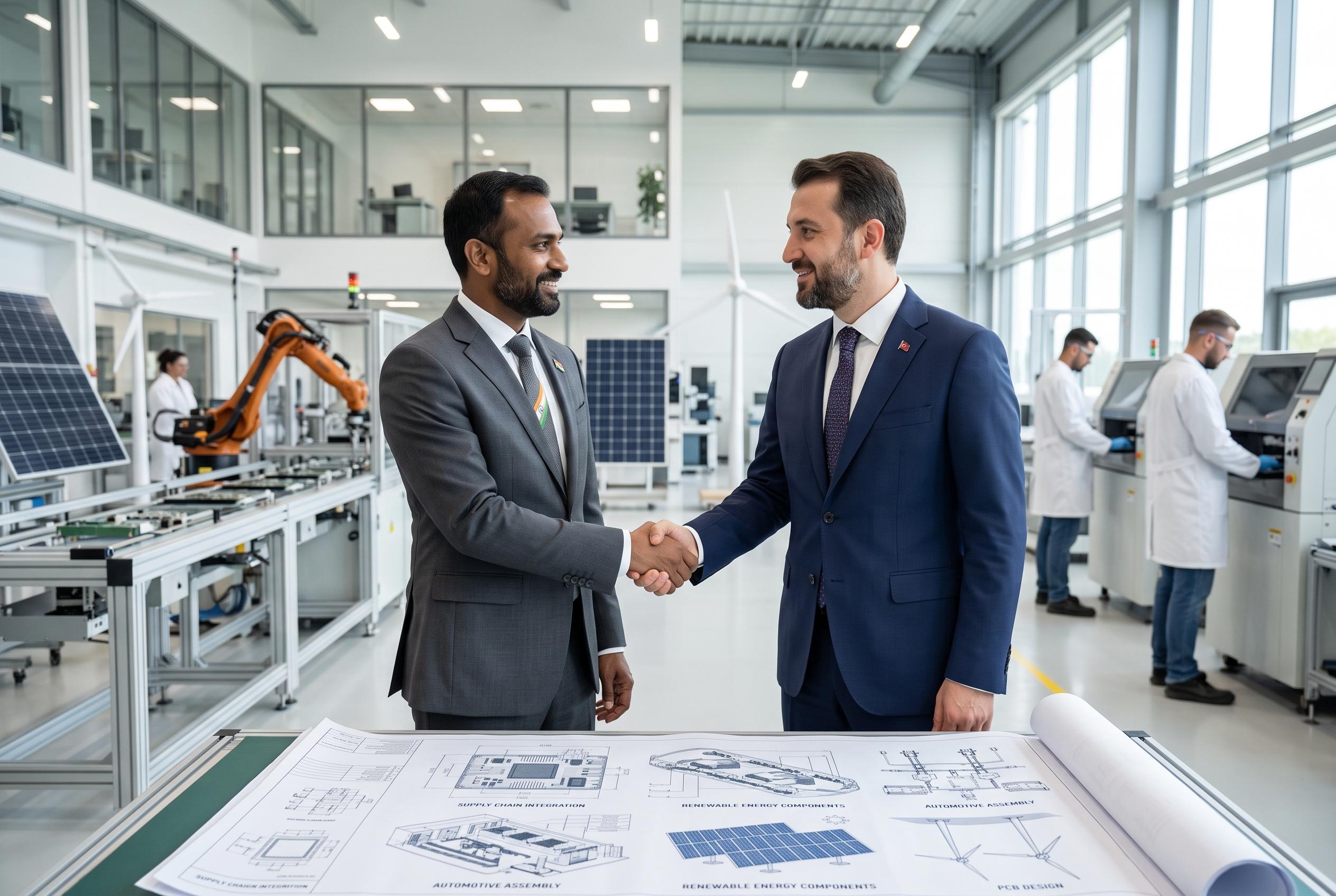

Amid increasing efforts to develop their industrial sectors, India and Türkiye are urged to shift from competing through subsidies to collaborating on specialised supply chains in electronics, automotive, and renewable energy sectors, promising more sustainable growth.
India and Türkiye are each trying to climb higher up the industrial ladder, but they are doing so in ways that could easily pull them into competition rather than partnership. India has recently expanded support for electronics components, while Türkiye’s HIT-30 programme is targeting semiconductors, mobility and green energy. Taken together, the two strategies suggest a familiar risk: both countries may end up subsidising the same multinational firms to build separate plants for the same products.
A better approach would be to divide work, not ownership. Instead of each side trying to win a whole factory, the two economies could specialise within the same product line, with firms in both countries qualifying for different stages of manufacture and selling beyond the bilateral market. Automotive electronics, railway equipment, renewable-energy hardware, machinery parts and industrial software are the most plausible starting points. In those sectors, the prize is not a single headline investment, but a workable supply chain that can be used in more than one country.
The policy backdrop shows why that matters. India’s Electronics Component Manufacturing Scheme, approved by the Union Cabinet in March 2025 and later launched with detailed guidelines, is designed to strengthen domestic component production, reduce import dependence and deepen integration with global value chains. The government says the programme covers passive electronic components, camera and display modules, Li-ion cells, printed circuit boards and related equipment, with incentives linked to performance and investment. Türkiye’s HIT-30 plan, meanwhile, is explicitly focused on building value chains in semiconductors, mobility, green energy and advanced manufacturing, including batteries, solar cells, wind systems and chip packaging. Both are ambitious, but ambition alone does not create complementarities.
The current commercial relationship between the two countries is still too shallow to support a true industrial partnership. Trade is expanding, but it remains concentrated in relatively basic goods on one side and finished parts on the other. Direct investment is also limited. That is why the relationship looks more like ordinary commerce than joint manufacturing. If the next phase is to be different, it will require more than a few investment announcements and more than a hope that geography can be turned into strategy.
Automotive electronics is the clearest place to begin. India has a growing base in components and vehicle electronics, while Türkiye already has an established automotive supplier network and a significant export-oriented manufacturing sector. A practical division of labour might see one side making flexible circuits, sensor modules or power-electronics boards, while the other supplies housings, tooling, thermal-management parts or system integration. The standard should be commercial qualification, not diplomatic symbolism. Each country should be able to own a demanding part of the process and still sell the finished component into third markets.
Rail and renewable energy offer similar possibilities, but only if both governments resist the temptation to duplicate entire ecosystems. India already has a substantial railway manufacturing base, while Türkiye’s machinery and control-system firms could contribute niche capabilities in maintenance, electronics and subassemblies. In solar and wind, the real opportunity may lie in inverters, monitoring software, control systems, battery-management units and selected mechanical parts, rather than in building two parallel protected chains for every product. According to the official outlines of HIT-30 and India’s component scheme, both countries are trying to strengthen critical capabilities; the challenge is to do so without wasting capital on redundant assembly lines.
That will require a more disciplined industrial framework. Mutual recognition of test results, clear rules for re-exported inputs, protection for jointly developed software and conditions tied to actual purchase orders would all make cross-border sourcing easier. The two governments should revive their long-dormant economic committee with a narrow task: identify components that one country can credibly supply and the other can qualify within two years. The most useful measure would not be the size of a factory announced at a press conference, but the number of certified parts, repeat orders and sales into wider markets. If India and Türkiye can reach that point, they will have built something more durable than a subsidy race.
Disclaimer: This content is intended for informational purposes only. Readers are advised to exercise their own judgement, conduct due diligence, or consult a qualified expert before acting on any information provided.