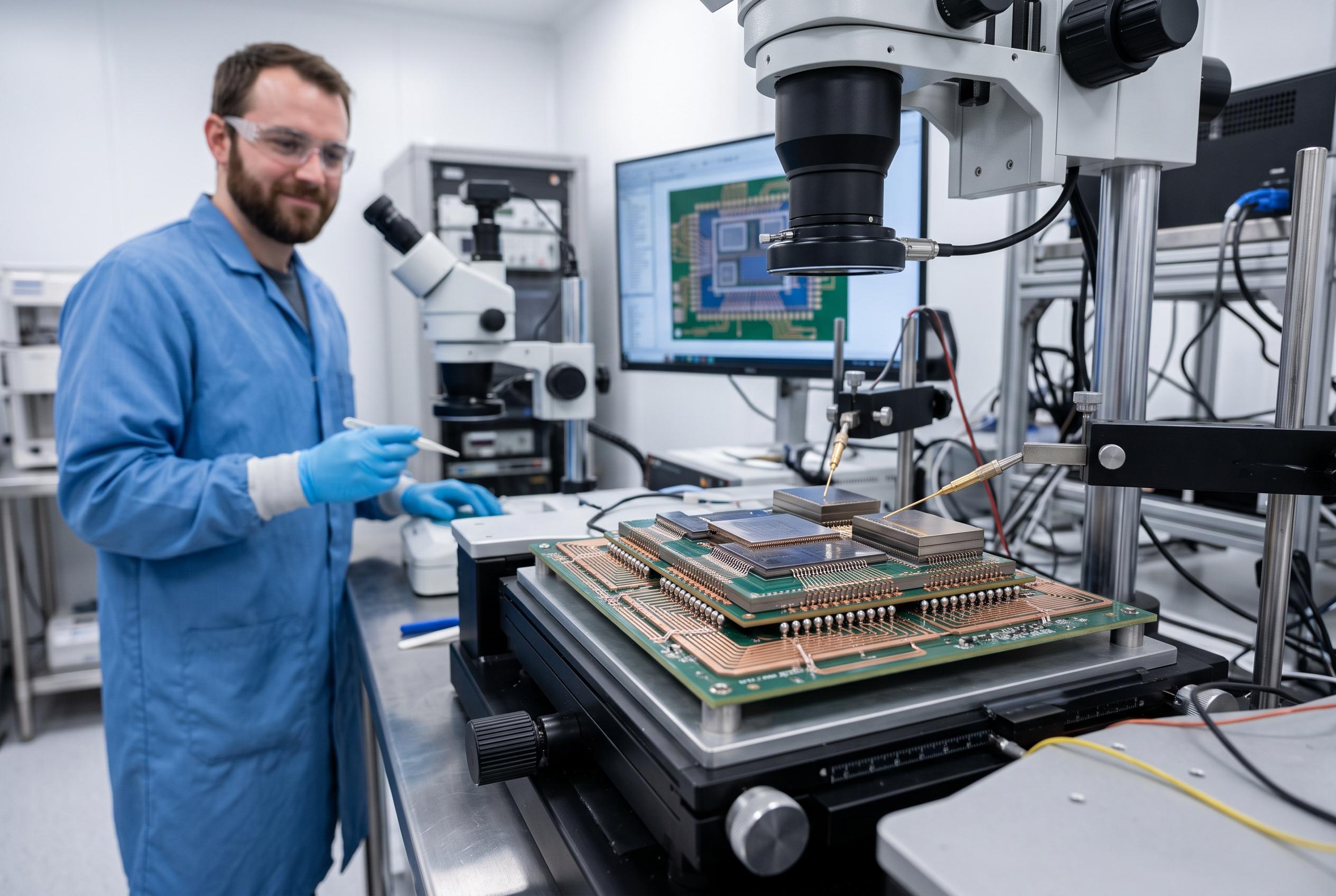

As AI accelerates demand for high-performance chips, advanced packaging becomes the new battleground, with TSMC leading a reshaping industry where integration and system complexity are key to future growth.
The semiconductor business is being reshaped less by smaller transistors than by how chips are assembled around them. In a market now dominated by AI accelerators and custom AI chips, advanced packaging has become a central source of performance gains, while much of the industry’s older logic around wafer scaling looks increasingly incomplete. The essay that prompted this piece argues that the most important change is not at the front end of manufacturing, but in the integration of compute, memory and networking at the back end.
That shift is visible in the numbers. Tom’s Hardware reported that the global foundry market reached a record $320 billion in 2025, up 16% year on year, with TSMC accounting for 38% of the market. The same report said the industry now uses a broader “Foundry 2.0” definition that includes pure-play foundries, non-memory IDMs, OSATs and photomask suppliers. Under that framework, pure-play foundries grew fastest, while OSATs also expanded, helped by the build-out of advanced packaging for AI systems.
TSMC sits at the centre of that change. According to Tom’s Hardware, the company posted record quarterly revenue of $33.1 billion in the third quarter of 2025, driven mainly by AI and high-performance computing demand, which accounted for 57% of wafer sales. The company later raised its full-year outlook and its capital spending plan for 2026, reflecting continued pressure on leading-edge capacity and packaging. Another report from Tom’s Hardware said TSMC has continued to increase investment in advanced fabs and packaging, while warning that higher input costs and geopolitical risks could affect margins.
The broader implication is that growth in semiconductors is becoming more uneven. The essay notes that the current cycle has outpaced the last peak-to-peak expansion, but much of the gain is concentrated in a small number of companies. That is consistent with Tom’s Hardware’s finding that TSMC’s annual growth far outstripped most rivals, while some Chinese foundries benefited from localisation efforts and non-memory IDMs grew far more slowly. The result is an industry in which revenue can surge without that growth spreading evenly through the supply chain.
That imbalance is especially clear in OSATs, where AI-related demand is strengthening utilisation and pricing, but mobile and other consumer lines remain weak. The essay argues that advanced packaging capacity is now a strategic constraint, particularly for TSMC, which has already outsourced parts of its CoWoS flow to partners such as SPIL. Tom’s Hardware’s reporting on Foundry 2.0 also points to advanced packaging as a critical bottleneck and a growth area, with capacity expected to keep expanding in 2026. In practice, that means the next stage of semiconductor competition may be decided less by process-node headlines than by who can assemble the most complex systems fastest, and at acceptable cost.
Disclaimer: This content is intended for informational purposes only. Readers are advised to exercise their own judgement, conduct due diligence, or consult a qualified expert before acting on any information provided.