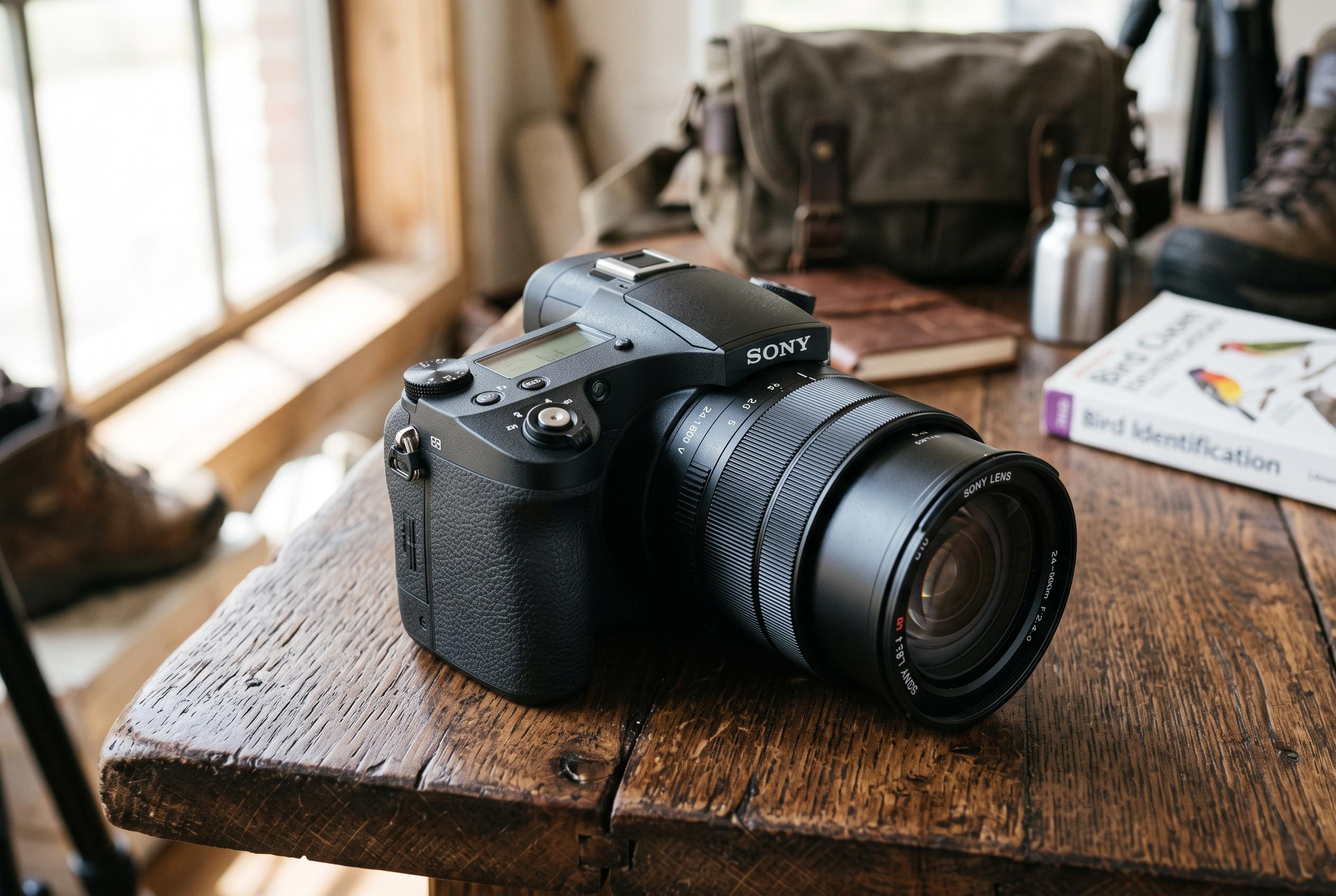

Sony has updated its long-standing RX10 line with the RX10 V, featuring advanced autofocus, high-quality 4K video, and a robust build, positioning it as a premium all-in-one travel and wildlife camera.
Sony has revived its long-dormant super-zoom line with a camera that feels oddly out of time and yet entirely current. The RX10 V keeps the formula that made the series distinctive: a 20.1-megapixel 1in stacked sensor paired with a Zeiss 24-600mm equivalent f/2.4-4 lens. According to Sony’s launch material and the independent reviews that followed, the point is not novelty for its own sake but a broad upgrade to the parts that matter most: autofocus, processing, burst shooting, video and handling.
The result is a bridge camera that tries to behave more like an Alpha body than a compact with a fixed lens. DPReview and TechRadar both note the new BIONZ XR processor, the dedicated AI unit and the expanded subject-detection system, which recognises people, animals, birds, insects, cars, trains and aircraft. Sony also claims blackout-free shooting at up to 30 frames per second with full AF and AE tracking, a substantial step up from the older model’s 24fps ceiling.
Sony has also addressed the RX10 IV’s handling shortcomings. Reviewers highlight the larger grip, AF joystick, AF-ON button, higher-resolution 3.68-million-dot electronic viewfinder and 1.62-million-dot tilting rear screen. The new body keeps the all-in-one approach but loses some conveniences, including the built-in flash and top LCD, while gaining USB-C charging and UHS-II card support. Those are practical changes, not cosmetic ones.
Video is one of the clearest advances. Sony says the RX10 V can record 4K at up to 120fps, with full-width 4K 60p and cropped 4K 120p, all in 10-bit. Independent testers describe the camera as a serious jump over the RX10 IV in motion work, especially for users who want a single body for travel, wildlife and sports without moving into a full interchangeable-lens system.
That said, the image-quality story is more restrained than the spec sheet might suggest. DPReview’s studio testing found that, despite the newer processor and faster readout, the 20-megapixel stacked Type 1 sensor does not dramatically outperform its predecessor. That is a familiar limit of the format: Sony has clearly improved speed, responsiveness and autofocus, but the underlying sensor class remains the main constraint on low-light performance and dynamic range.
Pricing reinforces the RX10 V’s unusual position. Sony lists the camera at about $2,300, while reviews published in early August 2026 place it firmly in premium territory for a fixed-lens bridge. That makes it far more expensive than most rivals in the class and closer, in practical buying terms, to an enthusiast mirrorless body with one or two lenses. The appeal is obvious: one camera, one lens, 24-600mm coverage and no compromise on reach. The cost is equally clear.
Disclaimer: This content is intended for informational purposes only. Readers are advised to exercise their own judgement, conduct due diligence, or consult a qualified expert before acting on any information provided.