
Apple’s HomePod, Amazon Echo, and Google Home all listen locally for wake words, but diverge significantly in data handling, physical controls, and privacy safeguards, shaping user trust and security.
HomePod, Amazon Echo and Google Home all begin with the same basic privacy compromise: their microphones must keep listening locally for a wake phrase before any assistant can respond. Apple says HomePod does not send audio to its servers until it hears “Hey Siri” or “Siri”, or until a user presses and holds the top of the device. Google and Amazon use similar on-device wake-word detection before handing a request to the cloud.
The main differences emerge after that first trigger. Apple says Siri requests are linked to a random identifier rather than an Apple Account, with communication encrypted in transit and request data kept separate from the broader account used for mail, purchases and other services. Apple’s privacy materials also say searches and requests are associated with a random identifier, not the user’s Apple Account, and that Private Cloud Compute data is not stored or made accessible to Apple. By contrast, Alexa activity is tied to the Amazon account used on the speaker, which makes it easier to review recordings and transcripts but also places voice history inside a wider commerce profile. Google’s Home and Nest privacy pages likewise show that Assistant and Home data are handled through a Google Account, with retention and deletion controls set by the user.
Retention policy is another dividing line. Apple says audio is not stored by default and that people must opt in if they want Apple to keep and review samples for Siri and Dictation improvement, although transcripts and related request data can still be held for service improvement. Google says its Home and Nest settings let users manage, export and delete data, and the company’s current Home privacy model includes account-based retention controls for connected-home activity. Amazon offers more granular choices for Alexa history, including automatic deletion windows and the option not to save voice recordings, though other records linked to orders, reminders or skills may remain.
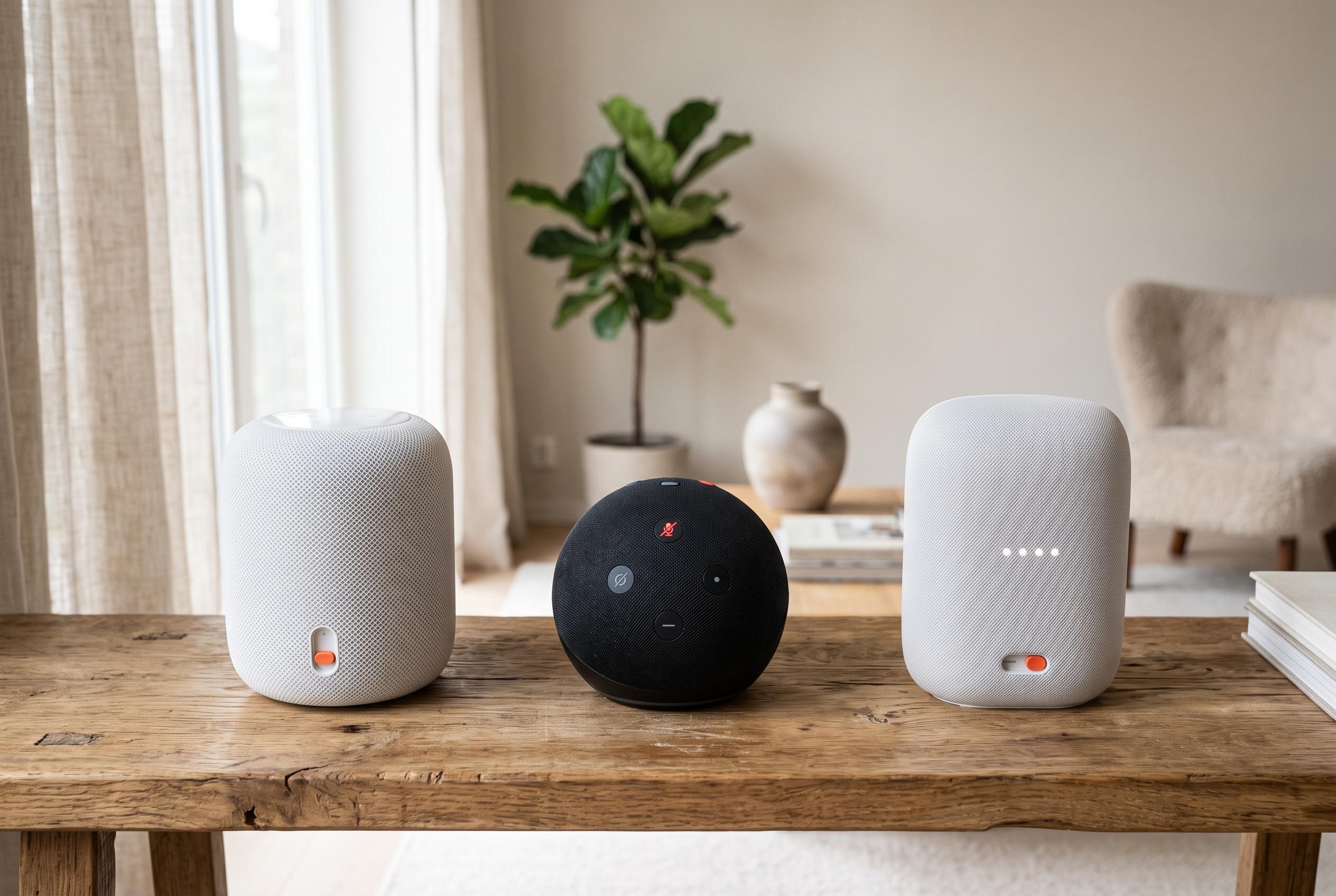
Physical controls are where the comparison becomes most obvious. Echo devices include a microphone-off button that electrically disconnects the microphones, and many Google speakers and displays have a hardware switch or button that disables the mic and shows a visible indicator. HomePod, however, has no comparable physical mute switch, leaving owners to rely on software settings or unplug the device entirely. That may be acceptable for casual use, but it is a weaker safeguard than a hard disconnect when someone wants certainty that the room cannot be heard.
The privacy question also extends beyond speech. Home systems can reveal routines through lights, thermostats, locks, cameras and motion sensors, even when nobody speaks to a speaker. Apple says Home data is encrypted and that HomeKit Secure Video is processed with end-to-end encryption, while Google and Amazon offer their own smart-home histories, camera features and automation logs that can be reviewed or deleted through account settings. In practice, HomePod offers the cleanest default separation from advertising and account profiling, but Echo and Google Home give users stronger physical mute controls. For households deciding between them, that trade-off matters more than the wake phrase itself.
Disclaimer: This content is intended for informational purposes only. Readers are advised to exercise their own judgement, conduct due diligence, or consult a qualified expert before acting on any information provided.