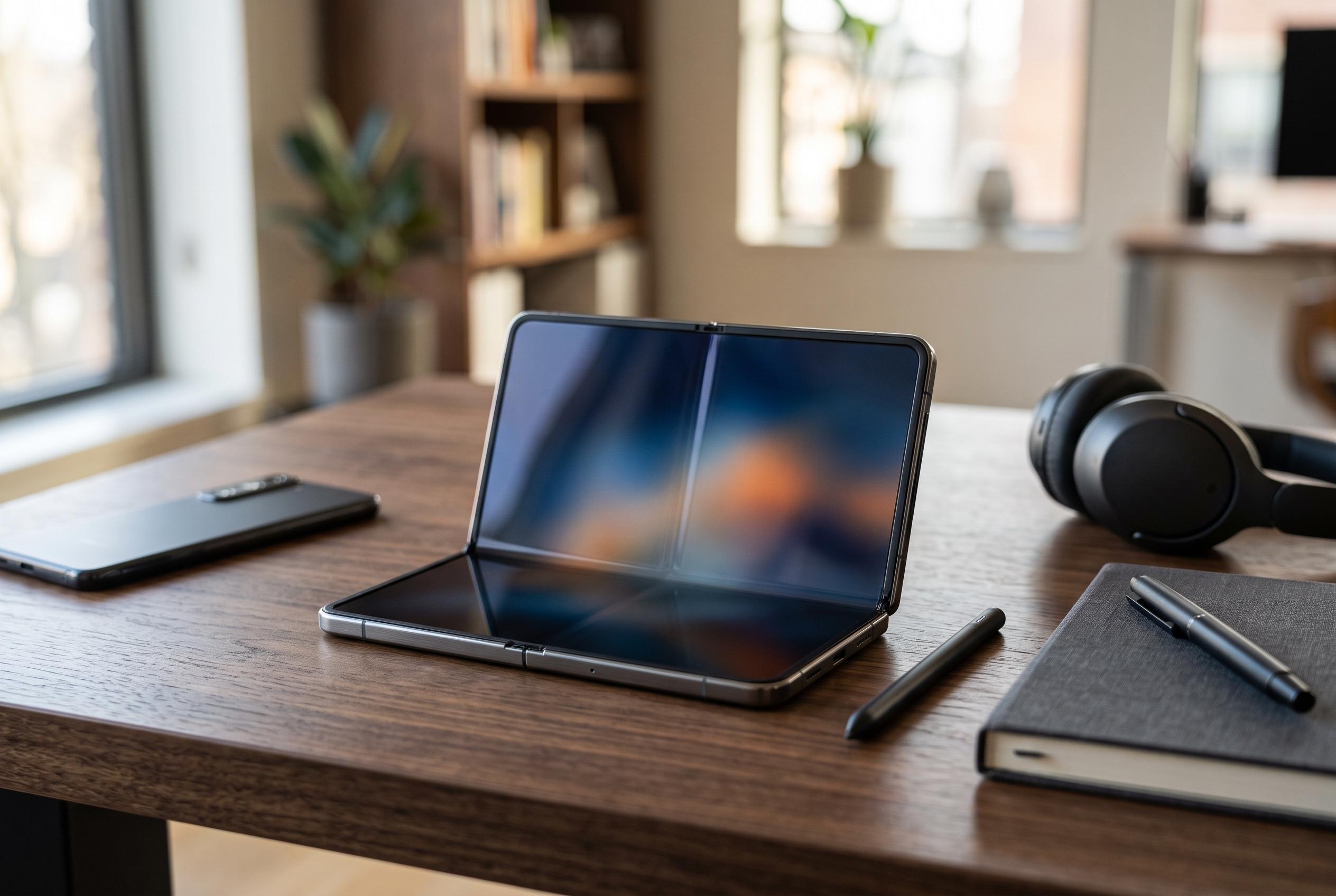

Samsung unveils its most polished foldable yet with the Galaxy Z Fold8 Ultra, emphasising productivity features and design enhancements to elevate its premium position despite a high price tag.
Samsung’s first Ultra-branded foldable is an impressive but expensive refinement of the book-style format. After a month of testing, the Galaxy Z Fold8 Ultra comes across as a device built less to reinvent the category than to remove many of the compromises that have long defined it. Its slimmer body, stronger hinge and much less visible crease make it feel closer to a conventional premium phone when folded, while the unfolded screen gives it a clear advantage for multitasking, note-taking and desktop-style productivity. Reuters has not covered the device directly, but the broader review consensus is that Samsung has made its most polished foldable yet.
The hardware helps explain that verdict. The handset pairs a Snapdragon 8 Elite Gen 5 chip with 12GB or 16GB of RAM, storage up to 1TB, and a 5,000mAh battery based on silicon-carbon battery technology, according to Android Central and other reviews. Samsung’s claim of seven years of software support, taking updates to 31 July 2033, is also significant for a product in this price bracket. At launch in Spain, the device costs 2,150 euros for the 256GB model, rising to 2,350 euros for 512GB and 2,750 euros for the 1TB version, placing it firmly in ultra-premium territory.
The display is one of the Fold8 Ultra’s strongest points. Its 6.5-inch cover screen and 8-inch inner panel are both Dynamic AMOLED 2X displays with 120Hz refresh rates, while the inner panel’s anti-reflective coating and peak brightness of 3,000 nits make it noticeably easier to use outdoors. That said, the large inner screen still shows familiar foldable limitations: the crease is reduced but not eliminated, and some app layouts, particularly on video and social platforms, still leave awkward black bars when stretched across the wider canvas. What Samsung gains in versatility, it does not fully resolve in content optimisation.
Battery life is good rather than class-leading. In regular use, the phone generally reaches the end of the day with a modest reserve, but heavy navigation or camera use shortens endurance quickly. Charging at 45W gives it a useful boost, with Samsung claiming roughly 67 per cent in 30 minutes using a compatible charger, while 20W wireless charging adds convenience for desk or car use. In practice, that puts it ahead of many foldables, but still below the very best non-folding flagships for stamina.
The camera system is another area where Samsung has chosen evolution over reinvention. The rear array combines a 200-megapixel main camera, a 50-megapixel ultra-wide and a 10-megapixel telephoto lens with 3x optical zoom. Reviewers have generally found the main camera sharp and natural, especially in good light, and the ultra-wide more capable than before. The telephoto unit, however, remains the weakest part of the package, and moving subjects can still expose the limits of the system. Creative Bloq found the Ultra clearly superior to the standard Fold8 for detail and zoom, but also noted that the cheaper model is more practical for everyday use.
Software and AI are central to Samsung’s pitch. One UI 9 on Android 17 makes better use of the folding form factor than most rivals, with split-screen modes, floating windows and Flex Mode all designed to support genuine multitasking. Galaxy AI features such as Circle to Search, image editing tools, Now Brief and Gemini integration add genuine utility for power users, although not every owner will need them. Audio is competent through stereo speakers, but not exceptional, and media fans may still prefer a slab-style flagship for richer sound and a simpler aspect ratio. The result is a highly accomplished foldable that strengthens Samsung’s lead, even if its price and battery limits stop it being the obvious choice for everyone. According to reviews from Android Central, What Hi-Fi? and Tom’s Guide, it is best understood as a productivity-first device for users willing to pay for the most mature foldable experience available.
Disclaimer: This content is intended for informational purposes only. Readers are advised to exercise their own judgement, conduct due diligence, or consult a qualified expert before acting on any information provided.