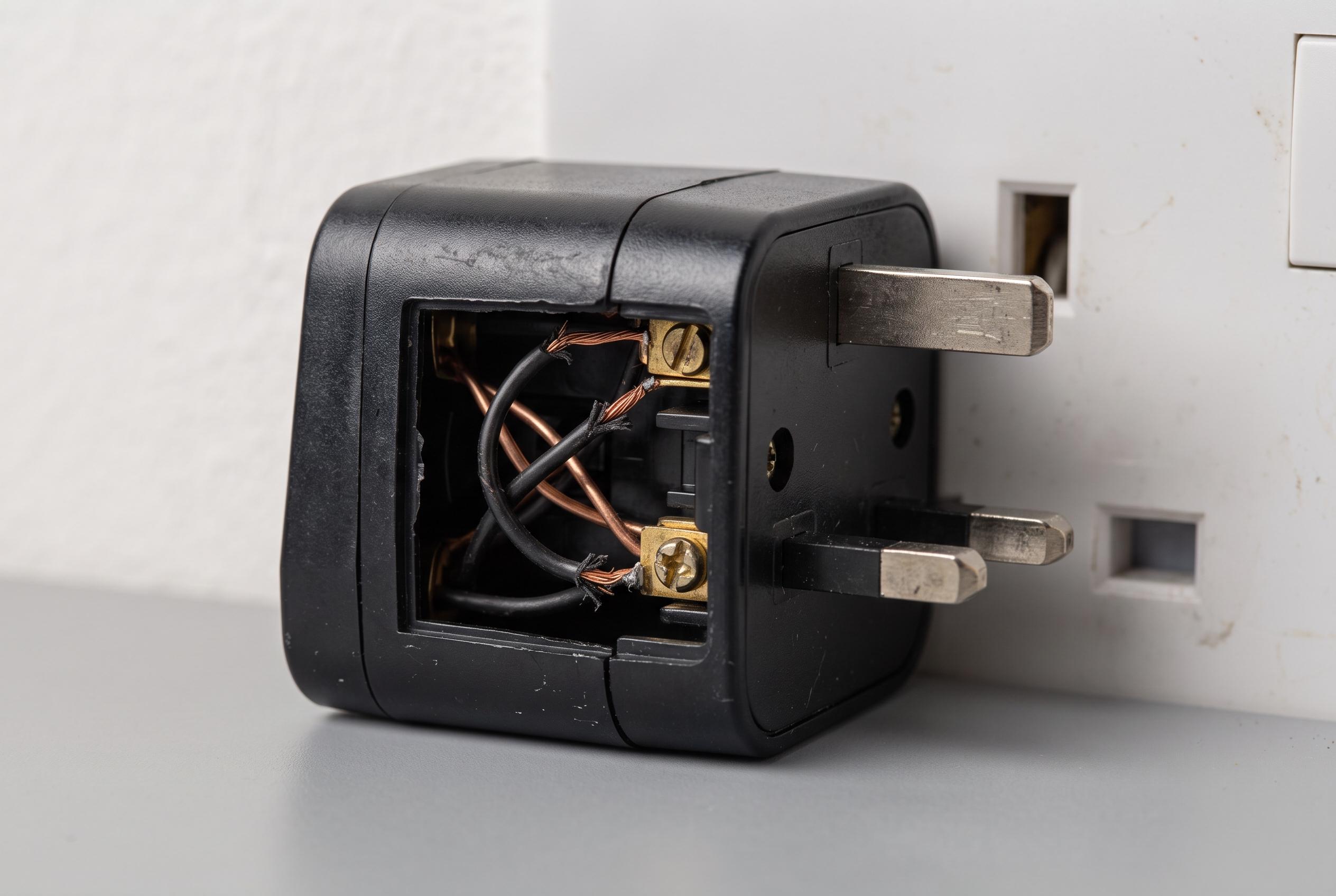

Investigations reveal that cheap universal travel adapters, often marketed for convenience, can be dangerously unsafe due to internal wiring flaws and non-compliance with safety standards, raising concerns over their use for extended periods.
Cheap universal travel adapters promise convenience, but the internal design can make that convenience fragile and unsafe. Hackaday, examining a budget model bought for $9.26 by [Brainiac 75], found that its three sets of mains prongs were effectively hard-wired together, so whichever plug was in use energised the others at the same voltage. The adapter did keep the exposed pins dead when fully retracted, but the mechanism did not force that safer position, leaving room for user error.
The teardown also showed that the unit’s two USB ports were little more than a basic 5V, 2.1A charger, without any sophisticated charging control. Inside, the sliding plug assemblies fed into a central bus bar whenever they were unfolded or extended. That layout is simple, but it does not prevent more than one plug standard from being exposed at once, which is exactly the sort of design shortcut that increases the risk of accidental contact.
That concern is not merely theoretical. In a separate product safety report, the UK government said a Decqle Universal Travel Adapter failed to meet BS 1363 requirements and had an undersized fuse, creating a serious fire risk. Officials rejected the import at the border, underlining how small manufacturing compromises can have serious electrical consequences.
Safety specialists have long warned that travel adapters are meant for short-term use, not continuous loads. Brennenstuhl cautions against using them for appliances such as heaters or refrigerators over long periods, while other industry guidance notes that loose fits, sparking and contact resistance can lead to overheating, arcing and fire. In that context, [Brainiac 75]’s decision to remove the less useful US and UK plugs and turn the device into a simple USB charger with a single universal inlet looks less like a hack and more like a correction to the original design’s risks.
Disclaimer: This content is intended for informational purposes only. Readers are advised to exercise their own judgement, conduct due diligence, or consult a qualified expert before acting on any information provided.