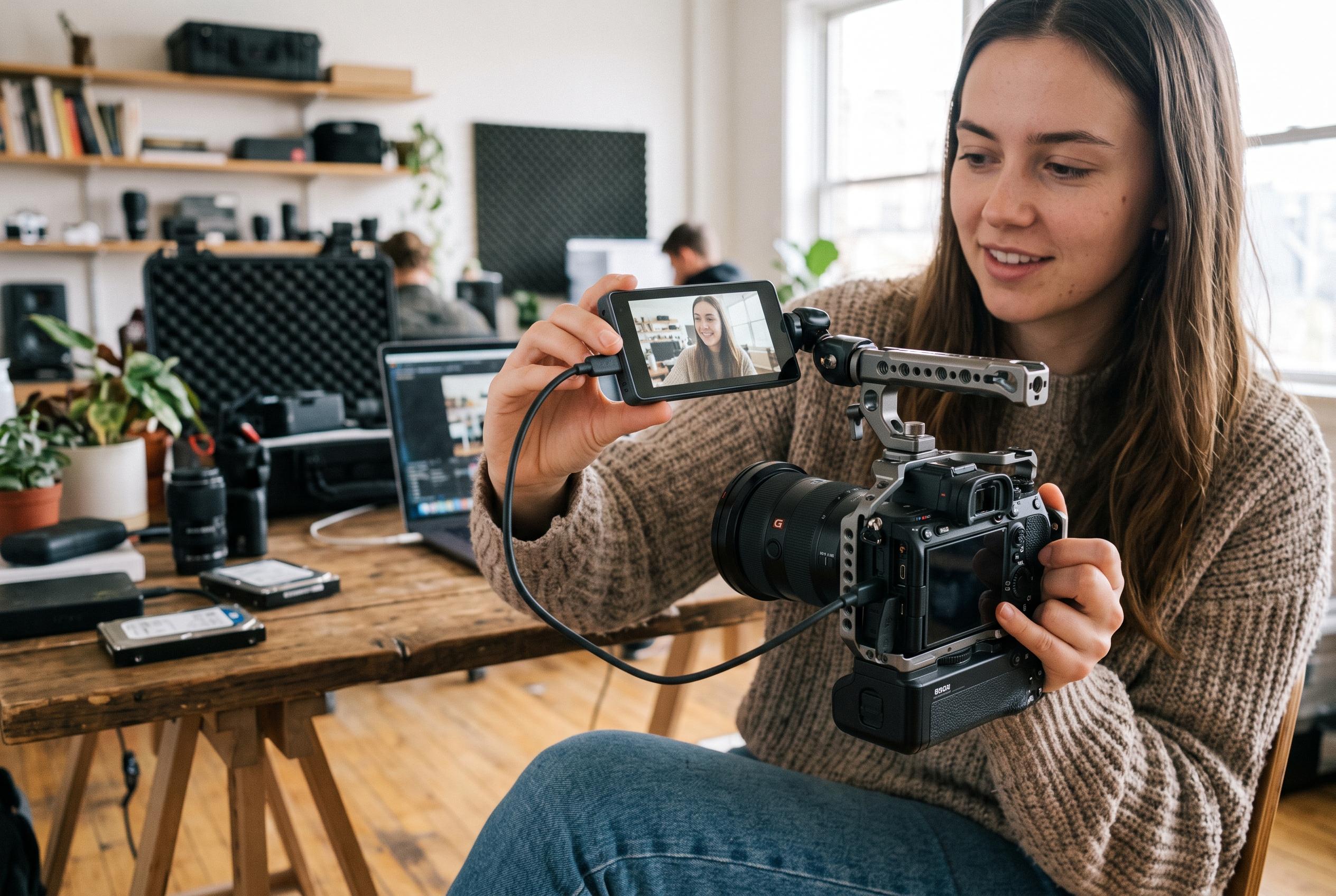

The new Insta360 Snap Selfie Screen emerges as a practical, wired alternative to wireless selfie monitors, offering quicker responsiveness and enhanced usability for creators on the move, compared to older wireless rivals like SmallRig.
A clearer consensus has emerged around these rear-camera selfie monitors since the spring launch cycle: for most solo creators, Insta360’s Snap is the more convincing tool, because it replaces a lag-prone wireless link with a magnetic screen that connects directly over USB-C. Tom’s Guide’s John Velasco, testing on an iPhone 17 Pro, described it as a strong answer to the long-running problem of using a phone’s better rear cameras for selfies and vlogs, while TechRadar argued that the wired approach removes many of the compromises it had previously encountered with SmallRig’s wireless rival. Macwelt reached a similar conclusion after hands-on testing, praising the immediacy of the connection and the security of the magnetic mount. (tomsguide.com)
The product itself is relatively new. Insta360’s official specifications say the Snap Selfie Screen and the Snap Selfie Screen with Light were released on 5 March 2026, and launch coverage from Digital Camera World and T3 described them as compact 3.5-inch touchscreen monitors that let a phone’s rear cameras double as selfie cameras. T3 reported two variants: a standard model and a version with an integrated light developed with AMIRO. At launch, it listed pricing at $80 and $90 in the US, £73 and £88 in the UK, €86 and €96 in Europe, and AU$140 and AU$155 in Australia. (onlinemanual.insta360.com)
The hardware is simple, but that simplicity cuts both ways. iGeneration measured the unit at 103 x 67.5 x 8.2 mm and said it uses a built-in 8cm USB-C cable, while Macwelt put the weight at about 89g and said the light-equipped model still feels slim enough to carry easily. Both publications described a fold-over protective cover, and Digital Camera World noted that when opened it sits over much of the phone’s main display during use. Tom’s Guide liked the modular, MagSafe-style attachment, but singled out the fixed cable as the main drawback because it limits how flexibly the screen can be used away from the handset. (igen.fr)
What reviewers repeatedly liked was the day-to-day behaviour. Tom’s Guide said the display mirrored the phone reliably and worked with apps such as Instagram and TikTok, while TechRadar said the plug-in design avoids the interference and delay that can affect wireless monitors. Macwelt reported no pairing step and no noticeable latency problems, and said the side mirror button is particularly useful because it corrects text and facial movement in preview. On iPhone, however, several reviewers noted an awkward software caveat: touch input on the Snap requires Apple’s Zoom accessibility setting to be enabled first. Tom’s Guide added that the monitor also mirrored a Galaxy S26 with full touch support and no extra setup. (tomsguide.com)
Those gains come with meaningful limits. T3 and Macwelt both noted that the Snap has no battery of its own and draws power directly from the phone, which reduces clutter but increases drain on the handset. Macwelt also said the accessory becomes noticeably warm in longer sessions and flagged a practical issue on the iPhone 17 Pro: the folded cover can obstruct the dedicated camera control, making it sensible to move shutter duties to a volume key instead. Compatibility is also narrower than the broad “iPhone and Android” marketing language implies. iGeneration reported that an iPhone Air would not work, and said the iPhone 16e, iPhone 17e and older Lightning models were unsupported because they lack the required output path. Insta360’s current compatibility page similarly excludes iPhone 17 Air, iPhone 17e, iPhone 16e and iPhone Air, while limiting supported Apple models to the iPhone 15, 16 and 17 lines apart from those exceptions. (macwelt.de)
That leaves SmallRig with a narrower but still real argument in its favour. TechRadar said its wireless Phone Vlog Selfie Monitor remains useful because it can be used away from the phone, which matters if the screen needs to sit off-device on a small stand or at a distance during tripod work. Yet the same review was blunt about the trade-offs: latency worsened on longer recordings, the display lacked touch controls, brightness was underwhelming and battery life was not especially impressive. For creators who need a remote monitor first and foremost, that may still be acceptable; for anyone trying to turn a flagship phone into a fast, hand-held vlogging camera, it is a more awkward compromise. (techradar.com)
Taken together, the spring 2026 coverage points to a fairly straightforward split. The newer Insta360 device is better thought through for quick, hand-held shooting, short-form video and any workflow where reliable framing matters more than cable-free neatness. It is lighter than the wireless alternative, avoids pairing, adds touch control, and in the light-equipped version provides adjustable fill lighting in a form factor several reviewers described as genuinely pocketable. The older SmallRig concept still suits users who value distance from the phone above all else, but the broader direction of the market now appears to favour the wired, magnetic monitor as the more dependable solution. (tomsguide.com)
Disclaimer: This content is intended for informational purposes only. Readers are advised to exercise their own judgement, conduct due diligence, or consult a qualified expert before acting on any information provided.