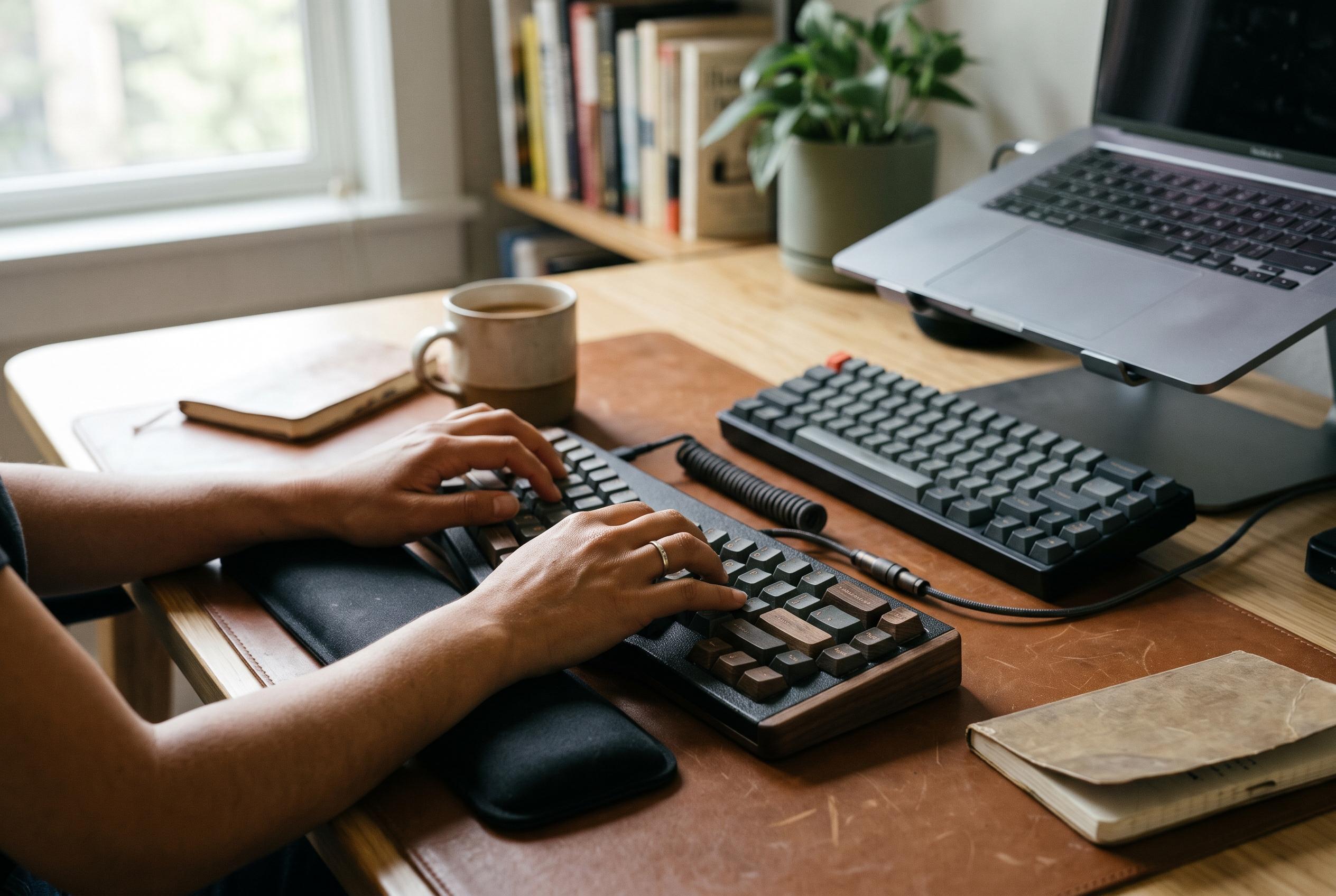

The Verge’s staff picks show how daily typing needs shape keyboard choices, from ergonomic split designs and custom builds to quiet, dependable defaults.
For a device so ordinary, the keyboard still says a great deal about how people work. The Verge’s staff accounts show a broad split between those who prioritise ergonomics, those who care most about sound and feel, and those who simply want something dependable enough to disappear into the background. Split boards, compact mechanical models, Apple’s slim wireless units and even laptop keys all appear in the mix, underscoring that the best keyboard is usually the one that fits a person’s habits rather than a universal standard.
For Jay Peters, that means a Kinesis Freestyle Pro, a split mechanical board designed to relieve strain by letting the two halves sit apart, with optional tenting accessories to change the typing angle. Kinesis’s own manual describes the Freestyle Pro as a tenkeyless, programmable keyboard with SmartSet programming, onboard memory and support for custom layouts including Mac and Dvorak. That helps explain why a user who once had wrist pain might remain loyal to it for years.
Kallie Plagge’s setup is more mixed. At work she uses a Keychron K2, a compact wireless mechanical keyboard that Keychron says supports macOS, Windows and Linux and connects over Bluetooth or USB-C. For gaming, however, she switches to Logitech’s G713, a tenkeyless wired board from the company’s Aurora line with a palm rest and GX mechanical switches. The smaller layout and included wrist support suit a desk where space matters as much as feel.
Danielle Steussy has stayed with Apple keyboards for more than two decades, beginning with an earlier Mac-era model and continuing through Apple’s wireless Magic Keyboard range. Apple’s current line includes versions with a numeric keypad and Touch ID, which fits the preference for a full-size layout that feels familiar and largely unobtrusive. Her account also highlights a common trade-off with low-profile boards: the comfort of long muscle memory against the annoyance of wear on the key legends and the occasional Bluetooth hiccup.
David Pierce’s preference story is less about loyalty than compromise. He likes the experience of typing on mechanical boards, but says he has been pushed back towards Apple’s Magic Keyboard because quieter keys matter in shared working environments and because Touch ID simplifies repeated password entry. Logitech’s MX Keys S, which the company describes as an illuminated wireless keyboard built for fast typing and device switching, sits in the same practical category: useful, restrained and chosen for convenience rather than personality.
Jacob Kastrenakes takes the opposite route, treating the keyboard as something worth curating for its own sake. His setup is a custom mechanical build, chosen for appearance as much as function, with matching case and keycaps that make the whole arrangement feel deliberate. The trade-off is familiar to anyone who has entered the hobby: more cost, more noise and often less efficiency than a plain office board, but a stronger sense that the machine on the desk belongs to its owner.
Antonio G. Di Benedetto’s attachment is to a budget 65 per cent kit he bought and modified himself. That sort of board reflects the appeal of the mechanical keyboard hobby at its most hands-on: switches, keycaps and other parts can be swapped until the typing feel is right, or at least interesting. Even if the market now offers cheaper boards that sound better out of the box, the appeal of making one’s own remains part of the story.
Other staff members are more pragmatic. TC Sottek has settled on a compact Keychron K2 after losing several expensive boards to accidents, a reminder that durability and price can matter more than prestige. Emma Roth uses a Corsair K55 RGB Pro, bought second-hand, and is now contending with software faults that have made backlit keys harder to read. Meredith Haggerty, by contrast, simply uses the M2 MacBook Air provided by her employer, a reminder that the default option is often the one most people rely on.
The more enthusiast-driven choices cluster around NuPhy, Kinesis and other compact mechanical designs. Andrew J. Hawkins says he came late to mechanical keyboards but was won over by NuPhy’s Air75, while Stevie Bonifield has spent a year on a NuPhy Halo75 V2 and values its solid build, wireless options and compatibility with both Mac and Linux. Nathan Edwards alternates between a Leopold FC660C and several Omnitype Bauer Lite boards, showing how some users keep multiple setups around because no single keyboard quite satisfies every preference at once. Elisabeth Lopatto, meanwhile, makes no apology for wanting a clackier split board, because comfort and sound both matter to her work.
Taken together, the staff picks read less like a product ranking than a map of trade-offs. Noise versus silence, portability versus ergonomics, customisation versus simplicity, full-size convenience versus compact efficiency: each writer lands somewhere different. The common thread is that keyboards are not merely accessories. For people who type all day, they shape posture, pace, fatigue and even mood, which is why a tool that looks trivial on paper can become a daily fixture that is hard to replace.
Disclaimer: This content is intended for informational purposes only. Readers are advised to exercise their own judgement, conduct due diligence, or consult a qualified expert before acting on any information provided.