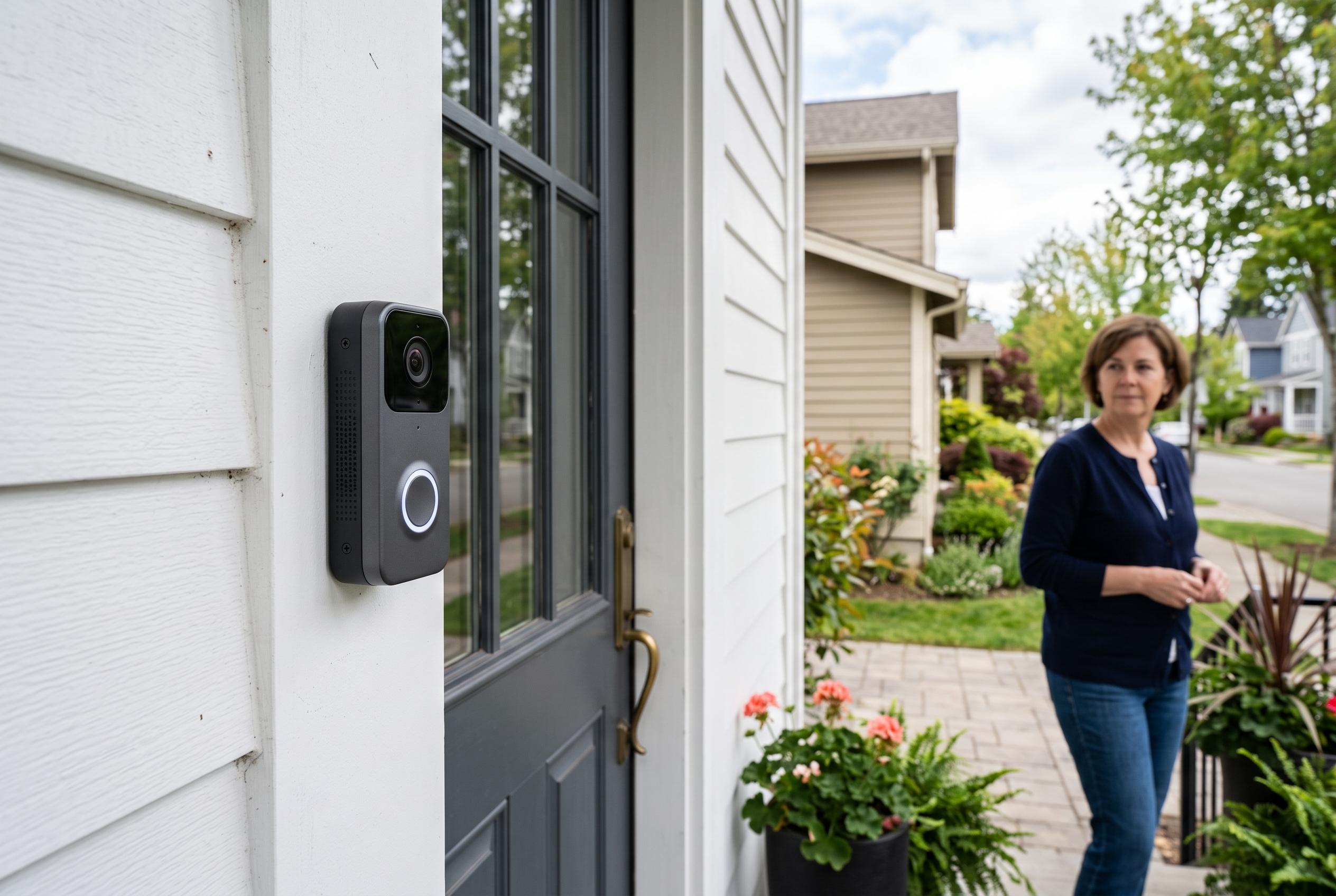

Guidance from the ICO and government emphasises necessity and proportionality when installing smart doorbells, highlighting legal considerations and privacy rights in neighbour disputes such as the notable Fairhurst v Woodard case.
Smart doorbells are not automatically unlawful in the UK, but once they monitor more than the immediate area around a front door they can move from ordinary home security into regulated surveillance. Guidance from the Information Commissioner’s Office and the government says that if a camera captures people beyond the boundary of private domestic property, including a neighbour’s home or garden, a shared entrance, a pavement or part of the street, data protection duties may apply.
That does not mean a device must never record anyone outside the property line. The ICO’s public guidance gives an example of a front-facing camera that catches a small part of the street and passers-by, and says that may still be justified. The key question is whether the set-up is necessary and proportionate. Homeowners are expected to record only what they genuinely need, point the device away from neighbouring property and communal areas where possible, and use privacy masking or filters if a wide angle cannot be avoided. Consent will rarely be the legal basis in these cases; the owner will usually need to show a legitimate security reason that outweighs the intrusion.
Official advice goes further than camera placement. GOV.UK says householders should ask themselves why they need the system in the first place, whether improved lighting or another measure would do the job, whether the camera needs to run all the time, and whether audio is necessary at all. The ICO’s separate guidance on smart doorbells notes that some models can cover up to 180 degrees and may collect sound as well as images, increasing the privacy impact. It also points to practical controls: clear signage, secure storage, sensible retention periods, software and app security, and limiting recording so the camera activates only when the bell is pressed rather than continuously.
The clearest illustration of how a neighbour dispute can escalate is Fairhurst v Woodard, a county court case from Thame, Oxfordshire, decided by Her Honour Judge Melissa Clarke in October 2021 after a hearing in May that year. The approved judgment shows that the dispute was not about a single doorbell. Jon Woodard had a Ring Video Doorbell 2 by his front door, a Ring Spotlight Camera on a shed in his rear garden, another Spotlight Camera mounted on the gable wall of No 85 and aimed down a driveway, and a Nest camera placed on the front windowsill of No 87. Dr Mary Fairhurst, a scientist who lived at No 83, brought claims in nuisance, harassment and data protection law against Mr Woodard, an audio-visual technician.
The layout of the properties was central to the case. The judgment records that Dr Fairhurst’s house was the end property in a terrace, with a driveway and private car park to one side, and that the rear gardens of Nos 83, 85 and 87 backed on to that parking area. Legal analysis of the ruling says the shed camera covered almost the whole of her garden and parking space, while the driveway camera had a view into her side gate and garden. The same reporting says Dr Fairhurst left her home on 29 April 2019 and later asked the court for damages and an injunction requiring the removal of the Ring doorbell and shed camera, along with a ban on further surveillance equipment.
Commentary on the case suggests audio collection was especially important. Mondaq reported evidence that one Ring Spotlight Camera could reliably record speech from about 53 feet away and that the Ring Video Doorbell could do so from about 68 feet away. Whitestone Chambers said Judge Clarke regarded audio capture as “even more problematic and detrimental than video data” because it could pick up private conversations. The same article said Mr Woodard sent Dr Fairhurst an image from the driveway camera while referring to a “suspicious stranger” near his property, which the judge treated as part of a pattern of harassment. The broader lesson is that a system presented as crime prevention can still fall foul of the law if it gathers far more than is needed.
For people who believe a neighbour’s device is filming them improperly, the ICO’s advice is practical rather than dramatic. It suggests starting with a direct complaint, asking what the system records and whether the angle can be changed. The regulator provides a template letter, says individuals may object in some circumstances, and notes that a person can make a subject access request for footage in which they appear. At the same time, the ICO also says it is unlikely to force a homeowner to move a camera simply because an objection has been raised. A complaint is more likely to succeed where the owner cannot show a strong reason for recording beyond the boundary or has failed to minimise the intrusion.
The safest set-up, then, is a limited one. A householder should decide what risk they are trying to address, aim the device as tightly as possible, switch off audio if it is not needed, tell people recording is taking place, protect the footage, and delete it when it no longer serves a purpose. If the camera still reaches a neighbour’s entrance, garden, a shared path or the public pavement, the owner may have to explain why that is necessary and alter the installation if it is not. A video doorbell may be sold as a simple consumer convenience, but the law can treat it as a surveillance system with real obligations.
Disclaimer: This content is intended for informational purposes only. Readers are advised to exercise their own judgement, conduct due diligence, or consult a qualified expert before acting on any information provided.