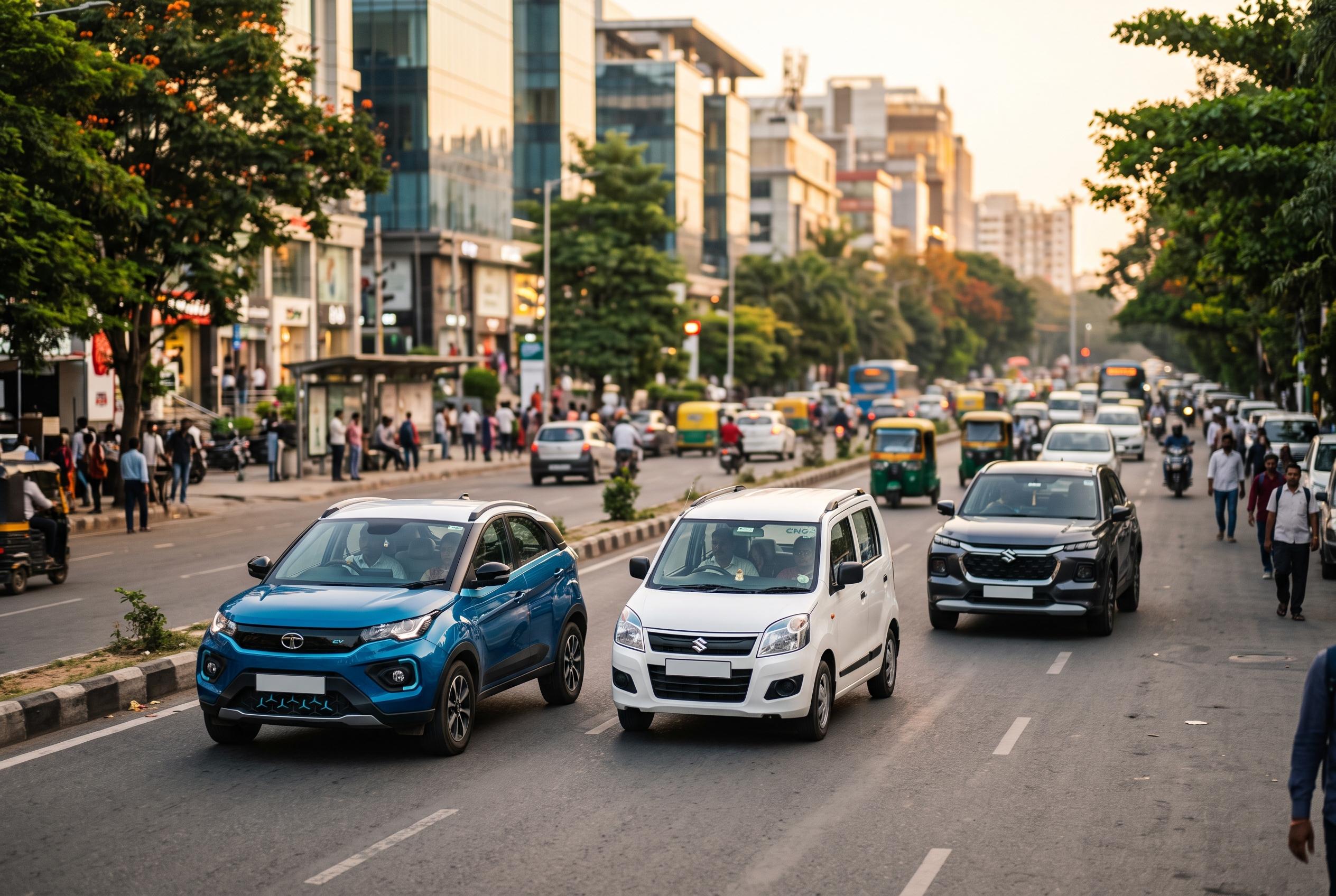

India’s passenger-vehicle sales in August saw a historic shift, with CNG, hybrid, and electric models overtaking petrol, signalling a rapid transition towards cleaner fuels and a broader market shift.
India’s passenger-car market crossed an important threshold in August, with CNG, hybrid and electric models taking a combined 41.95 per cent of retail sales and moving ahead of petrol and ethanol-blended petrol at 40.85 per cent. The change came only a month after alternative fuels had narrowed the gap to just 1.09 percentage points, underlining how quickly the fuel mix is shifting. The Federation of Automobile Dealers Associations said the broader market also posted its strongest August on record in the VAHAN registration system, with total vehicle retails reaching 24,23,201 units. (ddindia.co.in)
The August crossover was driven chiefly by CNG, which alone accounted for 25.28 per cent of passenger-vehicle retail sales. Hybrids added 9.04 per cent and battery-electric vehicles 7.63 per cent, while diesel stood at 17.21 per cent. Passenger-vehicle retails reached 4,02,398 units, up 16.14 per cent from a year earlier and the first time August volume has crossed the 400,000 mark; Autocar Professional said that was 55,930 units higher than in August 2025. Business Standard and Autocar Professional both noted that petrol remained the single largest individual fuel category, but it no longer led once CNG, hybrid and EV sales were grouped together. (business-standard.com)
The background to that shift has been building for months. In July, according to The New Indian Express, alternative fuels had already climbed to 40.59 per cent of passenger-vehicle sales, made up of 24.67 per cent CNG, 8.02 per cent hybrids and 7.90 per cent EVs, against petrol’s 41.68 per cent. That report said the faster-than-expected rollout of E20 fuel had stirred concerns over mileage, possible engine corrosion and the lack of pure petrol for older vehicles. Reuters reported on Monday that the government had dismissed parts of that backlash as “wild claims”, but FADA now says the move away from petrol is being sustained not only by E20 anxiety but also by lower running costs, a wider spread of alternative-fuel models, better EV range and a gradual expansion of charging infrastructure. (newindianexpress.com)
August’s record therefore came with caveats. DD India, Business Standard and The Economic Times all reported that total retails were 6.48 per cent below July’s record level because monsoon conditions softened demand and the boost from Ganesh Chaturthi and Onam shifted into September. FADA president Sai Giridhar also warned that the year-on-year comparison was flattered by a weak August 2025 base, when buyers had delayed purchases ahead of the GST 2.0 rate cut, and said “the true test of the season lies in showroom conversion through September to November, not in year-on-year optics”. (ddindia.co.in)
The strongest support came from rural India. The Economic Times said rural retail sales across all vehicle categories rose 19.79 per cent year on year, ahead of 15.17 per cent growth in urban markets. In passenger vehicles, rural sales rose 24.99 per cent, compared with 10.93 per cent in urban areas. Autocar Professional added that rural markets still represented 39.9 per cent of passenger-vehicle retail, against 60.1 per cent for urban markets, showing that a minority share of volume is nonetheless driving a disproportionate part of growth. In the Times of India, Giridhar said this showed “Bharat” is now a broader-based engine of consumption than the rainfall map alone would suggest. (economictimes.indiatimes.com)
That rural strength was not uniform. The Economic Times and DD India both reported that tractor sales were almost flat year on year, rising only 0.84 per cent, and fell 25.03 per cent from July as a monsoon deficit of about 13 per cent, with 14 states short of rain, weighed on farm-linked demand. Elsewhere, the market was considerably firmer. Business Standard said wheeled construction equipment grew 31.45 per cent, two-wheelers 19.69 per cent, commercial vehicles 14.45 per cent and three-wheelers 8.64 per cent. It also noted that electric two-wheeler share reached 10.68 per cent, the first time it had crossed 10 per cent in a non-festive month. (economictimes.indiatimes.com)
At manufacturer level, Autocar Professional said Maruti Suzuki India remained the largest passenger-vehicle retailer in August with 1,65,200 units and a 41.05 per cent market share, ahead of Tata Motors on 57,841, Mahindra & Mahindra on 50,245 and Hyundai Motor India on 46,987. Yet the channel is carrying more stock than dealers would like. FADA said passenger-vehicle inventory rose to about 38 to 40 days, against its recommended 21-day benchmark, and Business Standard reported that 56 per cent of dealers had higher stock than a month earlier. Dealers have urged manufacturers to keep wholesale billing aligned with real retail demand so working capital is not trapped in ageing inventory. (autocarpro.in)
The near-term tone remains hopeful, but disciplined. FADA’s July survey, published in August by The New Indian Express, found 87.85 per cent of dealers expecting growth through the August-September-October period, with 8.88 per cent looking for a flat market and 3.27 per cent expecting de-growth. Taken together, the July and August figures suggest that India’s vehicle market is not simply expanding; it is being reordered around running costs, rural demand and a wider range of non-petrol choices. If festival traffic converts cleanly in September and beyond, August 2026 may be remembered not only as a record month, but as the point at which petrol stopped setting the terms of India’s passenger-car market. (newindianexpress.com)
Disclaimer: This content is intended for informational purposes only. Readers are advised to exercise their own judgement, conduct due diligence, or consult a qualified expert before acting on any information provided.