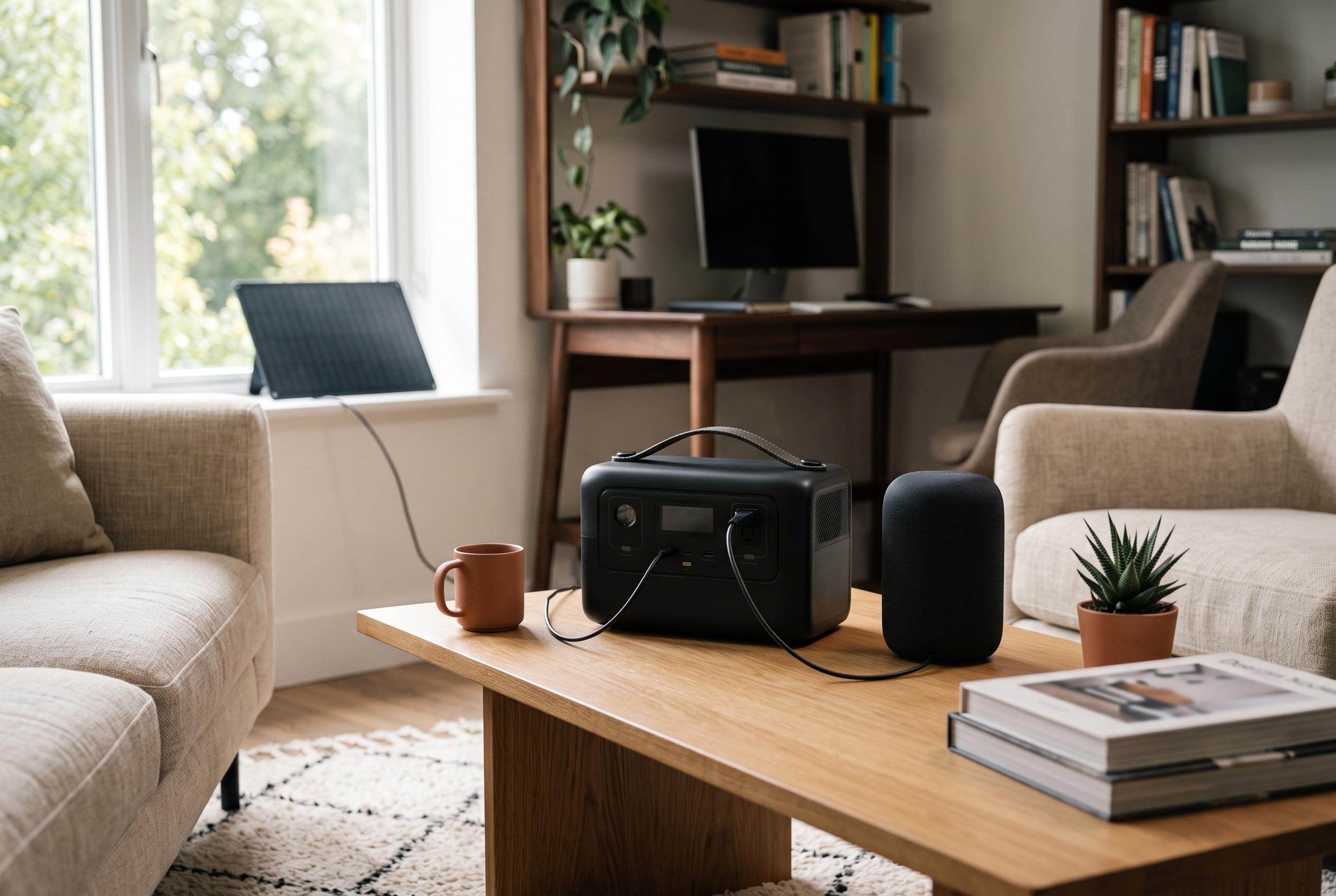

With advancements in portability, solar compatibility, and pricing, the competition among portable power stations heats up as buyers weigh new options in the 2kWh class, led by Jackery, EcoFlow, and BLUETTI.
As of 7 September 2026, the most striking change in this three-way contest is not a new battery or a faster inverter but the pricing. On their official US stores, EcoFlow lists the DELTA 3 Max at $899, BLUETTI lists the AC200L at $899, and Jackery lists the HomePower 2000 Plus v2 at $1,069, even though all three start from the same basic proposition: a 2,048Wh LiFePO4 battery and 2,400W of continuous AC output. That leaves buyers judging a blackout machine less by the headline numbers and more by what happens after the lights go out: how heavy it is to move, how much solar it can actually absorb, and whether the system can grow later.
On portability, Jackery has the clearest advantage. Its support material puts the HomePower 2000 Plus v2 at 18.8kg, while EcoFlow says the DELTA 3 Max weighs 20.3kg and BLUETTI puts the AC200L at 62.4lb, or 28.3kg. That is the difference between a unit one person can reasonably shift around a house and one that is much more likely to stay where it was first placed. Jackery is also leaning hard into that message, claiming a 34% weight reduction from the previous generation. Station Arena noted that the Jackery model only shipped in June 2026, which means its portability story is currently better established than any long-term record in the field.
The widest technical gap appears in solar input. BLUETTI says the AC200L accepts up to 1,200W of solar, Jackery’s FAQ gives the HomePower 2000 Plus v2 an 800W ceiling, and EcoFlow rates the DELTA 3 Max at 500W maximum PV input. Those figures matter because identical battery capacity does not mean identical recovery speed during a multi-day outage. EcoFlow says 500W input can take the unit from 0% to 80% in 3.43 hours, and markets a 400W solar bundle as a roughly 6.4-hour full charge. Jackery’s support page adds some useful detail missing from glossy listings: the two DC8020 inputs are parallel, four panels are supported only if they are identical, and mixed-wattage pairings are not supported. For households intending to rely on solar rather than occasional wall charging, the BLUETTI’s higher ceiling is a meaningful operational advantage rather than a minor specification footnote.
Expansion follows the same pattern. Jackery says the HomePower 2000 Plus v2 can scale to 12kWh and support up to five battery packs, but only the Battery Pack 2000 Plus v2 is compatible with this model. BLUETTI takes a different route, saying the AC200L works with B210, B230 and B300 expansion batteries up to 8,192Wh. EcoFlow’s naming is the one buyers need to watch most carefully. On its current US product page, the extra-battery path belongs to the separately named DELTA 3 Max Plus, a 3,000W model that EcoFlow says can scale to 4kWh with its smart extra battery. The standard DELTA 3 Max shares the same 2,048Wh starting capacity but is positioned as a fixed-capacity product.
Backup performance and control features are also more varied than the shared battery number suggests. EcoFlow advertises sub-10ms UPS switching, a 5-year warranty, app-based control through OASIS 3.0, and “Storm Guard Mode”, which is designed to trigger charging when severe weather alerts are issued. Jackery’s support documentation lists 10ms UPS performance, standby consumption of up to 16W, pass-through charging, app control, and a range of battery-saving and scheduled charging settings. BLUETTI, meanwhile, gives the AC200L a strong RV and mixed-use profile with a 120V/30A NEMA TT-30 outlet, Wi-Fi and Bluetooth app control, pass-through charging, a 5-year warranty, 4,800W surge output and a 3,600W “power lifting” mode for more demanding resistive loads.
The third-party verdicts are less settled than the original comparison suggests, and in some cases have already been overtaken by price changes. Station Arena argued that the EcoFlow was the better buy when it saw the DELTA 3 Max at $799 against $1,049 for the Jackery, saying the two had the same 2,048Wh capacity, the same 2,400W output, the same 4,800W surge, the same 10ms UPS performance and the same 5-year warranty. OffGridBenchmark reached a different conclusion on BLUETTI versus Jackery, scoring the Jackery slightly higher overall while still calling the BLUETTI the better value at its cited $1,299 against $1,799. Those are not trivial differences, but they are snapshots, not constants. As of 7 September 2026, the official brand pages show a narrower market than either comparison captured, with BLUETTI and EcoFlow both sitting below Jackery.
That matters because Jackery is still the least proven of the three in long-term public use. Its own pages make a strong case: a projected 16-year service life based on 6,000 cycles, 30dB quiet-mode operation, a 140W USB-C port, and a “Priority Routing” system intended to preserve essential loads. Yet Station Arena’s caution is reasonable. It says there is still no substantial hands-on or long-term review base for this exact v2 machine, so its noise, cycle-life and UPS claims remain manufacturer numbers until the model has spent more time in real homes and under sustained load.
Taken together, the current picture is more segmented than simple winner-picking allows. The BLUETTI AC200L now makes the strongest technical case for buyers who care about solar harvest, RV compatibility or later battery growth, especially when its official price is level with EcoFlow’s. The EcoFlow DELTA 3 Max remains the cleanest value play for users who want good UPS performance, a lighter chassis and a fixed 2kWh class unit without paying for expandability they may never use. The Jackery HomePower 2000 Plus v2 still has a persuasive brief for people who will actually carry the machine from room to room and who want the largest published expansion path, but it asks buyers to pay a premium while its real-world track record is still being built. In this category, identical capacity and inverter numbers are the beginning of the comparison, not the end.
Disclaimer: This content is intended for informational purposes only. Readers are advised to exercise their own judgement, conduct due diligence, or consult a qualified expert before acting on any information provided.