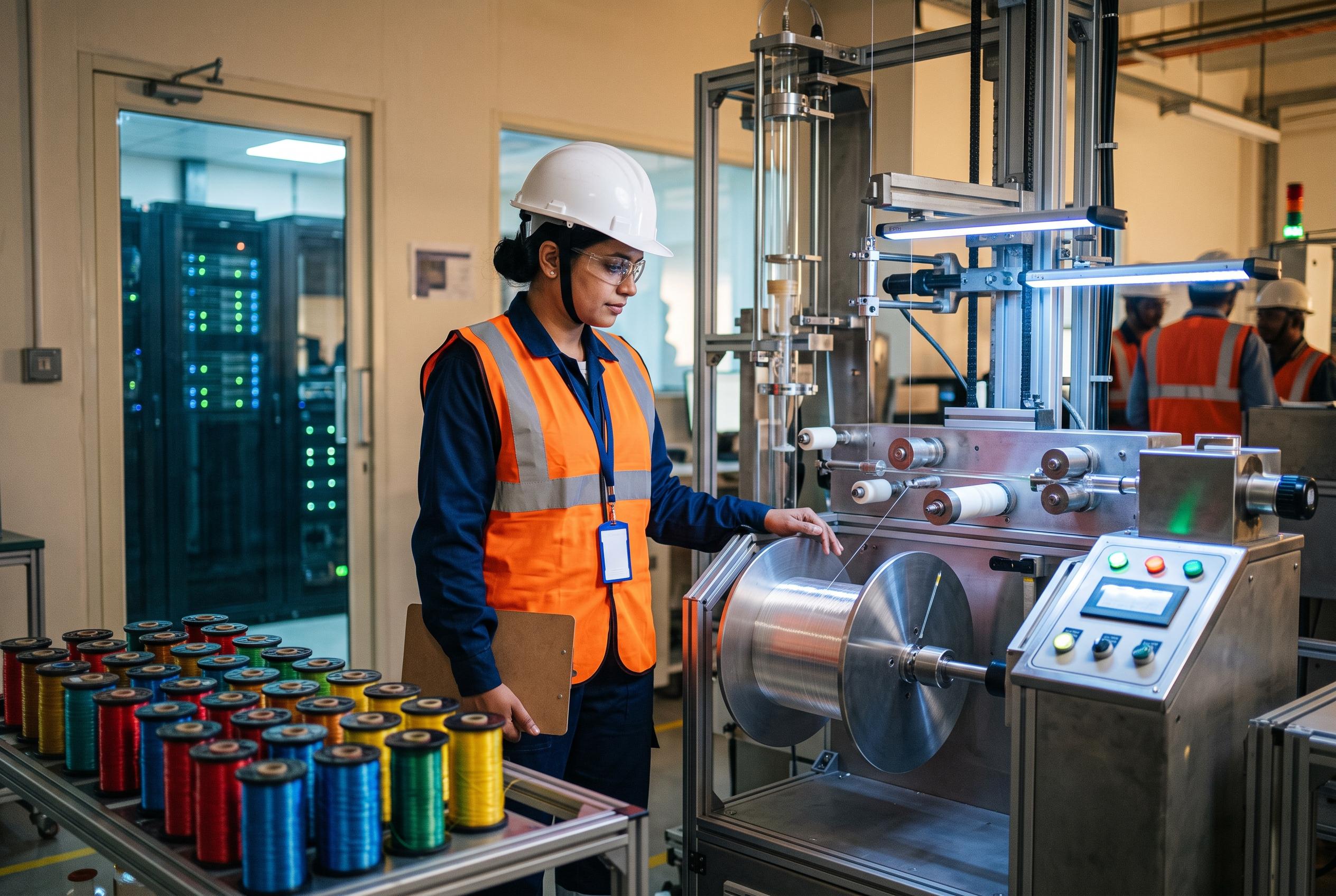

Sterlite Technologies unveils a Rs 3,000 crore expansion plan over three years, targeting a leap to Rs 20,000 crore in revenue by FY29, driven by AI infrastructure and advancing fibre technologies.
Sterlite Technologies has set out a three-year manufacturing and product expansion drive worth Rs 3,000 crore as it tries to lift annual revenue to Rs 20,000 crore by FY29, a target that would more than quadruple its FY26 scale and place it among the world’s five largest optical connectivity specialists. The plan, presented to investors on 3 September and amplified by a strong market reaction a day later, helped push the company’s shares into a 5% upper circuit at Rs 750 on the BSE, according to ETMarkets.
The financial goals are unusually aggressive. ScanX reported that STL wants EBITDA margin to rise by more than 1,380 basis points to above 27% by FY29, from about 13% in FY26, while Quartr’s summary of the investor update put the starting margin at 13.2% and the target at 27% or more. Both reports said the company intends to spend roughly Rs 1,000 crore a year for three years, taking manufacturing capacity to 1.5 times its present level by the end of FY29. ScanX also said STL entered the period with an open order book of more than $2 billion and had delivered record quarterly revenue and EBITDA in the first quarter of FY27.
Management’s central argument is that the market for fibre is being reshaped by artificial intelligence infrastructure rather than by conventional telecom spending alone. In the transcript of the investor event filed under SEBI regulations, managing director Ankit Agarwal said STL was “at a pivotal moment in its journey” because optical demand is now being driven by several structural forces at once. He described a sharp jump in fibre intensity inside advanced computing systems: a traditional front-end rack requires about 1,000 fibres, he said, while Nvidia’s Hopper architecture needs around 4,000, Blackwell about 16,000 and Vera Rubin roughly 64,000 fibres per rack. He also argued that interconnection demand rises quickly as campuses grow, saying that two data centres need one link, four need six, six need 15 and 10 need 45.
That matters because STL is trying to present itself as a broader digital infrastructure supplier, not merely a cable vendor exposed to telecom cycles. In the same filed transcript, Agarwal said demand had already been supported by broadband roll-outs, fibre-to-the-home deployments, 4G and 5G networks, BharatNet in India and the BED project in the US. Quartr and ETMarkets said the company’s Lakshya strategy rests on four pillars: a wider optical total addressable market, co-development with customers, integrated connectivity solutions and technology-led differentiation.
The existing industrial base is part of that pitch. Quartr said STL has more than 38 years in the sector, holds a 9% share of the global optical fibre cable market excluding China and owns more than 785 patents. It also said the group runs more than 10 advanced manufacturing facilities, makes its own glass and sells not only optical fibre cable but also pre-terminated systems and structured cabling used in data centres. The same source said STL plans to invest in hollow core fibre, multi-core fibre and co-packaged optics, technologies aimed at boosting speed, density and efficiency as computing clusters become more demanding.
The operational build-out goes beyond line extensions. ScanX said STL is setting up a greenfield manufacturing site in India for pre-terminated connectivity products, a move expected to create more than 3,000 jobs for women. It also reported that the board had approved the broader Rs 3,000 crore programme to scale existing facilities, with financing to come from internal accruals and/or debt. MarketScreener’s page carrying an S&P Capital IQ transcript linked the investor event to related corporate items, including an announcement on manufacturing capacity expansion and a long-term supply agreement with a hyperscaler worth $288 million, suggesting that STL is seeking to tie new capacity to large, committed customers.
The company has also been signalling that manufacturing scale must sit alongside environmental positioning. ICICI Direct’s corporate-announcements listing shows STL had formally notified exchanges of the 3 September investor and analyst meeting, and had separately issued a press release on 27 August saying it was moving towards a 100% green power model as part of a decarbonisation push. Quartr said STL’s manufacturing network operates with zero waste to landfill and zero liquid discharge. In the investor event, Rahul Darak, STL’s head of investor relations, opened with a warning that the discussion contained forward-looking statements, a reminder that the FY29 ambition depends on demand, execution and funding aligning over the next three years.
The prize, if STL delivers, is a much larger place in a market being redrawn by hyperscale data centres and AI clusters. The risk is that the company must expand factories, lift profitability, deepen customer relationships and convert a sizeable order pipeline into sustained revenue growth in a short period. For now, investors appear willing to give management the benefit of the doubt, but Lakshya will be judged less by the scale of its promise than by whether STL can turn record orders and AI enthusiasm into repeatable earnings by March 2029.
Disclaimer: This content is intended for informational purposes only. Readers are advised to exercise their own judgement, conduct due diligence, or consult a qualified expert before acting on any information provided.