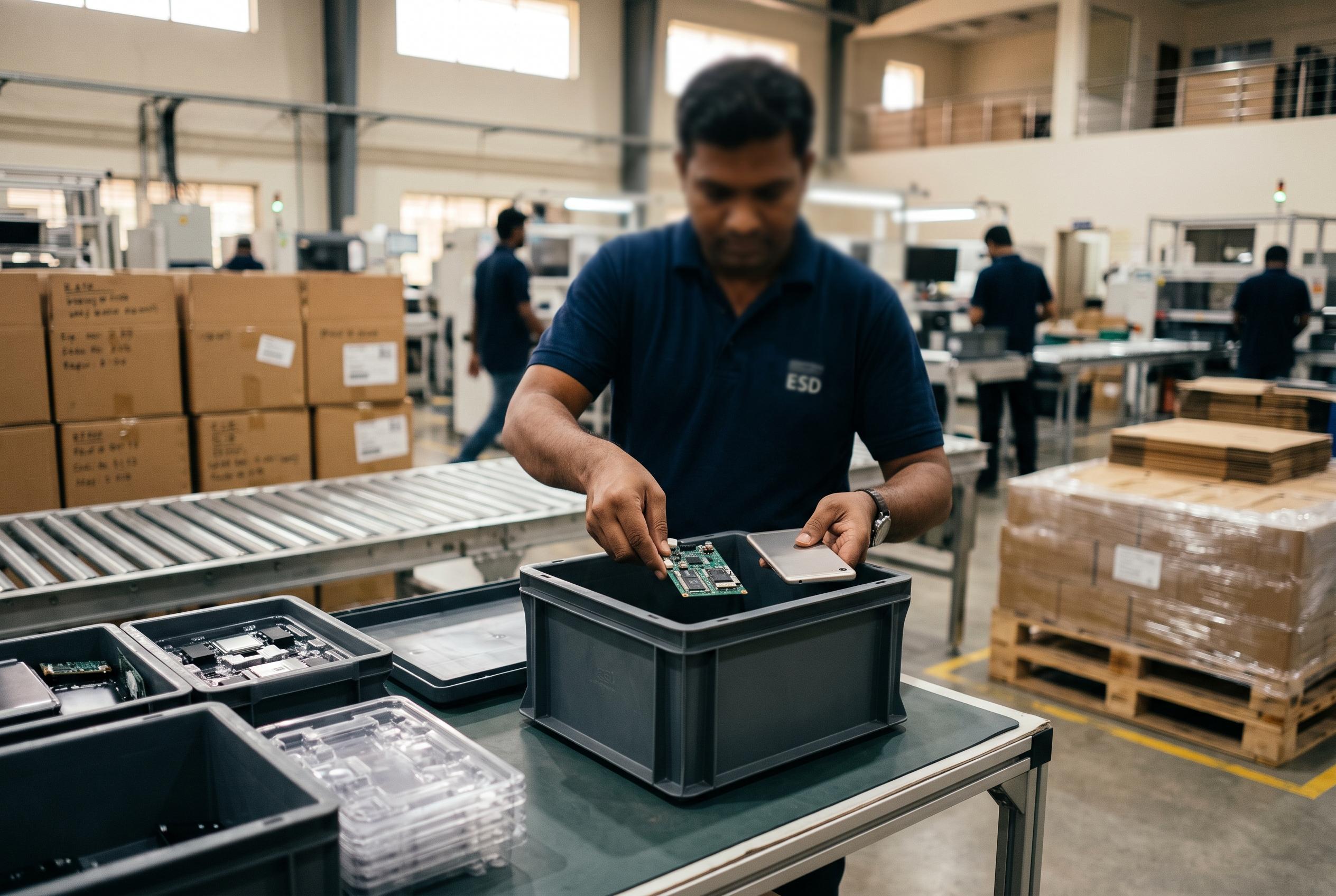

A new study reveals India’s electronics supply chain remains heavily dependent on Chinese imports, with over 80 per cent reliance across 71 product lines in 2025-26, prompting calls for increased domestic manufacturing and strategic localisation.
India’s electronics supply chain remains heavily exposed to China, with a new study finding that Chinese suppliers accounted for at least 80 per cent of imports across 71 product lines in 2025-26. The dependence is concentrated in core inputs such as motors, cables and switching equipment, rather than finished consumer devices, according to the Koan Advisory Group and the Institute of Chinese Studies.
The number of heavily China-dependent product lines has risen sharply from 44 in 2018-19, suggesting that concentration has deepened over time. The study says 46 of the 71 tariff lines crossed the 80 per cent threshold only after 2018-19, underscoring how embedded Chinese sourcing has become in components that feed telecoms infrastructure, consumer electronics and industrial machinery.
The report argues that India’s trade deficit with China is structural, not cyclical. It says the imbalance remains concentrated in the same major HS chapters, with electrical machinery alone accounting for $43.1 billion of India’s $112.1 billion deficit in 2025-26. HS Chapter 85, which covers electrical and electronic equipment, is also India’s largest export chapter to China, but at $3.18 billion it is far smaller than the import bill.
Lithium-ion batteries emerged as a particularly sensitive area. India’s imports from China in that segment have more than doubled since 2021-22 to $3.9 billion, lifting China’s share to 83.6 per cent and pushing the category beyond the 80 per cent dependence threshold for the first time in 2025-26. The study also said China supplied 48.9 per cent of India’s semiconductor imports, even after its share fell from about 64 per cent a year earlier.
The findings come as New Delhi is trying to widen domestic production. In August, the government approved 31 new proposals under the Electronics Components Manufacturing Scheme, with an investment of ₹7,877 crore, but India still depends on imports for advanced display panels, memory chips and image sensors. The report says restricting imports alone will not close the gap, because the dependence sits upstream in components; it calls instead for localisation, backed by critical-minerals policy and, where needed, a calibrated approach to allowing Chinese manufacturers to produce in India.
Disclaimer: This content is intended for informational purposes only. Readers are advised to exercise their own judgement, conduct due diligence, or consult a qualified expert before acting on any information provided.