
The Geekom IT13 Max offers impressive port options and a tiny footprint, but its ageing Silicon and constrained upgrade options limit its appeal for creative workloads and gaming.
Geekom’s IT13 Max is a compact Windows mini PC that looks, on paper, better suited to office work and light creative tasks than to serious production. Creative Bloq’s review found that it offers strong connectivity, a useful second M.2 slot and a tidy footprint, but is constrained by ageing Meteor Lake-era silicon, integrated graphics and a maximum of 24GB of soldered memory in the tested configuration. Other reviews from PCWorld, Tom’s Hardware, Notebookcheck, TechRadar and IT Pro reached broadly similar conclusions.
The chassis is small, plain and designed to disappear behind a monitor or sit unobtrusively on a desk. It includes front-facing USB ports, a VESA mounting bracket and internal headers for serial connections, which gives it a degree of industrial flexibility that is unusual in this class. For users who want a neat workstation with minimal cable clutter, those are practical advantages rather than cosmetic ones.
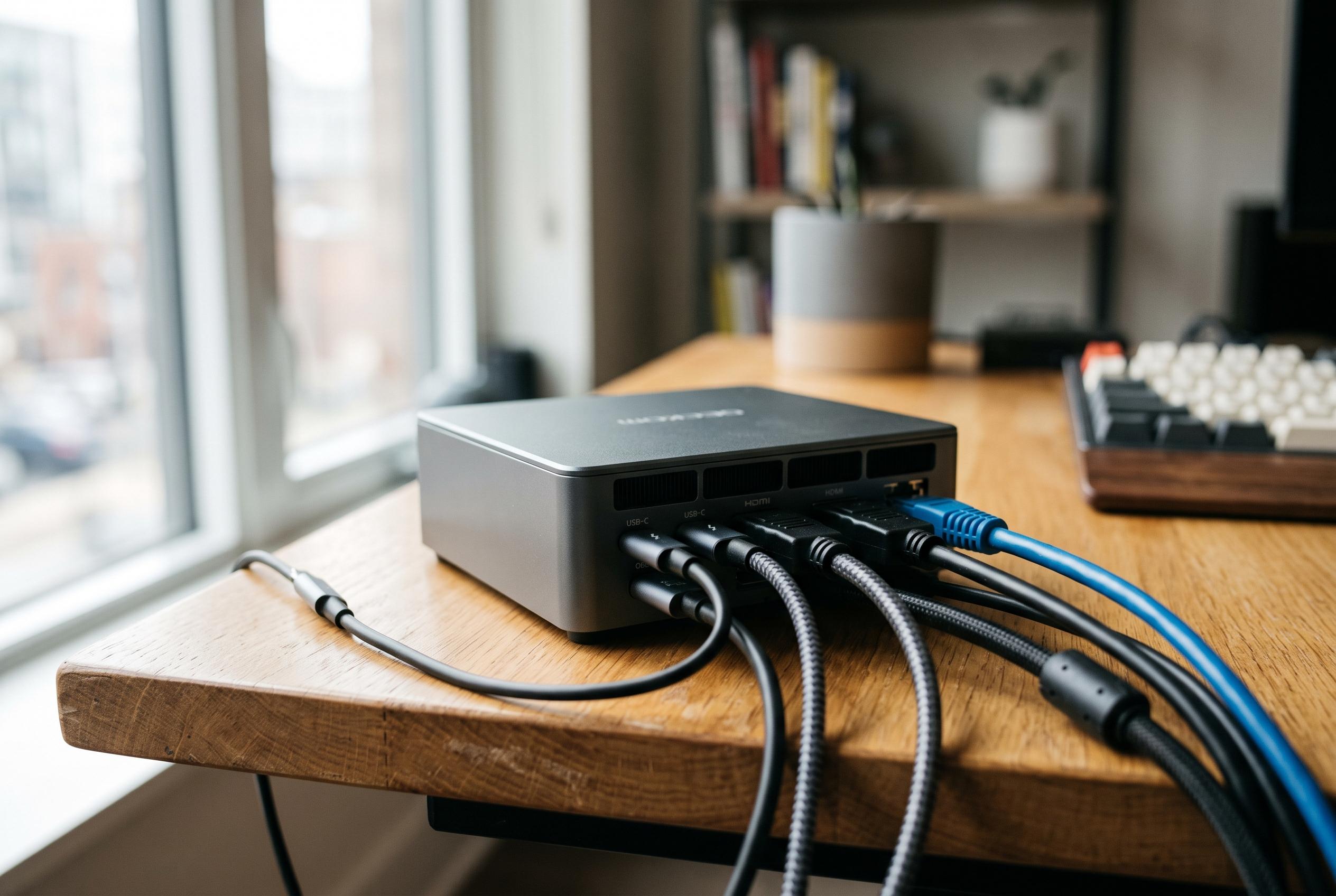
Connectivity is one of the IT13 Max’s clearest strengths. The review unit provides two USB4 ports, two HDMI outputs, five USB 3.2 Type-A ports, a USB 2.0 port, dual 2.5GbE Ethernet, Wi-Fi 7, Bluetooth 5.4 and an SD card slot. It can drive up to four 4K displays or a single 8K display, and one USB4 port supports power input, which can help reduce desk clutter. That makes it well suited to multi-monitor office setups and modest content-creation workflows.
Performance is more nuanced. The machine uses Intel’s Core Ultra 9 185H, a first-generation Core Ultra chip with 16 cores and integrated Intel Arc graphics. Independent testing suggests it is fast enough for productivity, Photoshop and other 2D design work, and in some cases it performs better than laptops using the same processor because the larger chassis can cool it more effectively. But the lack of a discrete GPU, plus the fixed 24GB memory ceiling in the reviewed unit, makes it a weaker choice for video editing, AI-heavy tools and modern games.
Pricing is where the IT13 Max becomes harder to judge. Creative Bloq reported a price of £999 or $1,399 for the tested model, while Tom’s Hardware described a 2026 review sample at $799, showing that regional pricing and seller configuration can vary substantially. Geekom’s own product page also advertises much larger RAM options, including up to 96GB of DDR5, which sits uneasily alongside review-unit reports of soldered 24GB LPDDR5 memory. For buyers, that means the exact specification matters as much as the model name.
Overall, the IT13 Max is best seen as a capable small-form-factor PC for office users, students and designers who mainly edit images, run standard business software and value ports over power. It is less convincing for anyone expecting upgrade headroom, strong GPU performance or sustained creative workloads that lean heavily on graphics acceleration.
Disclaimer: This content is intended for informational purposes only. Readers are advised to exercise their own judgement, conduct due diligence, or consult a qualified expert before acting on any information provided.