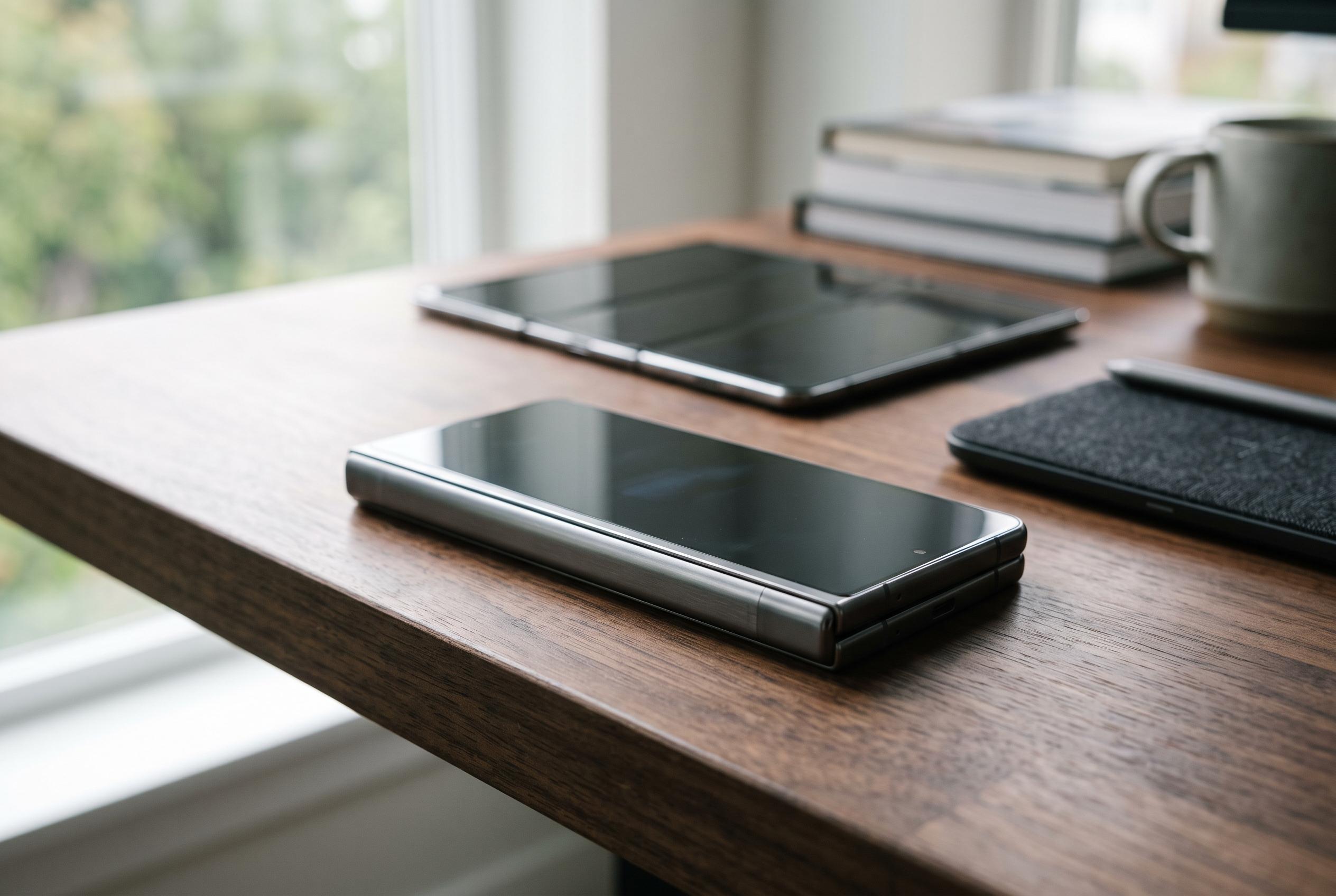

Apple and Huawei showcase divergent visions for the future of foldable handsets, with Apple emphasising durability and ecosystem integration, while Huawei pushes towards larger, tablet-like displays, signalling a new era of device versatility.
Apple’s iPhone Duo and Huawei’s Mate XT 2 Ultimate point to two very different ideas of what a foldable handset should be. According to early coverage of the iPhone Duo, Apple is pitching a more conventional book-style device built around ecosystem continuity, while Huawei is pressing further with a tri-fold design that opens into something closer to a tablet. For buyers weighing the next step beyond a standard smartphone, that difference may matter more than raw specifications.
On design and display, Apple is leaning on durability and polish. Reuters-style reporting from launch coverage describes a titanium frame, Ceramic Shield protection, IP68 resistance and a refined hinge meant to reduce the crease and make the open-close transition feel more natural. The iPhone Duo’s inner panel is said to measure 7.6 inches, with a 5.4-inch cover screen, both supporting 120Hz refresh rates and up to 3,000 nits of peak brightness. Huawei’s Mate XT 2 Ultimate, by contrast, is built around a three-section layout that expands to a 10.2-inch LTPO OLED panel, giving it a much larger working surface, albeit with a lower 90Hz refresh rate on the main display.
Performance is where Apple appears to have the cleaner story. Launch reports say the iPhone Duo uses the A20 Pro chip, paired with iOS 27 and up to 12GB of memory, with storage options reaching 2TB. Tech reviewers have also highlighted Apple’s software integration and the promise of a smoother handover between folded and unfolded modes. Huawei’s device is reported to use the Kirin 9050 Pro with 16GB of RAM, a specification that should suit heavy multitasking on a large screen, but the broader perception remains that Apple has the edge in raw efficiency and app optimisation.
Battery and charging strategies also diverge. Huawei’s handset is said to carry a 5,600mAh silicon-carbon battery, with 66W wired charging, 50W wireless charging and reverse charging, making it well suited to long sessions of split-screen use. Apple is taking a different route, with reports pointing to faster wired charging and 25W MagSafe and Qi2 wireless support, while relying on tighter hardware-software integration to stretch endurance. Review commentary suggests the Duo can last most of a day under balanced use, though like many foldables, real-world stamina will depend heavily on how often the larger screen is active.
Camera hardware reinforces each company’s priorities. Apple’s foldable is reported to use dual 48-megapixel rear cameras, with a strong emphasis on video, including 4K recording at up to 120 frames per second, Dolby Vision, ProRes and spatial video. Huawei’s system is broader in scope, with a 50-megapixel main camera, a 50-megapixel periscope lens offering 3.5x optical zoom and a 40-megapixel ultra-wide unit. On the front, Apple is said to combine an under-display inner camera with a 12-megapixel external camera, while Huawei uses 8-megapixel selfie cameras capable of 4K capture. Pricing underlines the split: Apple’s device starts at $1,999 for 256GB, while Huawei’s tri-fold is positioned at roughly $2,900, a premium that only makes sense if the larger, tablet-like format is the priority.
Disclaimer: This content is intended for informational purposes only. Readers are advised to exercise their own judgement, conduct due diligence, or consult a qualified expert before acting on any information provided.