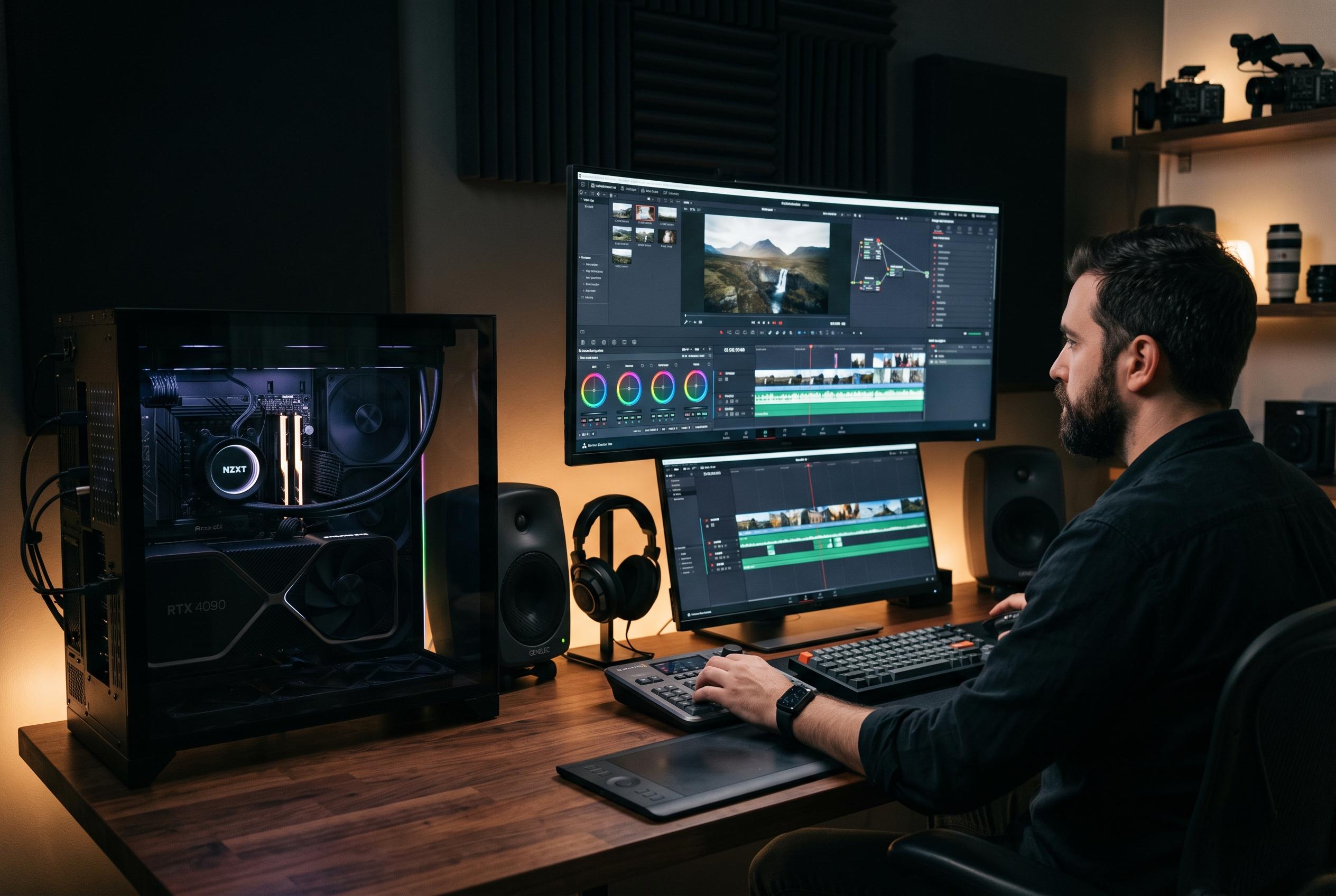

ShortFilmCentral’s latest test results position Nvidia’s RTX 4090 at the top for native 8K RAW workflows, emphasising memory headroom and encoder support over gaming performance, while AMD offers a compelling value with the RX 7900 XTX for high-resolution editing.
The best GPU for 8K video editing depends less on raw gaming speed than on memory headroom, encoder support and how demanding the timeline really is. According to ShortFilmCentral’s testing, 24GB cards still offer the safest margin for native 8K RAW work, while 16GB models are better suited to lighter timelines, proxy workflows and less complex source material. Their wider guide, updated for September 2026, places the VIPERA NVIDIA GeForce RTX 4090 Founders Edition at the top, followed by the Sapphire Nitro+ Radeon RX 7900 XTX and ASUS TUF Gaming GeForce RTX 5080 OC Edition.
That ranking broadly matches other 2026 buying guides, which continue to treat VRAM and encoding throughput as the key decision points for editors. Fluence.ai also points to the RTX 5090 for the heaviest 8K work, while positioning the RTX 5080 as a strong all-round choice for more mainstream production. The same guidance also underscores that 24GB-class cards remain the most comfortable option for sustained, high-resolution timelines.
Among the NVIDIA options, the RTX 4090 remains the most balanced choice for editors who need both CUDA acceleration and enough framebuffer for complex grades, multicam and AI-assisted effects. ShortFilmCentral says its hands-on tests showed strong playback and export performance on stacked 8K RED and BRAW projects, while the RTX 5080 family offers quieter thermals and newer Blackwell features at the cost of reduced VRAM headroom. That trade-off matters most in DaVinci Resolve, where heavy effects stacks can push memory use beyond 16GB.
AMD’s RX 7900 XTX remains the most compelling value pick for Resolve users who care more about capacity than CUDA-specific software support. ShortFilmCentral and TechRadar both note that AMD’s 24GB framebuffer gives it an advantage in high-resolution workflows, even if NVIDIA retains an edge in creative applications that depend on CUDA. TechRadar’s broader comparison of the RX 7900 XTX and RTX 4080 Super similarly frames AMD as the stronger value proposition when VRAM is the priority.
For mid-range buyers, the RTX 5070 Ti and RX 9070 XT sit in a narrower performance band and are best suited to lighter 8K or proxy-led editing. TechRadar’s comparison says the RTX 5070 Ti has the stronger feature set, while the RX 9070 XT offers better value and availability. ShortFilmCentral’s testing reaches a similar conclusion: the 5070 Ti is the more capable Blackwell option, but 16GB cards are still easier to overwhelm in native RAW workflows than 24GB models.
The practical conclusion is straightforward. Editors working in Premiere Pro or other CUDA-optimised tools should favour NVIDIA, especially if they want the broadest plugin compatibility. Resolve users on tighter budgets can make AMD work well, provided they accept that 24GB is still the safer floor for serious native 8K. And for anyone building a full workstation, the GPU alone is not enough: the rest of the system still needs fast storage, ample system memory and a strong power supply to avoid bottlenecks.
Disclaimer: This content is intended for informational purposes only. Readers are advised to exercise their own judgement, conduct due diligence, or consult a qualified expert before acting on any information provided.