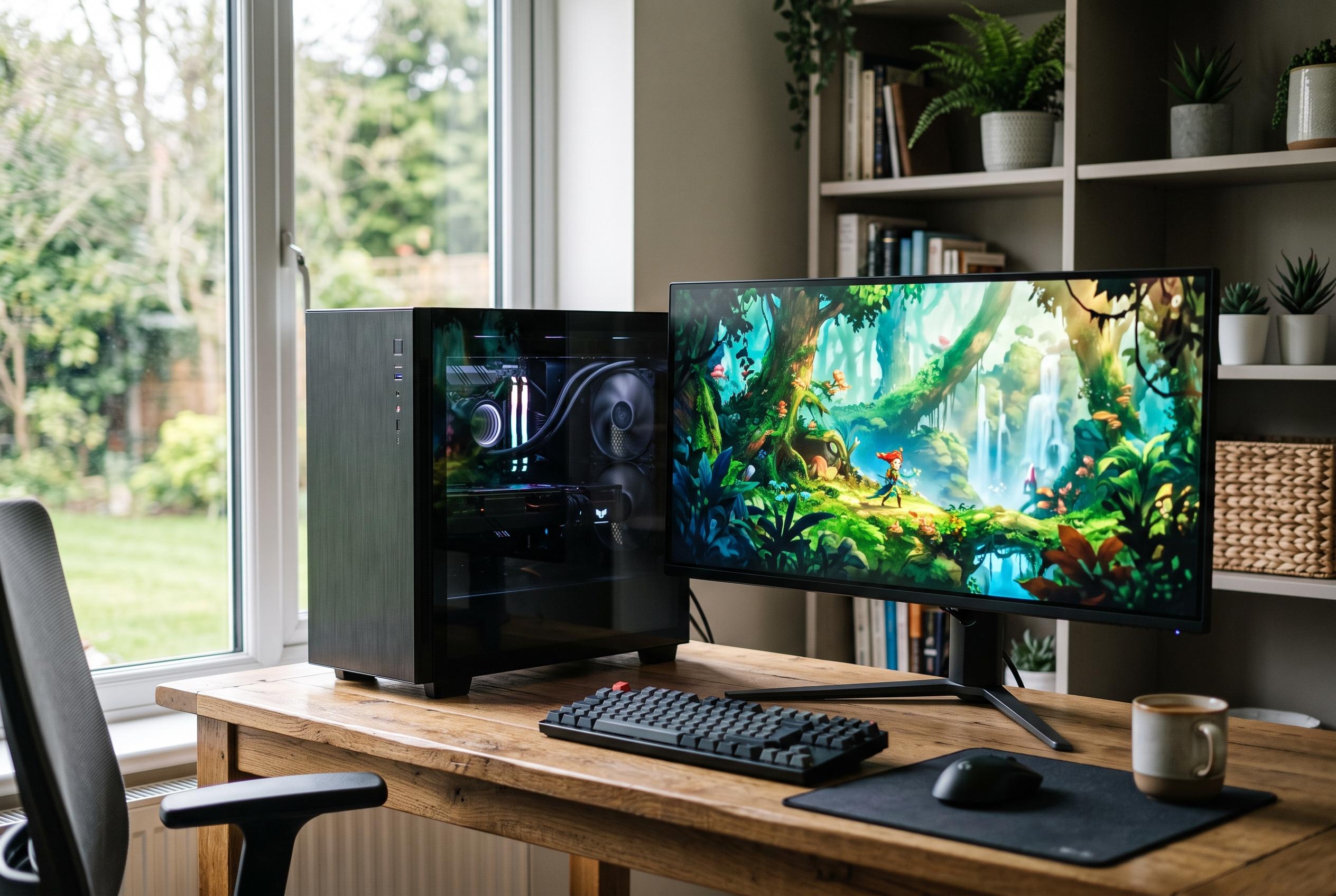

A carefully balanced ₹65,000 desktop in India now enables native 1440p gaming, delivering smoother performance and future upgrade potential without reaching enthusiast prices, thanks to strategic component choices based on real-world testing.
For Indian buyers who have outgrown 1080p, a carefully balanced ₹65,000 desktop can now reach native 1440p gaming without drifting into enthusiast pricing. The appeal is straightforward: Quad HD panels have become more affordable, and their higher pixel count makes modern open-world games look markedly cleaner while also giving creative and development work more usable screen space. The configuration outlined by Kunal Chowdhury’s guide aims to capture that middle ground, pairing a mainstream six-core processor with a graphics card that has enough memory headroom for current high-resolution titles.
The proposed parts list centres on an Intel Core i5-12400F or AMD Ryzen 5 5600, alongside either an AMD Radeon RX 7600 XT or an Nvidia GeForce RTX 4060. The key distinction is memory: the guide favours the 16GB buffer on the RX 7600 XT as a way to avoid the texture streaming and stutter problems increasingly seen on 8GB cards at higher resolutions. It combines that GPU choice with 32GB of dual-channel DDR4 memory, a 1TB PCIe Gen4 NVMe SSD, a 650-watt 80 Plus Bronze power supply and a mesh-front micro-ATX case, with the total estimated cost placed at about ₹64,900.
That hardware mix is intended to deliver more than just theoretical value. The guide says real-world testing at 2560×1440 produced roughly 60 to 80 frames per second in demanding games such as Cyberpunk 2077 and Black Myth: Wukong, while Forza Horizon 5, Grand Theft Auto V, Counter-Strike 2 and Valorant ran well above the refresh range needed for high-end esports monitors. Those figures support the build’s central claim: it is not merely a cheap gaming PC, but one designed to sustain usable 1440p performance in both cinematic and competitive workloads.
Thermals and power delivery are treated as practical considerations rather than afterthoughts, which matters in India’s hotter climates. The guide argues that a mesh-front cabinet, sensible airflow and a correctly sized power supply are more important than decorative extras, especially when ambient temperatures climb. It also notes that the stock CPU cooler is acceptable for light use, but recommends an inexpensive tower cooler for longer gaming sessions, particularly if the machine is expected to run for hours in warm conditions.
There is also a clear upgrade path, which is one reason this specification makes sense for buyers who want the machine to last. According to the guide, the platform leaves room for a faster graphics card later, additional NVMe storage and wider workload use, including software development and editing. Compared with the publication’s earlier ₹40,000 and ₹50,000 gaming guides, this configuration shifts the priority from entry-level 1080p play towards a more durable 1440p experience, with the extra budget concentrated where it most affects frame rates: the GPU, system memory and storage responsiveness.
Disclaimer: This content is intended for informational purposes only. Readers are advised to exercise their own judgement, conduct due diligence, or consult a qualified expert before acting on any information provided.