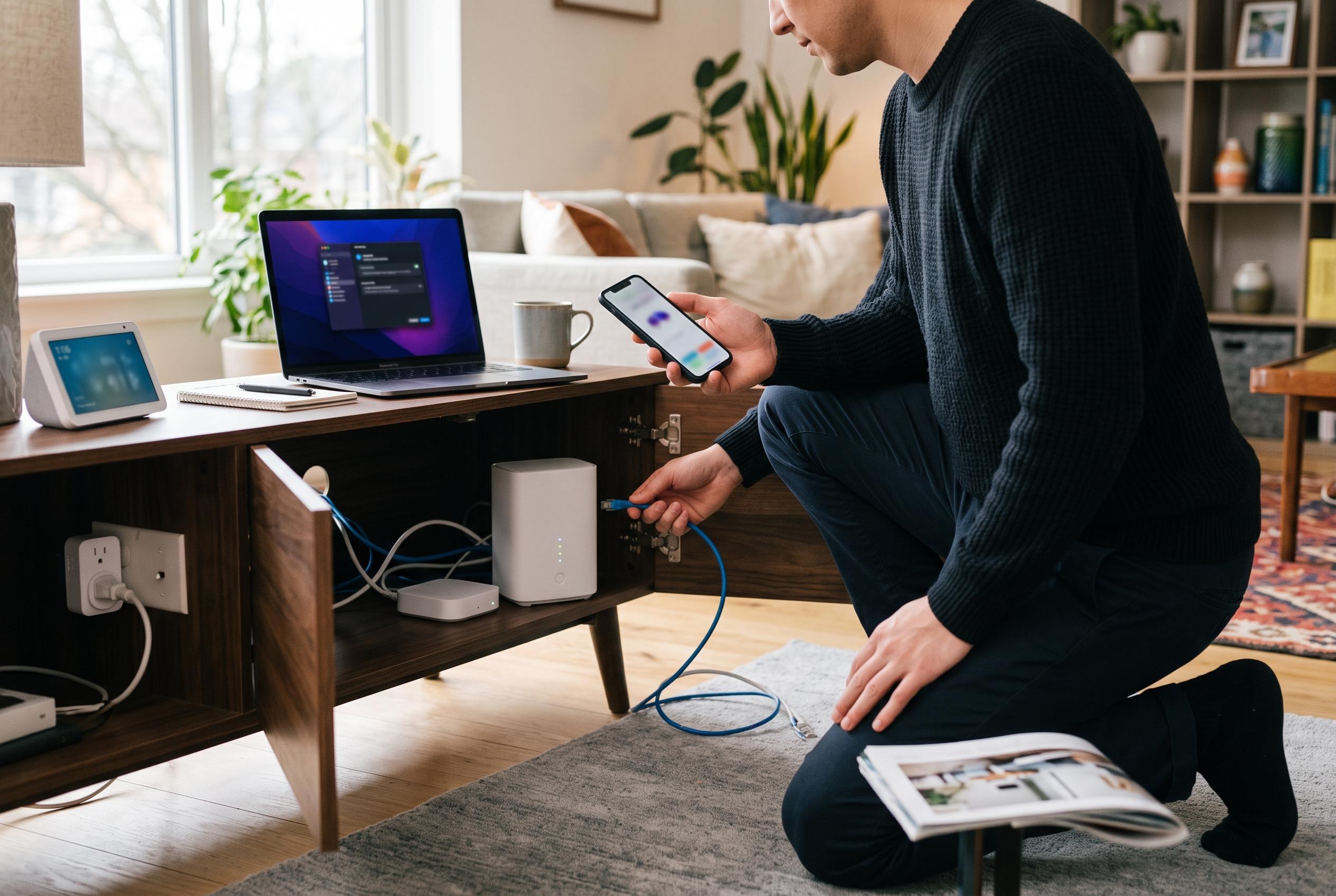

Reconfiguring a new router with the same network name and password simplifies the process of switching internet providers for smart homes, though it raises ongoing security questions about device authentication and network vulnerabilities.
For households filled with smart plugs, bulbs, thermostats and cameras, changing internet provider can look like a large job. In practice, it is often much simpler. As Alejandro Alcolea explained in Xataka, the key is to configure the new router with the same network name and password as the old one, so connected devices see no change and reconnect on their own.
That works because most consumer IoT devices authenticate only through the Wi-Fi credentials they already know. TP-Link says that, for most smart home equipment, keeping the same SSID and password on the replacement router is enough to avoid re-pairing each device one by one. In other words, the devices are usually not checking which router sits behind the network name; they are checking whether the familiar credentials are still present.
The convenience is obvious, but so is the security trade-off. If a device relies only on the network name and password, then anyone who knows those details could imitate the home network with a rogue access point. That is the logic behind so-called “evil twin” attacks. The risk is not trivial, although it generally requires close physical proximity and some technical effort, which is why the practical defence remains a strong Wi-Fi password and sensible router settings.
The broader issue is that home automation still sits between two worlds. Matter, backed by Apple, Google, Amazon and the Connectivity Standards Alliance, is meant to reduce fragmentation and make devices easier to move between ecosystems. Thread, which underpins part of that model, uses a different approach to joining and authentication from simple SSID-based reconnection. But the installed base of older devices is still vast, and many of them will not benefit from those improvements without being replaced.
More advanced IoT systems already use stronger identity controls. Alibaba Cloud’s IoT documentation points to methods such as device secrets, certificates and ID-based authentication, while Microsoft Research has explored proximity-based authentication schemes that add another layer of proof before a device is trusted. Those approaches show where the sector is heading, but they also underline how far consumer smart-home kit still has to go. For now, the most practical answer to a router swap remains the same old trick: copy the network name and password, and let the devices do the rest.
Disclaimer: This content is intended for informational purposes only. Readers are advised to exercise their own judgement, conduct due diligence, or consult a qualified expert before acting on any information provided.