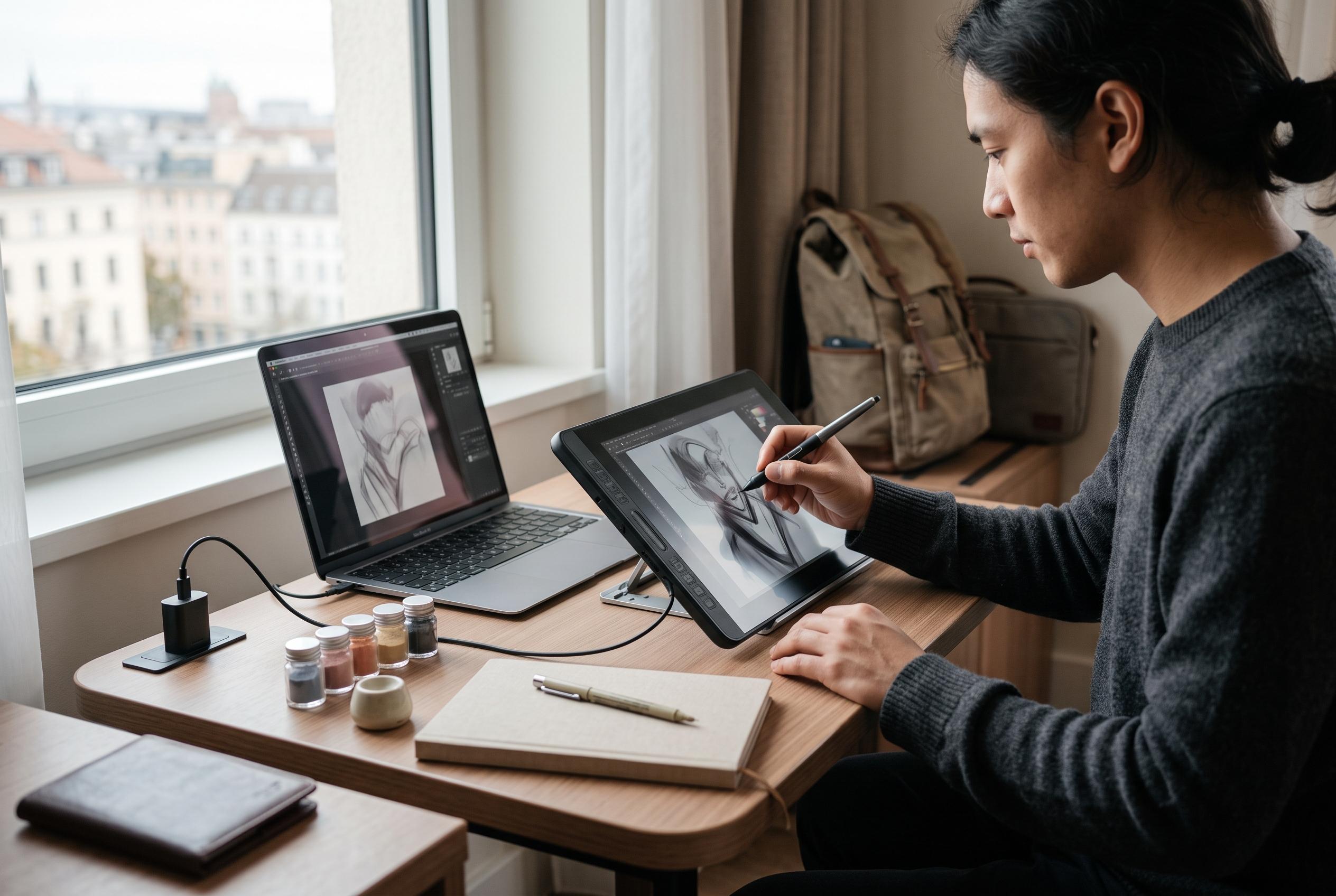

The portable pen display market splits into tethered and standalone options, with new models like XP-Pen’s Artist 13.3 Pro offering a balanced blend of portability, screen quality, and workflow flexibility for travelling artists.
Travel artists need more than a small screen. They need a display that survives transit, fits a crowded bag and still gives accurate line control once they reach a train seat, hotel desk or airport lounge. That is why the portable pen display market has split into two clear groups: tethered screens for artists who travel with a laptop, and standalone tablets for those who want to work without extra hardware. XP-Pen says the Artist 13.3 Pro is built around portability, with a fully laminated 13.3-inch Full HD panel, a battery-free stylus and a compact control layout designed for mobile use.
Among tethered options, the Artist 13.3 Pro remains a sensible mid-range reference point. XP-Pen describes it as offering 8,192 levels of pressure sensitivity, 60-degree tilt support, six programmable shortcut keys and a red dial for workflow control. The company also says the display covers 99% sRGB, 89% Adobe RGB and 95% Display P3, while Windows Central has noted the panel’s brightness, pen accuracy and convenient size, although it also pointed out that older-style connectivity can require extra adapters. Taken together, that makes it attractive for illustrators who want a compact travel companion without giving up a more traditional pen-display workflow.
The more important distinction for travelling artists is whether a device needs a computer at all. For many, standalone tablets remove the heaviest item from the bag and simplify setup in cramped spaces. That is why products such as the PicassoTab X11, XPPen Magic Drawing Pad, RubensTab T11 Pro and Wacom MovinkPad Pro 14 have become important alternatives in this category. They are not identical in performance or software support, but they do address the same practical problem: reducing the number of things an artist must carry, charge and connect on the road.
Screen quality still matters, especially for artists working on client-facing illustrations, print pieces or colour-sensitive concept work. The related material points to a clear hierarchy: full-laminated panels reduce parallax, higher colour coverage improves consistency, and larger screens become more comfortable for longer sessions but less convenient for flights. In that context, the Artist 13.3 Pro sits in the useful middle ground. It is small enough for travel, yet more capable than the cheapest entry-level displays, and XP-Pen’s own specification sheet positions it as a lightweight option for users who want a portable display without moving to a larger 15.6-inch class.
For buyers, the best choice depends less on the brand name than on the trip itself. Artists who fly often will usually fare best with a 13-inch-class device and a full-laminated screen. Those who work mainly from hotel rooms may prefer a larger panel with more desk space. And anyone who wants to travel light should consider a standalone Android tablet rather than a tethered pen display. The practical lesson is the same across the category: portability is not only about weight, but also about how quickly the display sets up, how reliably it tracks the pen and how little it asks from the rest of the kit.
Disclaimer: This content is intended for informational purposes only. Readers are advised to exercise their own judgement, conduct due diligence, or consult a qualified expert before acting on any information provided.