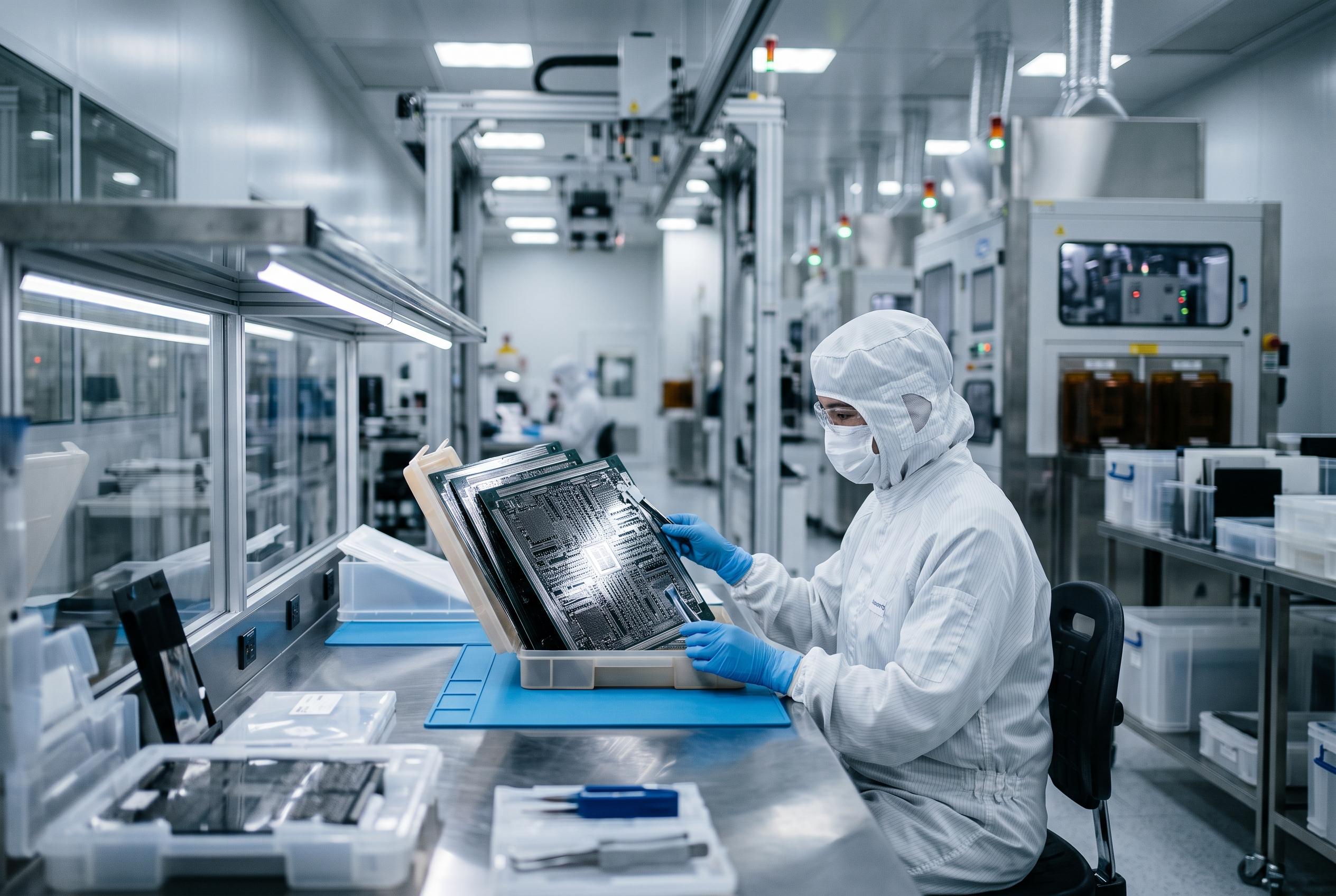

AT&S’s expansion of its Malaysian IC substrate manufacturing facility highlights the growing importance of advanced packaging components in meeting the surging demand for AI and data-centre chips, amidst a broader industry shift and geopolitical diversification.
AT&S, the Austrian maker of advanced printed circuit boards and chip substrates, is betting that one of the semiconductor industry’s least visible components will become one of its most constrained. In Kulim, Malaysia, the company is scaling production of IC substrates, the high-density base layers that link processors, memory and other components inside advanced chip packages.
These substrates matter because the shift towards chiplet architectures and more complex AI systems has increased the number of interconnects inside each package. That has pushed substrates from a specialist input to a strategic bottleneck in the supply chain, particularly for high-end AI accelerators, data-centre processors and other performance-intensive chips.
AT&S has made Kulim central to that strategy. The company said in May 2025 that the new plant there was ready for high-volume manufacturing, with production of high-end IC substrates for AMD’s data-centre processors and other customers. It has since said the site was expanded in June 2026 to support long-term customer demand, and that the move was tied to agreements with AMD and another major technology customer.
The latest public sign of that demand came this week, when AT&S announced an expanded long-term collaboration with Marvell Technology to supply advanced IC substrates for next-generation AI and cloud infrastructure. According to AT&S, the agreement reflects the way chip design is changing, with more manufacturers moving away from monolithic chips towards chiplet-based designs that depend on advanced packaging and substrate capacity.
Michael Mertin, the company’s chief executive, has framed the Malaysian build-out as part of a broader industrial race rather than a single-customer project. In the CNBC interview, he discussed competition in the substrate market, the pace of expansion and the impact of geopolitics on semiconductor sourcing. AT&S says its footprint across Austria, China, India and Malaysia is intended to give it flexibility as customers seek capacity outside a narrower set of production centres.
Malaysia has become an important node in that shift. AT&S’s Kulim facility sits in a region that has drawn major semiconductor investment as firms seek to diversify supply chains and reduce dependence on any single country. Industry commentary and company disclosures indicate that the country’s role is growing not just in assembly and test, but in advanced packaging and the materials that support it.
For AT&S, the opportunity is clear: if AI infrastructure continues to expand, the substrate makers that can deliver reliable high-end capacity may capture a larger share of the value chain. The challenge is equally clear. These parts are technically demanding, capital-intensive to produce and difficult to scale quickly, which is why the company’s Malaysian expansion now sits at the centre of its growth plans.
Disclaimer: This content is intended for informational purposes only. Readers are advised to exercise their own judgement, conduct due diligence, or consult a qualified expert before acting on any information provided.