
A rising trend in local-first voice systems leverages Android devices as autonomous edge controllers for physical hardware, eschewing cloud dependence and enhancing privacy and resilience.
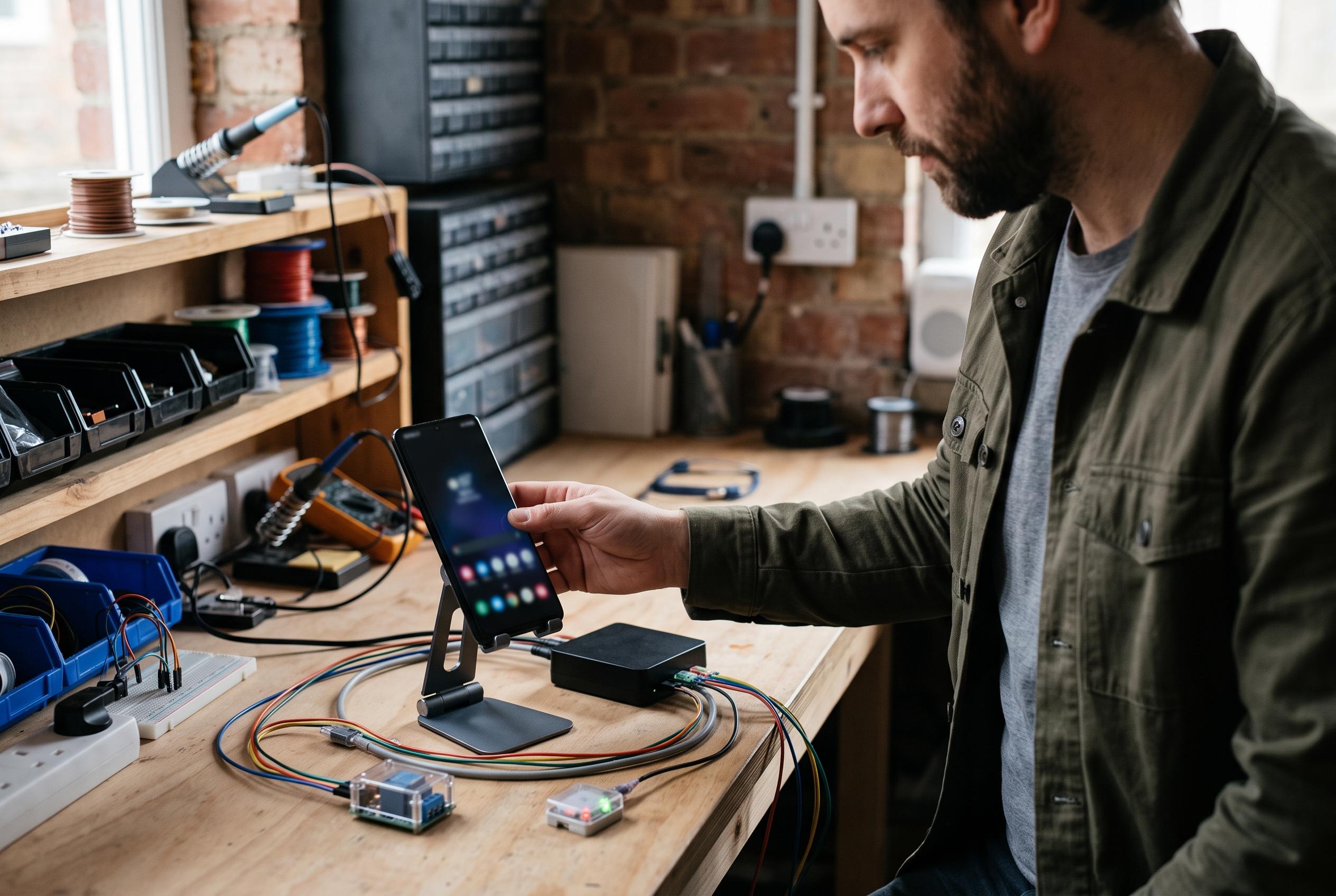
What begins as a modest Termux experiment on an Android handset is, in effect, an attempt to turn a consumer phone into a local control node for physical devices. The core idea is straightforward: a spoken command is captured, converted into text, interpreted as intent, and then translated into an action that can switch hardware such as a relay. The appeal of that approach lies not in novelty alone, but in the promise of a system that can work with less dependence on remote services and more awareness of the device sitting in the user’s hand.
The project is built around a local-first mindset. The phone already contains the basic ingredients of a small computing platform: processor, memory, microphone, speakers, storage and network access. Termux adds a Linux-like environment that makes it possible to run scripts and prototype Python-based components directly on the device. That makes the handset more than an endpoint. It becomes part of the edge layer, capable of handling voice capture and at least some of the processing before any instruction reaches the hardware-control stage.
That architecture reflects a wider trend in voice systems. VoxRouter, for example, is designed as a self-hosted voice agent router that can pair Android phones and Wear OS watches over a trusted local network, while routing speech through controlled model chains. HAwake takes a different route, but with a similar purpose: it turns Android devices into voice terminals for Home Assistant and keeps wake-word detection on-device to avoid cloud dependence. Kiosk Satellite follows the same privacy-first logic by converting Android devices into dedicated Home Assistant kiosks with local voice control. Taken together, these systems show that the idea of repurposing Android hardware as an always-available voice interface is no longer experimental in principle; the remaining challenge is how far the local stack can be pushed.
The lead project goes one step further by linking speech recognition to direct hardware control. That is where the engineering becomes more demanding. A phrase such as “Turn the relay on” is not useful unless the system can reliably turn it into a structured instruction, validate what was heard and ensure that the target device exists and is connected. Once physical equipment enters the loop, errors are no longer merely software errors on a screen. They can become state changes in the real world. For that reason, the emphasis on clear command definitions, predictable states and careful failure handling is important. The author is also right to limit experiments to low-voltage, safely isolated hardware rather than treating mains wiring as a hobby task.
The same concern for privacy and resilience appears in other projects that extend Android into a local assistant platform. XiaoXin App turns phones, tablets and wall-mounted panels into AI voice terminals connected to a backend, while supporting offline keyword spotting and voice activity detection on the device. Ruuh goes further still by combining Android, Termux and a full Ubuntu environment with optional local models, persistent memory and device control features. Both point to the same underlying appeal: useful voice automation does not necessarily require a permanent cloud connection, especially when the goal is personal control, privacy or offline operation.
There is also a practical argument for this kind of work beyond convenience. A well-designed local voice system can continue operating when connectivity fails, which matters in homes, workshops, laboratories and embedded settings. The same logic appears in broader offline-phone projects, including guides that turn smartphones into walkie-talkies by using built-in microphones, speakers and local networking. In each case, the device is being reclaimed as a self-sufficient tool rather than a passive client. The phone becomes a controller, an interface and, potentially, a coordinator for other devices.
What makes the current experiment compelling is not that it promises a finished voice assistant, but that it treats the pipeline as a system worth understanding in detail. The distinction between hearing a command and safely executing one is where the real work lies. By separating voice input, intent parsing, device coordination and hardware interfacing, the design leaves room for future inputs as well: buttons, mobile apps, automation rules or even other agents. That modularity is what could eventually turn a simple relay demo into a broader edge automation platform.
For now, the project remains an exploration. It is a study in how far an ordinary Android phone can be pushed when it is treated as part of an edge-computing stack rather than just a communications device. That alone makes it a useful test case for a wider question in consumer technology: how much of the intelligent layer can be kept close to the hardware it is meant to control?
Disclaimer: This content is intended for informational purposes only. Readers are advised to exercise their own judgement, conduct due diligence, or consult a qualified expert before acting on any information provided.