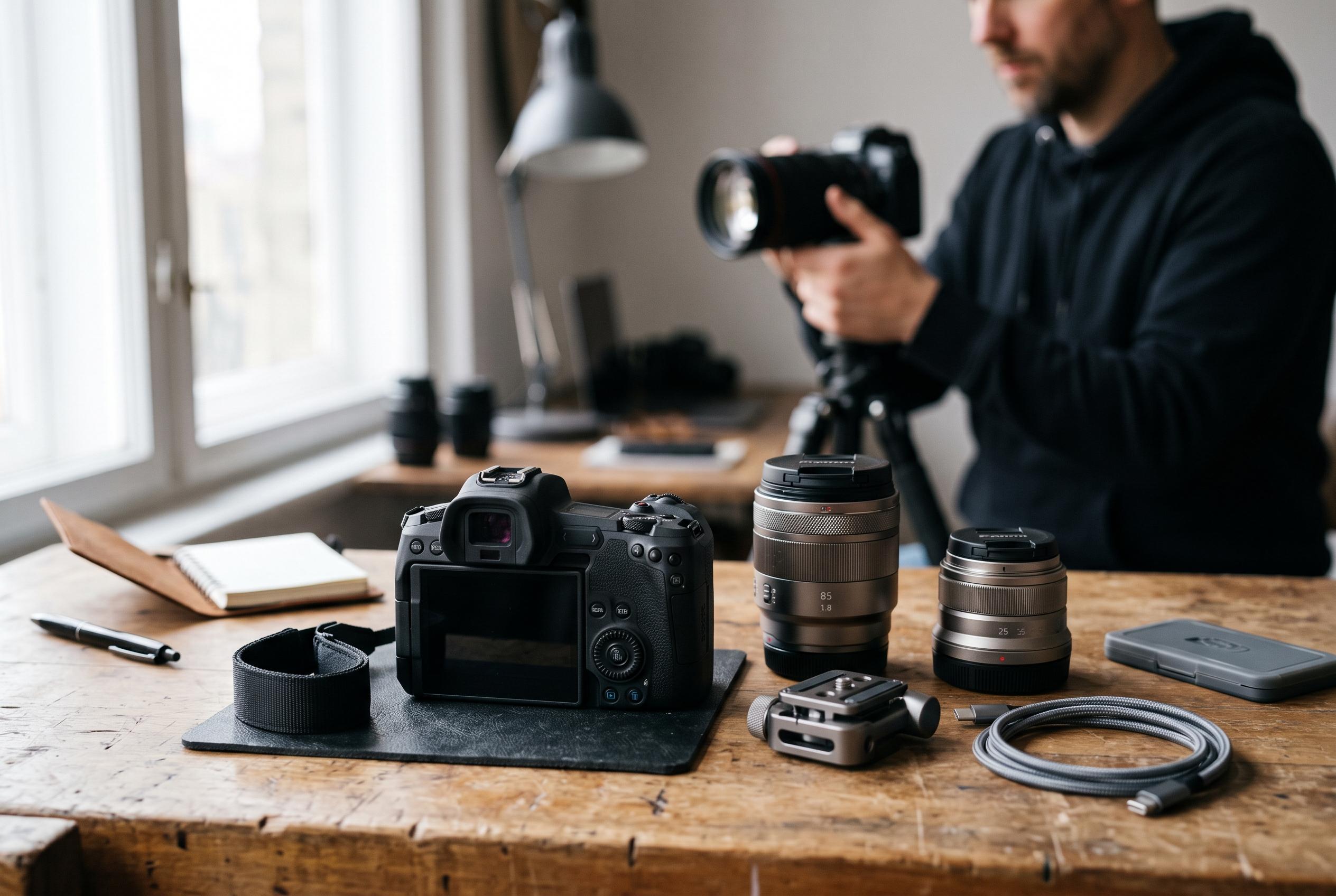

Canon has unveiled the EOS R8 Mark II, a more capable but still compact full-frame mirrorless camera featuring the latest developments in in-body stabilisation, autofocus, and video recording, positioning it as an attractive upgrade for photographers and videographers on a budget.
Canon’s EOS R8 Mark II is a more serious camera than its predecessor, but it is not the retro redesign some enthusiasts were expecting. TechRadar said the new body takes some visual cues from classic SLRs, yet still lands closer to a modern, angular mirrorless design than a full revival of Canon’s film-era styling. Even so, the update brings meaningful gains for photographers who want full-frame performance without stepping up to the heavier and more expensive EOS R6 series.
According to Canon’s announcement, the R8 Mark II uses a 24.2-megapixel full-frame sensor and adds in-body image stabilisation rated at up to 7.5 stops, making it Canon’s lightest full-frame camera with IBIS at about 546g with battery and card. The company also said the camera can shoot at up to 40 frames per second with the electronic shutter and record uncropped 4K video at up to 60p, oversampled from 6K. Canon has priced the body at $1,899 and set a launch date of 20 October 2026.
TechRadar said the most practical addition is the new multi-controller, which sits near the AF-ON button and makes autofocus point selection faster and more intuitive. The magazine also noted the arrival of pre-capture, called Pre-Continuous Shooting by Canon, which buffers up to half a second before the shutter is fully pressed. That feature, previously seen in higher-end Canon bodies, should be particularly useful for wildlife and action work. Canon has also improved low-light autofocus sensitivity, with the system rated to -7.5EV, and added a Register People Priority function that can store up to 10 faces for preferential tracking.
The camera is not without compromises. TechRadar said Canon has retained the same 3.0-inch vari-angle screen and 2.36-million-dot electronic viewfinder from the original EOS R8, while the battery remains small and the body is still not weather-sealed. The review added that battery life is rated at 220 shots through the viewfinder or 340 shots using the rear screen, and both figures are likely to fall further when stabilisation is in use. Canon has also kept the single SD card slot, although it has been moved to a side door, and the new grip accessory does not include a battery.
That leaves the EOS R8 Mark II in an awkward but understandable position. DPReview and Cameralabs both described it as a more capable entry-level full-frame body, thanks to the addition of IBIS, the joystick-style controller and stronger video options, but neither suggested it dramatically changes the class. TechRadar reached a similar conclusion: for Canon users, it is a sensible step up from the EOS R8 and a cheaper alternative to the EOS R6 Mark III, yet Nikon’s Z5 II remains a tougher rival on value, build quality and display specifications.
Disclaimer: This content is intended for informational purposes only. Readers are advised to exercise their own judgement, conduct due diligence, or consult a qualified expert before acting on any information provided.