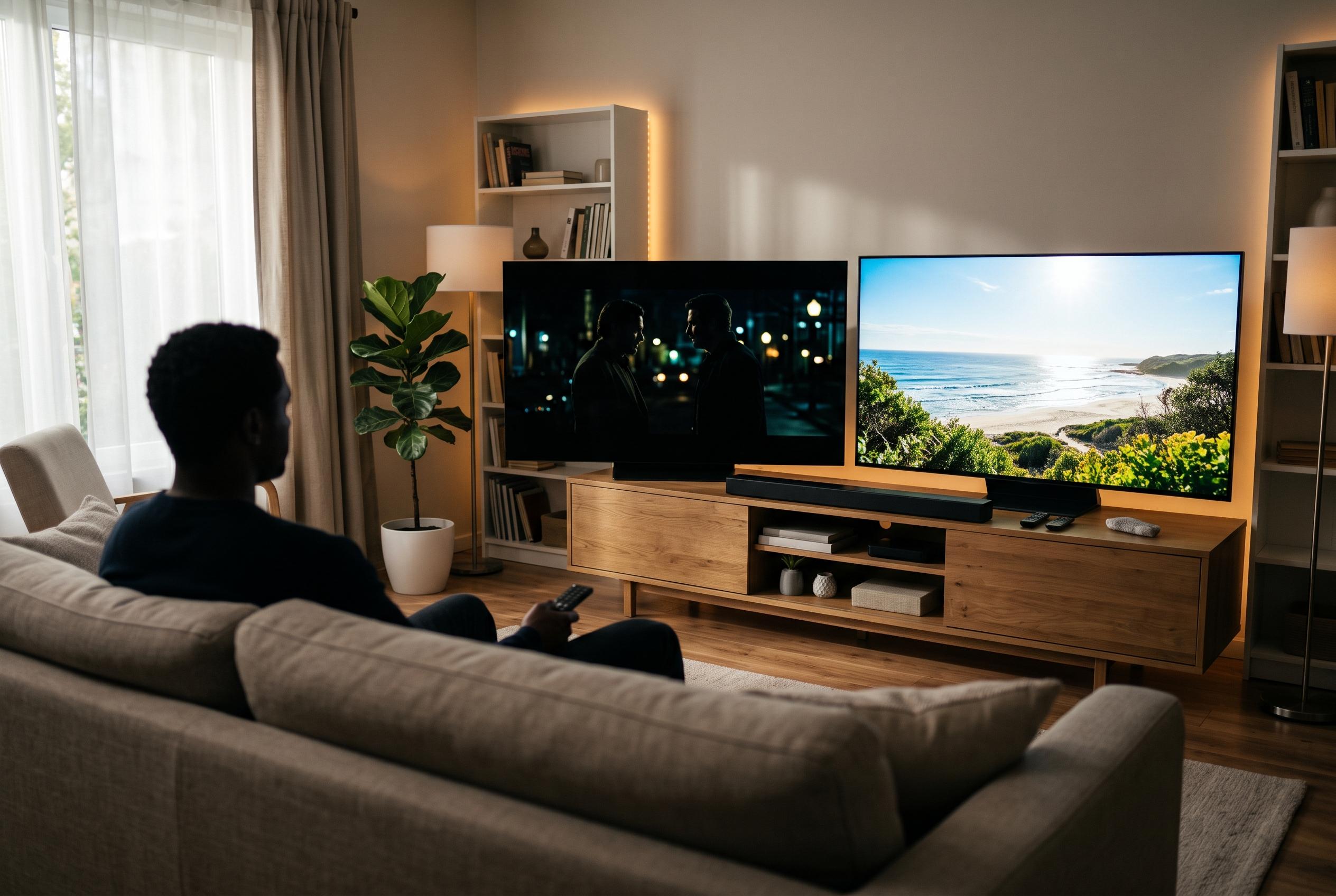

As 2024 advances, the debate between OLED and Mini-LED screens heats up, with new models offering enhanced contrast, brightness, and colour performance tailored to different viewing environments, challenging traditional brand loyalty.
The case for the best movie television still begins with contrast. OLED remains the reference because each pixel emits its own light, allowing blacks to fall to true black and preserving shadow detail in a way that backlit screens cannot quite match. Tom’s Guide recently went further and named LG’s C6 OLED its best TV overall, citing the set’s black levels, wide viewing angles and stronger HDR brightness than its predecessor. That reinforces the point at the heart of any film-first buying decision: a good movie picture is usually about how well a set controls darkness, not simply how much resolution it advertises.
Within that OLED category, LG’s C4 remains a highly credible choice, especially for viewers who want strong processing and broadly useful gaming features alongside cinema performance. Tom’s Guide described it as the new gold standard for OLED televisions in 2024, while What Hi-Fi? praised its improved brightness, sharpness and colour balance, as well as its more capable sound than earlier LG models. The newer C6 appears to extend that formula with further gains in HDR brightness and the latest processor, but the C4 still stands out as the kind of set that suits film nights without demanding the compromises of a flagship price tier.
For buyers who watch in brighter rooms, the argument shifts towards Mini-LED. TCL’s QM6K has emerged as the value model to watch in that space, with Tom’s Guide calling it an excellent Mini-LED television at an affordable price and noting that it delivers strong picture quality with only limited compromises. TCL’s broader 2026 line-up underlines why the technology has become so influential: Mini-LED can deliver high peak brightness, better controlled local dimming and more vivid colour volume than standard LCD sets, making it easier to hold detail in daytime viewing or in rooms that cannot be darkened completely.
That distinction between OLED and Mini-LED is the practical dividing line for film buyers. In a dim room, OLED’s self-emissive design still offers the more cinematic result, because it keeps letterbox bars dark and preserves the subtle gradations in night scenes. In a room with windows, lamps or an open-plan layout, Mini-LED’s brightness and harder-working backlight become more useful. The best choice therefore depends less on brand loyalty than on the room itself: light-controlled viewing favours OLED, while glare and ambient light favour Mini-LED or QLED.
Format support also matters more than many shoppers expect. Dolby Vision remains a meaningful advantage for film and streaming libraries because it carries scene-by-scene metadata that can help a television map highlights and shadow detail more precisely. LG’s OLEDs support it, and that remains one reason they keep surfacing in movie-focused round-ups. Where Samsung’s OLEDs and some other sets rely on HDR10+ instead, the choice can still work well, but the library you watch most often should guide the decision. For viewers with older discs, upscaling quality is another differentiator, and Sony’s processing has long been praised for bringing lower-resolution films closer to modern panel standards without making them look artificially sharpened.
The most sensible shortlist, then, is not a single winner but a set of room-specific recommendations. LG’s C4, and now the even newer C6, are the clearest all-round OLED options for a darkened cinema room. TCL’s QM6K makes the strongest case for buyers who want Mini-LED value without giving up serious film performance. And for anyone comparing models, the simplest rule still applies: choose OLED for contrast and low-light viewing, Mini-LED for brightness and daytime flexibility, then make sure the television supports the formats your library actually uses.
Disclaimer: This content is intended for informational purposes only. Readers are advised to exercise their own judgement, conduct due diligence, or consult a qualified expert before acting on any information provided.