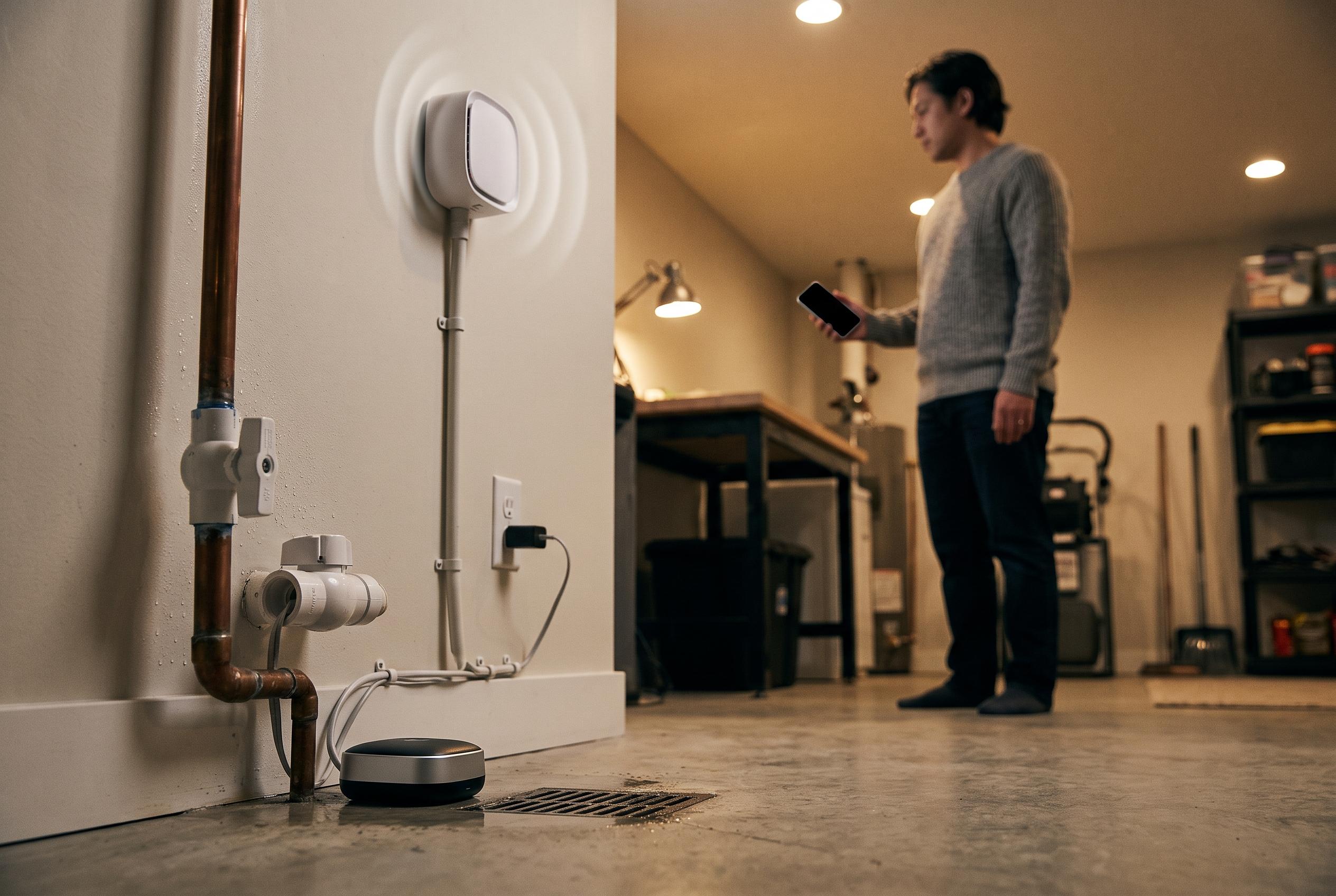

Innovative leak detectors are enhancing basement security by combining reliable sensing, offline resilience, and loud alerts, with options tailored for long-range, quick response, or simple installation, transforming threat management in vulnerable home areas.
Finished basements are among the most vulnerable parts of a home because leaks often begin out of sight and progress before anyone notices. That is why the best smart water leak detectors for basements are judged less by app polish than by how reliably they report through concrete, whether they still alert during a power cut, and how loudly they warn when the water reaches the floor. The most useful systems in this category pair dependable sensing with a radio link that can survive the realities of a lower level.
The strongest all-round choice remains the YoLink Water Leak Starter Kit, which combines a hub with four sensors and uses LoRa radio for an open-air range of up to a quarter of a mile. According to the supplier and third-party reviews, each sensor runs on two AAA batteries for up to five years and the hub can support more than 300 devices, which makes it suitable not only for a basement but for larger properties with outbuildings or multiple risk points. That combination of long range, broad expansion and offline resilience is the main reason the kit is repeatedly singled out as a leading option.
For homes that already rely on Apple Home, Google Home or other hub-based automation, the Aqara water leak sensor remains a credible alternative. Its appeal is the small form factor and the ability to detect shallow water quickly, but its shorter Zigbee range means placement matters more than with long-range LoRa systems. In practice, that makes it better for a basement where the hub can be positioned centrally and close to the likely leak points, rather than one with thick concrete walls or a long run to the far corner.
Where noise is the priority, X-Sense stands out. The SWS54 kit is designed so both the sensor and the base station sound at 120 dB, which is a meaningful distinction in a finished basement where a silent alert might be missed upstairs. The six-probe layout is also practical, because it can catch water touching the top of the unit as well as pooling underneath. That makes it well suited to sump rooms, laundry areas and water-heater spaces where fast audible warning matters as much as the notification itself.
If range is the main concern, GoveeLife’s Smart Water Leak Detector 2 pack is notable for its claimed LoRa reach of up to 1,968 feet. The system also combines app push, SMS and email alerts, which reduces the risk that one missed notification becomes a missed leak. For larger homes or properties where the basement sits far from the main router, that is a practical advantage over shorter-range Wi-Fi devices.
At the simpler end of the market, SwitchBot’s WiFi water sensor is the most approachable no-hub starter option. It connects directly to 2.4 GHz Wi-Fi, includes app and email alerts, and adds Bluetooth backup if the network drops. That makes it attractive for buyers who want quick installation without adding a separate hub, although the shorter battery life means it is better for users who are prepared to check the unit regularly.
The YoLink Water Leak Sensor 4 six-pack is the right answer when every sensor needs to be audible on its own. According to the product details and review summaries, every unit includes a built-in 105 dB alarm, while the same LoRa platform still provides the long-range and offline benefits seen in the starter kit. That makes it the more complete choice for large finished basements, rental properties or any setting where the leak must be heard in the room where it starts.
Placement remains as important as product choice. The most effective positions are at the sump pit, along the discharge line, under the water heater, beside the main shut-off, near floor drains and around laundry or HVAC equipment. In a typical basement, three to five sensors is usually sufficient, while six provides fuller coverage. The best systems also reduce false alarms by separating leak sensors from routine discharge splash, condensation and softener backwash, which are the most common nuisance triggers in real homes.
In practical terms, the right basement detector depends on the shape of the room and the kind of failure you most want to avoid. A long-range system such as YoLink or GoveeLife is best where walls and distance weaken ordinary Wi-Fi. A loud local alarm such as X-Sense is better when the warning itself has to carry through closed doors. And for homeowners who want the simplest possible first step, a direct Wi-Fi sensor such as SwitchBot is a reasonable starting point, provided the signal is strong where the sensor will actually sit.
Disclaimer: This content is intended for informational purposes only. Readers are advised to exercise their own judgement, conduct due diligence, or consult a qualified expert before acting on any information provided.